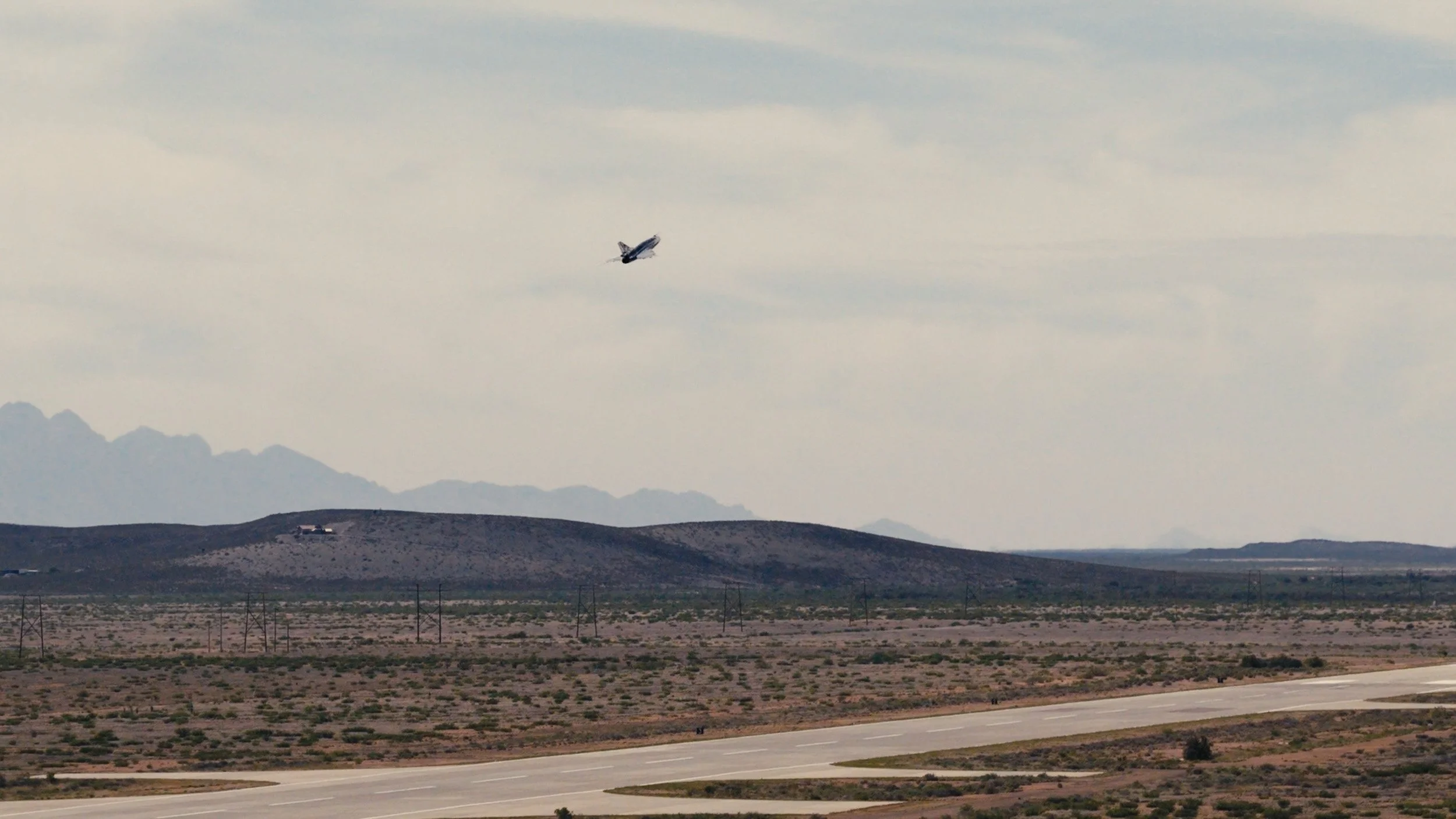
On May 26, 2026, Hermeus — a venture-backed defense aviation company headquartered in Atlanta, Georgia — announced that its Quarterhorse Mk 2.1 unmanned aircraft had achieved its first supersonic flight, reaching a top speed of Mach 1.21, or approximately 930 miles per hour, during a test sortie at Spaceport America in New Mexico over the restricted airspace above White Sands Missile Range.
The milestone, which came on only the aircraft’s third test flight and less than three months after its subsonic maiden flight in early March 2026, establishes the Quarterhorse Mk 2.1 as the world’s first privately developed unmanned supersonic jet — a distinction that simultaneously marks Hermeus as the fastest company in aviation history to progress from founding to supersonic flight.
The achievement carries implications well beyond a single speed record. The Pentagon, increasingly preoccupied with great-power competition and the pace of China’s high-speed aviation programs, is watching closely. AJ Piplica, CEO and co-founder of Hermeus, noted in the company’s press release:
“Our customers at the Department of War are paying close attention to how fast this program is moving. This flight demonstrates a pace of execution that is extremely rare in modern aviation. Our country’s ability to deliver new asymmetric military capability at scale depends on teams that can solve hard technical challenges quickly. That’s exactly what we’re proving with each test flight we conduct and each new aircraft we build at Hermeus.”

How Hermeus Achieved Its First Supersonic Milestone In Under Three Months
The Quarterhorse Mk 2.1’s supersonic breakthrough is perhaps most striking not for the Mach number itself but for the compressed timeline in which it was attained. According to FlightGlobal, the Federal Aviation Administration approved Hermeus to conduct up to seven supersonic flights before the end of 2026, signaling that the company’s test campaign is only beginning.
The Mk 2.1’s maiden flight took place on March 2, 2026, from Spaceport America — a facility Hermeus began operating out of in December 2025, specifically for its extensive test infrastructure. Both the first and second flights were conducted subsonically, methodically expanding the aircraft’s envelope before the third sortie pushed into supersonic territory. Hermeus designs, builds, and flies aircraft in quick succession, using flight test data from each sortie to guide performance improvements and manage program risk — a philosophy the company describes as “hardware richness,” borrowing the rapid-iteration vocabulary that has come to define American commercial space.
The third flight itself followed a structured profile. According to Aviation Week, the test began with a southbound takeoff from Spaceport America’s 12,000-foot runway before the aircraft returned for a northerly approach and landed at the opposite end of the same runway. Subsequent flights are expected to include subsonic pattern work and further takeoff and landing approaches before the program pushes deeper into the supersonic envelope.
Quarterhorse Mk 2.1: Key Technical Specifications And Design Features
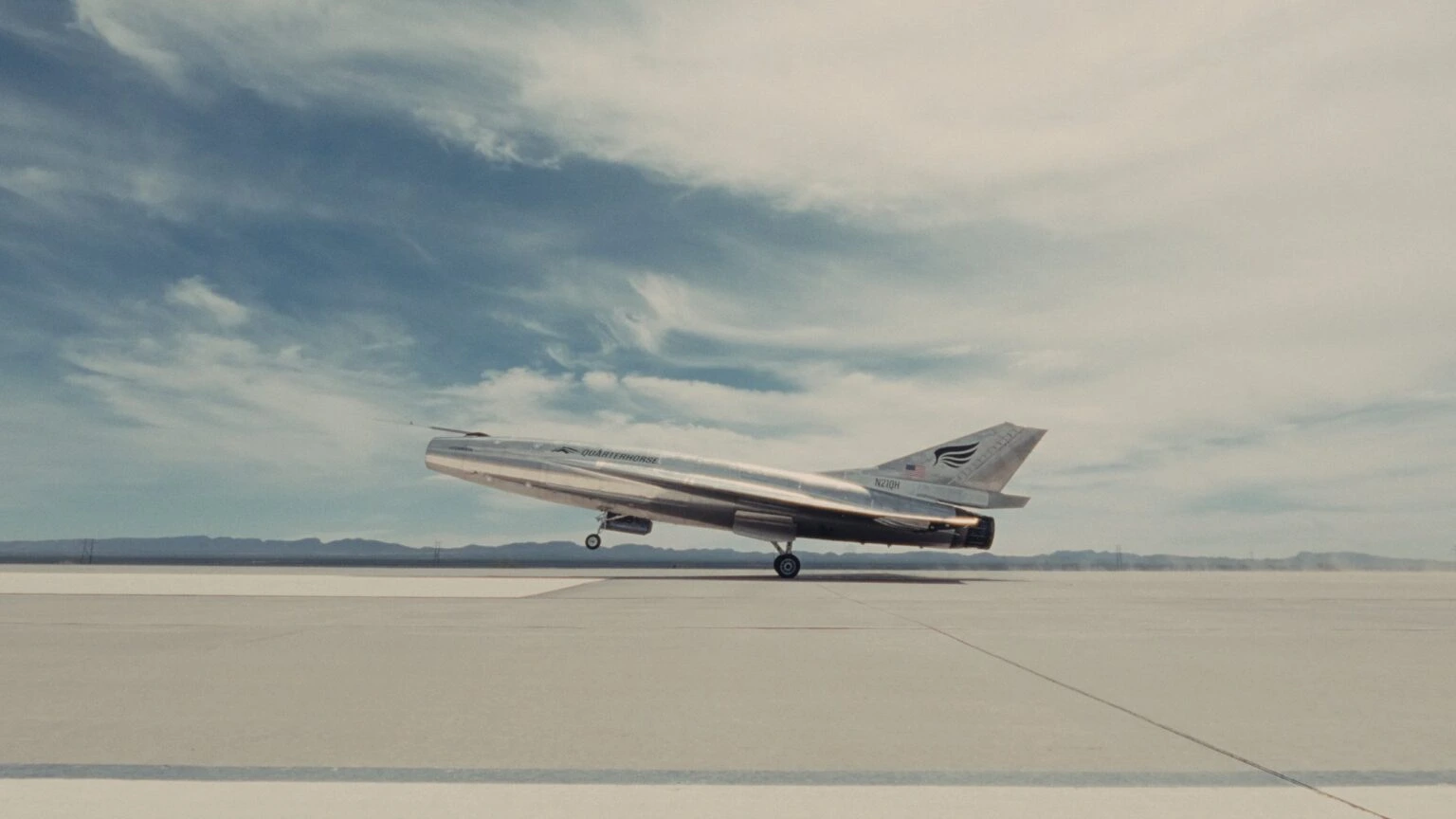
The Quarterhorse Mk 2.1 is an unmanned, remotely piloted aircraft designed around the aerodynamic demands of sustained supersonic flight. Its configuration marks a significant departure from its predecessor, the smaller Mk 1, which flew from Edwards Air Force Base in California on May 21, 2025, primarily to validate high-speed takeoff and landing behavior.
The Mk 2.1 is roughly the size of a Lockheed Martin F-16 Fighting Falcon and is nearly three times larger and four times heavier than the Mk 1. Hermeus describes it as one of the largest unmanned aircraft ever built. Key design features include:
- Delta-wing configuration: Optimized for supersonic aerodynamic stability, replacing the more conventional layout of the subsonic Mk 1.
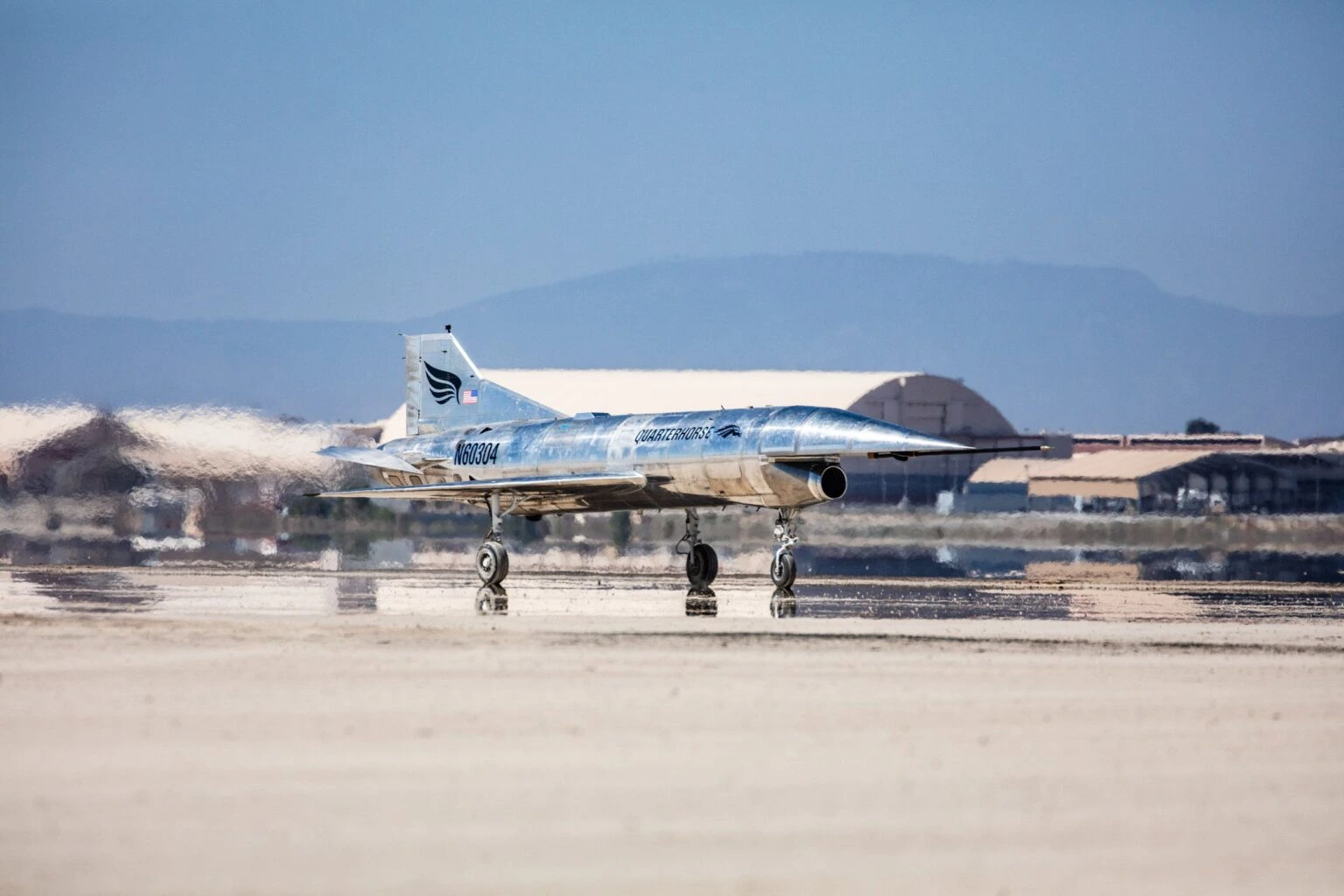
- Variable air inlet: Positioned in the nose cone, the inlet dynamically adjusts airflow to maintain stable engine combustion as speeds increase.
- Single vertical stabilizer: Provides directional control across the subsonic-to-supersonic transition regime.
- Proprietary inlet precooler: A Hermeus-designed thermal management system fitted to the air inlet to prevent overheating at elevated Mach numbers.
- Pratt & Whitney F100 turbofan engine: The same powerplant used in the F-15 and F-16 family of fighter aircraft, supplied through RTX’s Pratt & Whitney business.
As reported by Interesting Engineering, the delta-wing design boosts performance once the aircraft accelerates beyond subsonic speeds, while the modified Pratt & Whitney F100 turbofan with its afterburning capability allows the Mk 2.1 to reach and sustain supersonic velocities during test regimes. The Mk 2.1 also flies without the precooler fully integrated. The Mk 2.2 successor will be the first variant to fly with the precooler installed in its full configuration, underscoring the incremental nature of the Quarterhorse program.
From Mk 0 To the Race Toward Mach 5
Hermeus began testing the Quarterhorse series in 2023 with the ground-based Mk 0 prototype, which was used exclusively for ground and taxi testing. The Mk 1, powered by a General Electric J85 engine, flew at Edwards Air Force Base in May 2025 and validated the company’s core systems, including aerodynamic stability and high-speed ground handling.
The Mk 2 phase, of which the Mk 2.1 is the first aircraft, is a multi-vehicle series focused explicitly on achieving and expanding the supersonic flight envelope.
The Mk 2.2 is already in fabrication, and Mk 2.3 is described by Hermeus as “soon to follow”. Each successive variant in the Mk 2 series is designed to push further toward the Mach 5 threshold. The Mk 2.2, according to Hermeus, is expected to become the world’s fastest unmanned aircraft upon its own supersonic demonstration.
Beyond the Quarterhorse series, the longer arc of the Hermeus program points toward two distinct operational products: Darkhorse, a multi-mission reusable hypersonic uncrewed aerial system designed for defense and national security missions, and Halcyon, a commercial passenger aircraft that the company envisions flying from New York to London in approximately 90 minutes.
The Mk 3 phase of Quarterhorse will replace the Pratt & Whitney F100 with Hermeus’ proprietary Chimera turbine-based combined-cycle (TBCC) engine — a system capable of transitioning from a turbine mode at low speeds to a ramjet at high Mach numbers, targeting sustained flight beyond Mach 5.
Hermeus And the Department of War
The Quarterhorse program exists within a broader and financially substantial relationship between Hermeus and the United States government. In July 2021, the U.S. Air Force awarded Hermeus a three-year, $60 million jointly funded contract to build and test three Quarterhorse aircraft and to flight test a reusable hypersonic propulsion system. That contract, brokered through AFWERX — the Air Force’s commercial technology office — was at the time considered one of the largest such agreements in AFWERX’s history.
The relationship deepened in subsequent years. A Defense Innovation Unit (DIU) contract awarded in 2023 tasked Hermeus with demonstrating high-speed flight test capabilities under the Hypersonic and High-Cadence Airborne Testing Capabilities (HyCAT) initiative, which aims to expand the Department of Defense’s capacity for sustained high-speed flight experimentation. Separately, Hermeus’ partnership with the Air Force for its advanced battle management systems program carries a ceiling of up to $950 million.
The Pentagon’s calculus reflects a broader anxiety within American defense circles. According to the Hermeus press release, the milestone comes as the Pentagon increases its focus on high-speed capability in response to growing competition from near-peer adversaries.
Faster unmanned platforms can shorten response times, penetrate contested airspace at speeds that outpace surface-to-air missile systems, and deliver asymmetric advantage in scenarios where conventional aircraft would be dangerously exposed.
How Quarterhorse Mk 2.1 Compares With Hermeus’ Earlier Program Milestones
The supersonic achievement of the Mk 2.1 is best understood against the company’s own iterative chronology. Hermeus was founded in 2018 in Atlanta, Georgia by AJ Piplica, Skyler Shuford, Glenn Case, and Mike Smayda, with initial funding led by Khosla Ventures. The company’s stated ambition from the outset was to build the world’s fastest reusable aircraft by commercializing hypersonic flight technology.
The Quarterhorse Mk 1 completed its maiden flight on May 21, 2025, at Edwards Air Force Base in California — a milestone that validated the rapid development approach but remained firmly subsonic in its operational scope.
Manufacturing of the Mk 2.1 had already begun by the time the Mk 1 flew in May 2025, reflecting the overlapping, parallel-track approach that distinguishes Hermeus from traditional defense contractors. The company had initially targeted a Mk 2.1 first flight by the end of 2025; the actual first flight slipped to March 2, 2026, by only a matter of weeks.
From first flight to first supersonic flight, the Mk 2.1 required fewer than three months — a compression of timelines that would be exceptional even for a mature program with decades of institutional knowledge. The fact that it was achieved by a startup that had not existed eight years prior makes it a genuinely singular data point in modern aviation history. Piplica, in the company’s press release, described it as “a pace of execution that is extremely rare in modern aviation”.

Photo: NASA | Wikimedia Commons
Quarterhorse Mk 2.1 And the Legacy of the X-15: Comparing Two Eras of High-Speed Research
The Quarterhorse’s ambitions are most strikingly illuminated when placed alongside the canonical antecedent of American high-speed research: the North American X-15 hypersonic program, which was the first aircraft to cross the boundaries of outer space and the first airplane to achieve hypersonic speed.
The X-15 program, a collaborative effort between NASA, the U.S. Air Force, the Navy, and North American Aviation, spanned nearly a decade — from the first unpowered glide flight on June 8, 1959, piloted by A. Scott Crossfield, to the final flight on October 24, 1968. Three rocket-powered X-15 aircraft were manufactured by North American Aviation, and twelve pilots participated across 199 total flights. The program was powered not by a turbofan but by the Reaction Motors XLR-99 rocket engine, which generated approximately 57,000 pounds of thrust — a propulsion philosophy fundamentally different from the air-breathing turbofan approach Hermeus employs.
The divergence in methodology is instructive. The X-15 required an air-launch system: a modified Boeing NB-52 Stratofortress carried the rocket plane to an altitude of 45,000 feet, releasing it so that the X-15 would apply thrust only in the thinner air at altitude, conserving propellant. The Quarterhorse Mk 2.1, by contrast, takes off autonomously from a conventional runway — a capability that substantially reduces operational complexity and cost per sortie.
The speed records, however, remain in a category their own. Our ranking of the top 10 fastest aircraft in the world details that the X-15 achieved a maximum speed of Mach 6.7 — specifically 4,520 mph — when pilot William J. “Pete” Knight flew the X-15A-2 on October 3, 1967. The X-15A-2, a modified version of the second X-15 aircraft delivered to NASA in February 1964, was equipped with external fuel tanks and a 28-inch fuselage extension for liquid hydrogen, allowing 141 seconds of full thrust — 50 seconds more than the baseline aircraft. That record for the highest speed ever achieved by a crewed, powered aircraft remains unbroken to this day.
Hermeus’ Mach 1.21 is numerically far removed from the X-15’s Mach 6.7. But the structural comparison between the two programs is not about immediate speed parity — it is about the paradigm each represents.
The X-15 required the combined institutional weight of NASA, the Air Force, and the Navy, operated over a decade, and was never designed for reuse in any commercially scalable sense. The Quarterhorse, by contrast, is privately funded, iteratively developed, and intended to evolve toward operational productization in the form of Darkhorse. The X-15 was a monument of state-sponsored aeronautical science; Quarterhorse is a commercial defense product using the X-15’s lessons as a foundation.

How The Quarterhorse Stacks Up Against the World’s Fastest Aircraft
At the apex of the speed hierarchy sits the NASA X-43A, also known as Hyper-X, which achieved Mach 9.68 during its third test flight on November 16, 2004, making it the fastest aircraft ever flown. Second is the North American X-15, at Mach 6.7. Third is the Lockheed SR-71 Blackbird — the world’s fastest jet-propelled aircraft, which set a speed record of 3,418 km/h (2,124 mph) on its final flight from Los Angeles to Washington D.C., with its structure composed of 85% titanium to withstand the thermal loads of sustained high-speed cruise.
As noted by New Atlas, the SR-71 holds the official world airspeed record for a crewed, air-breathing jet aircraft at Mach 3.32 — and Hermeus has publicly identified surpassing this record as a key program objective.
The Blackbird’s performance was made possible by the Pratt & Whitney J58 turbojet engine, whereas the Quarterhorse Mk 2.1 uses the Pratt & Whitney F100 — a newer-generation turbofan that shares the same manufacturer lineage but operates at lower peak Mach numbers in its baseline configuration. The Mk 3 phase of Quarterhorse will introduce the Chimera TBCC engine, which Hermeus designed specifically to unlock sustained flight beyond Mach 5 by transitioning from turbine to ramjet modes — the same air-breathing propulsion category that places the SR-71’s record within theoretical reach.
Mk 2.2, Mk 2.3, And the Road to Darkhorse
Hermeus is already building the aircraft that will extend the Mk 2.1’s speed record. The Mk 2.2, currently in fabrication, is expected to fly with the Chimera precooler installed in full configuration and to push into higher Mach regimes than its predecessor. The Mk 2.3 will follow, designed according to the company to “push performance further and move quickly toward sustained high-Mach flight.”
The Mk 2.1’s flight test campaign is itself far from complete. The FAA approved Hermeus to conduct up to seven supersonic sorties before December 31, 2026, meaning the aircraft has six additional supersonic tests authorized in the near term. Each sortie will generate flight data that feeds directly into the Mk 2.2 design, accelerating the iterative cycle that has become the defining characteristic of the Quarterhorse program.
Data collected from the Mk 2.1 campaign will be used to develop the Mk 2.2 and Mk 2.3, both of which are oriented toward sustained high-supersonic flight in preparation for the uncrewed Darkhorse multi-mission military aircraft. Hermeus has also confirmed an executive leadership transition: Zach Shore has been named CEO, while AJ Piplica transitions to Executive Chairman.