Korean Air Expands Jakarta Service with Daily Dreamliner Flights

Korean Air (KE) will restore daily service between Seoul Incheon International Airport (ICN) and Soekarno-Hatta International Airport (CGK) in Jakarta from June 2026, bringing its weekly frequency on the route back to seven rotations after a period of enforced contraction to just twice weekly, Miami Herald reported.  This will mean that from June, the route will see three South Korean carriers operating simultaneously: Korean Air at seven weekly frequencies, T’way Air at five, and Asiana Airlines at a daily service.

Korean’s previously reduced frequency of  twice weekly was a direct consequence of the regulatory remedies attached to Korean Air’s US$1.3 billion acquisition of Asiana Airlines (OZ), which was completed in December 2024: the Korea Fair Trade Commission (KFTC) mandated that Korean Air and Asiana transfer airport slots and traffic rights on 34 routes — including Incheon–Jakarta — to third-party carriers in order to prevent a combined market dominance exceeding fifty percent on those corridors.
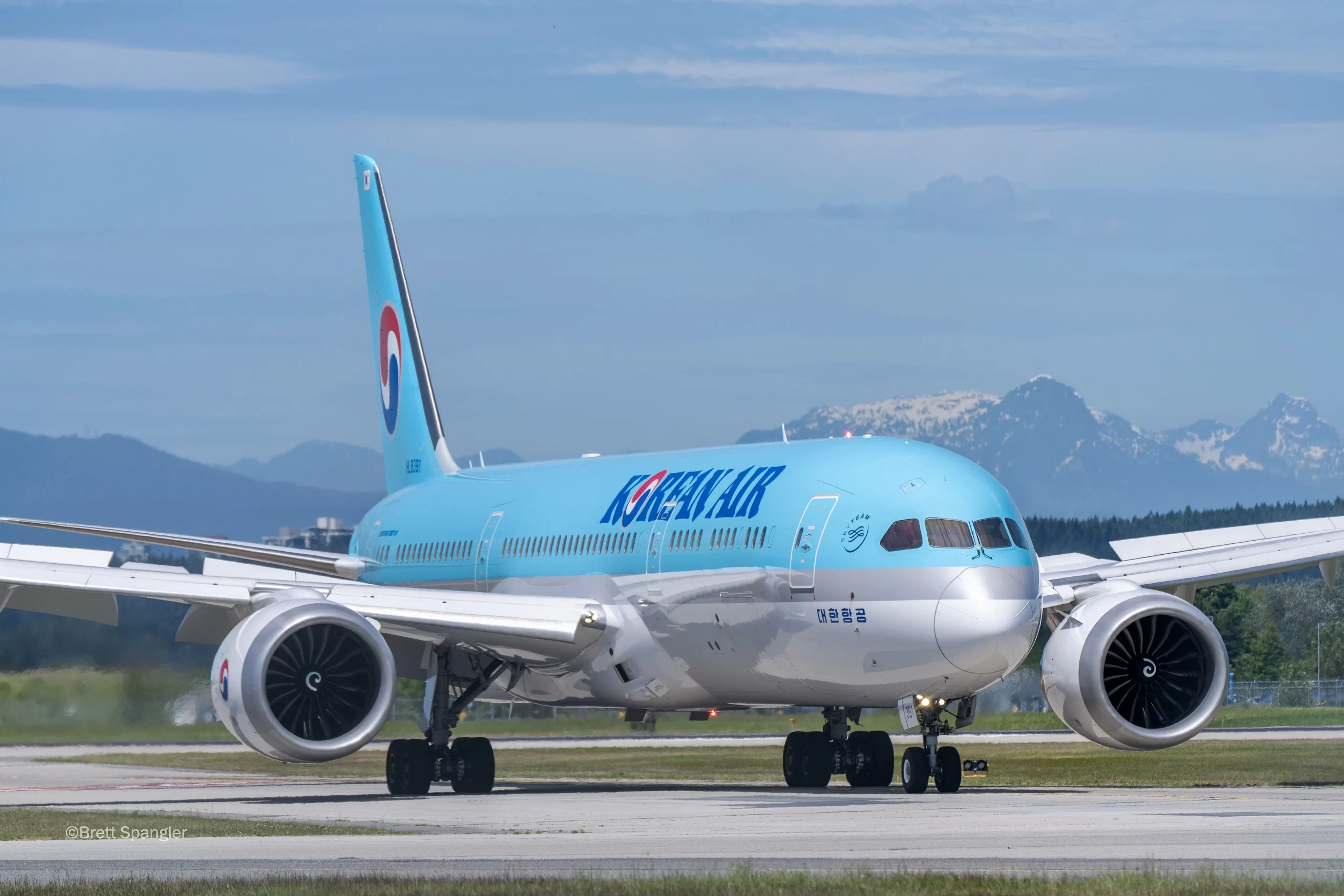
Photo: Brett Spangler | Wikimedia Commons

Korean Air’s ICN-GCK Route: Timings, Aircraft, and Codeshares

Under the revised schedule confirmed by Korean Air, the carrier’s Incheon–Jakarta flights will depart ICN at 19:40 and arrive in Jakarta at 00:45 the following morning local time. Return flights will depart CGK at 02:15 and arrive at Incheon at 11:30.

The early-morning departure from Jakarta and the red-eye arrival in the Indonesian capital are characteristic of long-haul schedule patterns that prioritise the maximisation of aircraft utilisation — minimising ground time at the overnight station — while offering corporate travellers arriving in Incheon a morning arrival that permits same-day onward connections across Korean Air’s domestic and international network at ICN.

Korean Air is deploying Boeing 787-10 Dreamliner aircraft on the restored daily service, a widebody configured in the carrier’s standard long-haul layout with Prestige Class (business class) flatbeds and Economy seating.

The 787-10 is a natural fit for the approximately 6,600-kilometre sector: its GE9X-powered fuel profile and extended range capability are well-matched to the route’s block time of approximately seven hours and twenty minutes:

Specs of the Boeing 787-10

Specification Details
Length 68 m / 223 ft
Wingspan 60 m / 197 ft
Height 16.9 m / 55.7 ft
Typical Seating 300–330 passengers
Maximum Seating Up to 450 passengers
Range ~6,330 nautical miles / 11,730 km
Cruise Speed Mach 0.85
Maximum Speed Mach 0.89 / 954 km/h
Engines 2 × Rolls-Royce Trent 1000 or GE GEnx-1B
Maximum Takeoff Weight 560,000 lb / 254,000 kg
First Flight March 31, 2017
Entry Into Service April 2018 with Singapore Airlines
Fuel Efficiency Around 25% lower fuel burn than older comparable aircraft
Korean Air’s record $36 billion Boeing order, placed in August 2025, included 25 Boeing 787-10s for its expanding medium and long-haul network — a fleet investment that Korean Air Chairman and CEO Walter Cho described as “the core of our fleet modernisation strategy“.
A Korean Air official told industry sources that the carrier “secured new airport slots and plans to restore the route under expanded codeshare arrangements permitted through the South Korea–Indonesia aviation agreement.
Photo: Edward Russel | Wikimedia Commons

Why the Jakarta Route for Korean Air?

 Unlike leisure-heavy destinations such as Bali or Bangkok, Jakarta is primarily a business travel market driven by the substantial Korean commercial presence in Indonesia, which is one of the world’s largest economies by purchasing power parity and a major recipient of South Korean foreign direct investment in sectors including:

  • automotive manufacturing
  • petrochemicals
  • consumer electronics

The Korea Times reported that the Jakarta route was specifically flagged by the KFTC as a competition-sensitive corridor, precisely because the combined Korean Air–Asiana entity would have commanded a dominant share of Korean capacity into Indonesia — a market generating the kind of high-yield, recurring corporate traffic that full-service carriers depend upon for premium cabin revenues.

The demand data corroborates the route’s commercial significance. UPI reported that passenger volumes on Incheon–Jakarta reached 121,642 in Q1 2026, a 4.5% increase year-on-year.

The Jakarta route’s profile contrasts sharply with more leisure-oriented corridors where Korean Air has shown greater willingness to cede ground to low-cost carriers. Business Traveller, in an interview with Korean Air Senior Vice President Jin Ho Lee, quoted him as saying the merged entity would offer “more flight options, improved schedules, and enhanced service — all under the trusted Korean Air brand” to business travelers in cities including Jakarta.
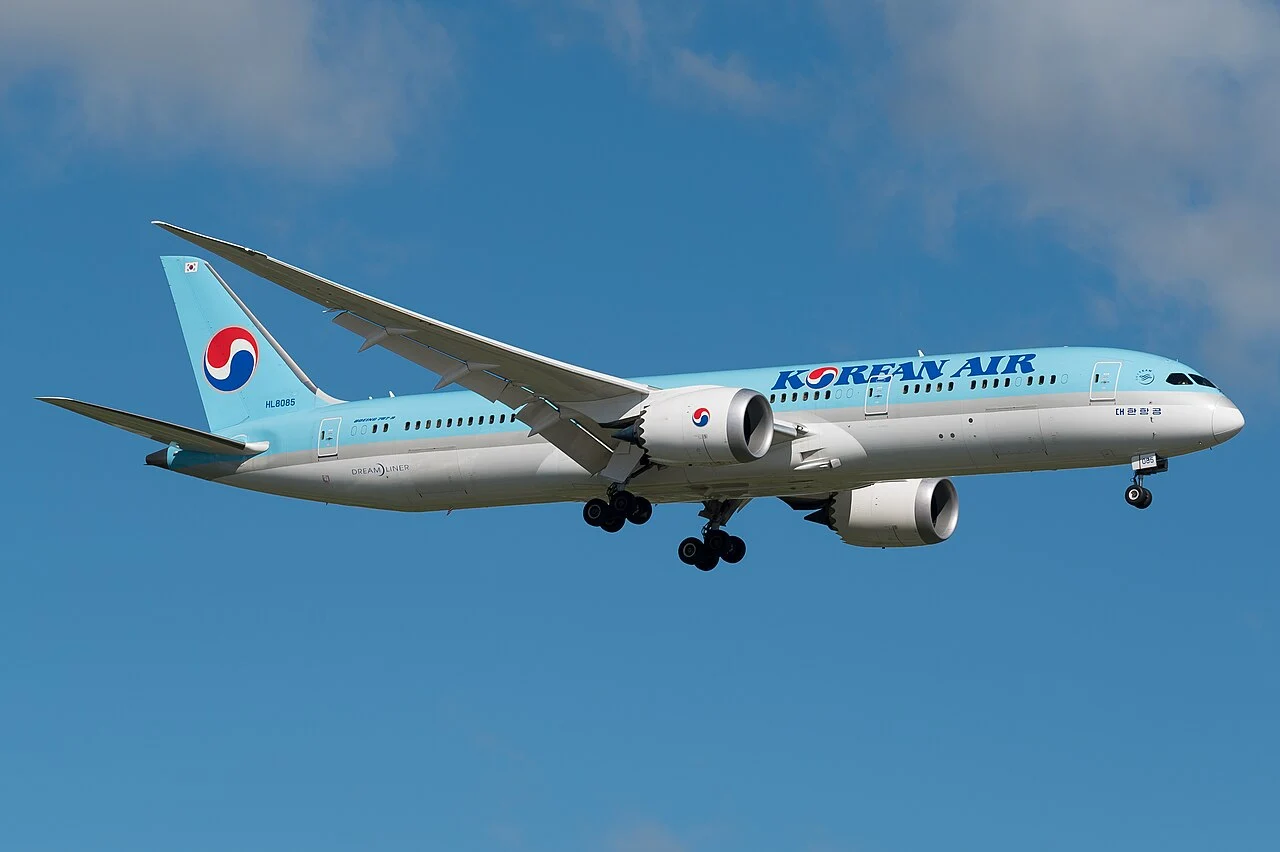
Photo: BriYYZ | Wikimedia Commons

T’way is Korean’s Competitor and the South Korea’s First LCC on the Route

T’way Air’s April 29, 2026 launch on the Incheon–Jakarta route marked a historic inflection point in Korean aviation: it was the first time any South Korean low-cost carrier had operated a scheduled service between Incheon and Indonesia’s capital. The Seoul Economic Daily reported that the carrier began accepting reservations for the route on February 10, 2026, with the service operating five times weekly on Mondays, Wednesdays, Fridays, Saturdays, and Sundays.

T’way Air is deploying Airbus A330-300 widebody aircraft configured with 347 seats — 12 in business class and 335 in economy — a layout that blends the seat density of a low-cost carrier with the medium-haul widebody capability required for a seven-hour sector.

T’way Air’s Jakarta flights depart ICN at 15:10 and arrive at CGK at 20:10 local time, with return flights leaving Jakarta at 21:50 and arriving at Incheon at 07:05 the following morning. The daytime outbound schedule represents a meaningfully different offering from Korean Air’s 19:40 departure, and analysts expect the two carriers to occupy distinct passenger segments rather than cannibalise each other directly as T’way would cater to budget travelers while Korean Air would be focused on travelers that like legacy airlines.
A T’way Air spokesperson, quoted in the Seoul Economic Daily’s launch announcement, said that by opening of the Incheon–Jakarta route schedule, the carrier had “significantly strengthened accessibility to major Southeast Asian cities“, while also adding that it would “continue to prioritize safety while pursuing customer convenience and route diversification“.

T’way Air is itself in the midst of a significant corporate transformation. This carrier that is currently serving 45 destinations is undergoing a rebranding to Trinity Airways, with the full rollout expected in the second half of 2026, following its acquisition by Daemyung Sono Group.

The combined Jin Air entity resulting from Korean Air’s absorption of Air Busan and Air Seoul — targeted for completion by Q1 2027 — will ultimately make T’way (as Trinity Airways) Korea’s second-largest LCC by fleet size and network reach. Indonesian full-service carrier Garuda Indonesia (GA) adds further competition.

Photo: Umedha Hettigoda | Wikimedia Commons

How the Jakarta Restoration Compares with Other Korean Air Merger Remedy Routes

The Jakarta route is one of the more commercially sensitive among the 34 routes mandated for third-party remedy by the KFTC following the Korean Air–Asiana merger. Aviation Week reported that the KFTC’s conditional approval in December 2024 identified the routes where the combined entity’s market share raised anticompetitive concerns, requiring divestment of slots and traffic rights to alternative carriers for a period of ten years from the merger date.

Six routes were completed in the first phase. These included services from Incheon to:

  • Los Angeles International Airport (LAX)
  • San Francisco International Airport (SFO)
  • Barcelona El Prat Airport (BCN)
  • Frankfurt International Airport (FRA)
  • Paris Charles de Gaulle Airport (CDG)
  • Rome Fiumicino Airport (FCO) —

…….with slots redistributed to Air Premia, United Airlines (UA), and T’way Air.

According to South Korea’s Ministry of Land, Infrastructure and Transport aviation portal, passenger traffic on the Incheon–Jakarta route reached 121,642 travellers during the first quarter of 2026, up 4.5% year-on-year.

Travel and Tour World noted that the KFTC ensured capacity restoration to at least ninety percent of pre-pandemic levels across remedy routes, preventing Korean Air and Asiana from using the slot-transfer process as a cover for reducing total market capacity.

On the loyalty programme front, the Jakarta restoration also has implications for Korean Air’s SKYPASS programme. The KFTC has twice rejected Korean Air’s proposed integration of Asiana Club into SKYPASS — most recently in December 2025, when Loyalty Lobby reported that the regulator found the plan offered fewer redemption options than what Asiana Club currently provides, and fined both carriers a combined $4.4 million.

The two programmes collectively hold 45 million members and approximately 3.7 trillion won ($2.7 billion) in unused miles — a figure that demonstrates how consequential the loyalty integration timeline is for millions of frequent travellers who use the Jakarta and other core routes regularly.

Photo: N509FZ | Wikimedia Commons

Jakarta as a Test Case for the Post-2027 Network

The Korean Air–Asiana integration, targeting full brand unification on January 1, 2027, is in its most complex execution phase. FlyMag’s April 2026 analysis noted that Korean Air is reportedly preparing to acquire the remaining 36.1% stake in Asiana not currently held after the December 2024 US$1.3 billion purchase of a 63.88% controlling interest, with the December 2026 management target set as the practical starting point for a final single-airline structure.

Meanwhile, Asiana has already begun replacing seats on its Airbus A350-900 fleet — its flagship aircraft for Southeast Asian routes including Jakarta — with Korean Air’s Prestige Class and Economy configurations, creating a physically unified cabin product across the two carriers’ fleets ahead of the brand merger.

Once full integration is complete, the combined Korean Air–Asiana entity will operate from ICN as one of Asia’s three dominant flag carriers, ranking alongside Japan’s ANA–JAL group and the combined Chinese triumvirate of China Southern, Air China, and China Eastern.

AwardFares noted that the merged airline will exit Star Alliance — where Asiana currently holds membership — in favour of exclusive SkyTeam affiliation, a transition that will materially affect connectivity for travellers who currently rely on Asiana’s Star Alliance partnerships for onward connections at ICN. For the Jakarta route specifically, this means that Star Alliance partners including Singapore Airlines, ANA, and Thai Airways will lose their Asiana feeder connections from CGK, shifting connecting traffic toward SkyTeam partners such as Delta Air Lines (DL) and Vietnam Airlines.

Korean Air SVP Jin Ho Lee, speaking to Business Traveller, articulated the carrier’s post-merger ambitions with particular reference to Southeast Asian markets:

“Whether you’re headed to a boardroom in Shanghai, a conference in Jakarta, or a development site in Hanoi, you’ll get there more efficiently with a great choice, shorter layovers, and consistent world-class service.”

That positioning signals management’s intent to defend Jakarta not as a legacy obligation but as a flagship commercial corridor — one that, even with T’way Air now operating five weekly flights alongside it, Korean Air views as central to its long-term Southeast Asian network architecture.

Leave a Comment

Your email address will not be published. Required fields are marked *

Scroll to Top