The A-10 Warthog, which is officially known as the Fairchild Republic A-10 Thunderbolt II, is a single-seat, straight-wing jet aircraft was designed and developed to serve the United States Air Force (USAF) for close air support (CAS) of friendly ground troops. Developed in the middle of the Cold War, it is one of the most iconic aircraft in history, mounting the devastating seven-barrel GAU-8 Avenger Gatling Gun in 30mm calibre — a weapon so large that the aircraft was essentially engineered around it.
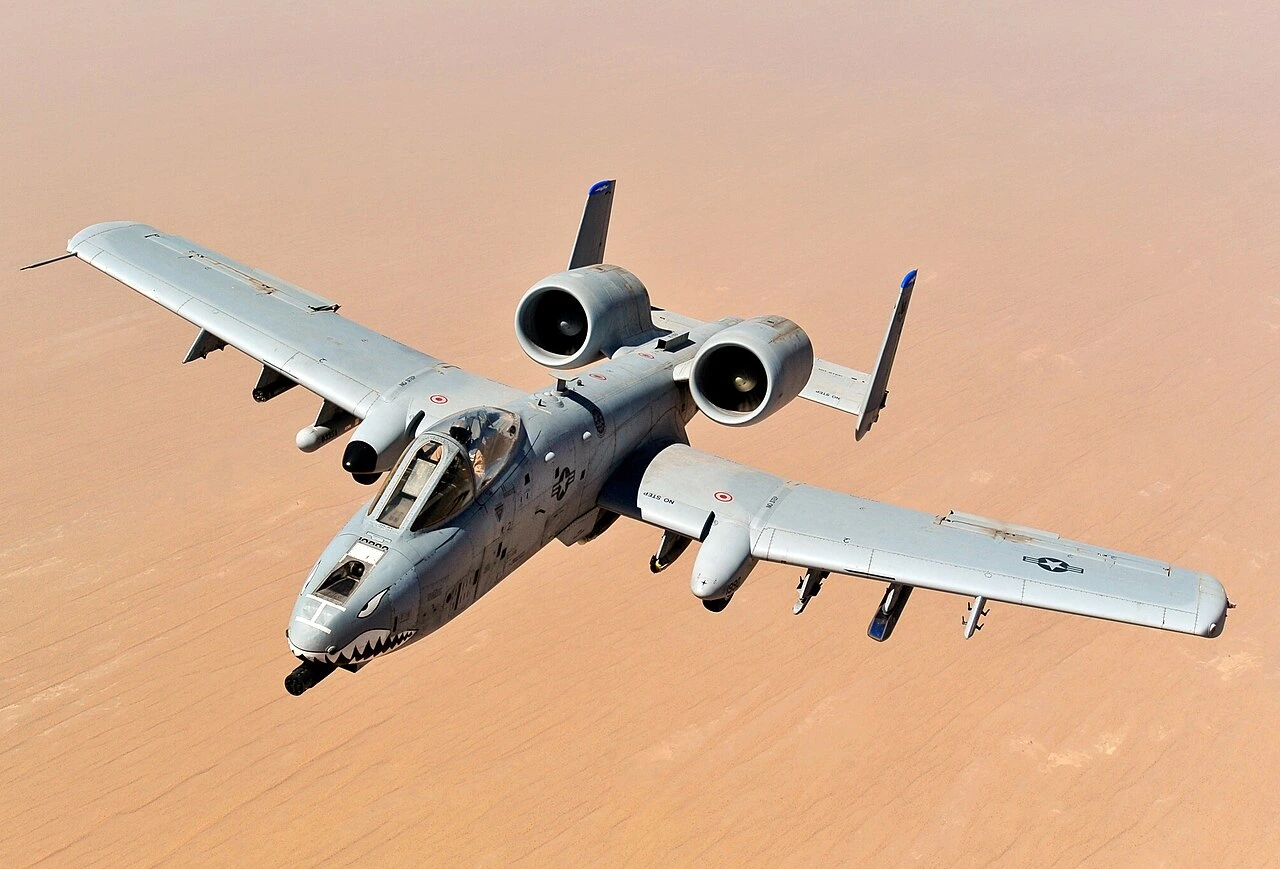
The A-10 entered USAF service in 1976, with its maiden flight on 10 May 1972, and was formally introduced in October 1977 as a dedicated CAS attack aircraft. More than 700 aircraft have been built. A secondary role — forward air control — sees the aircraft designated OA-10, providing guidance to other CAS aircraft attacking ground targets.
Specifications of the A-10
The A-10 Thunderbolt II is manufactured by the Fairchild Republic Company, USA. It is reputed for high survivability and versatility, well suited to operate from forward air bases with STOL capability.
| Specification | Detail |
|---|---|
| Full Designation | Fairchild Republic A-10 Thunderbolt II |
| Role | Close Air Support (CAS), Forward Air Control |
| Length | 16.16 m (53 ft 4 in) |
| Wingspan | 17.42 m (57 ft 6 in) |
| Max Speed | 700 km/h (450 knots) |
| Engines | 2× General Electric TF34-GE-100 turbofan, 9,000 lb thrust each |
| Primary Weapon | GAU-8/A Avenger 30mm seven-barrel rotary cannon |
| External Load | 7,260 kg across 11 store pylons |
| First Flight | 10 May 1972, Edwards AFB |
| Introduced | October 1977 |
| Status (2026) | Active — retirement extended to 2030 |
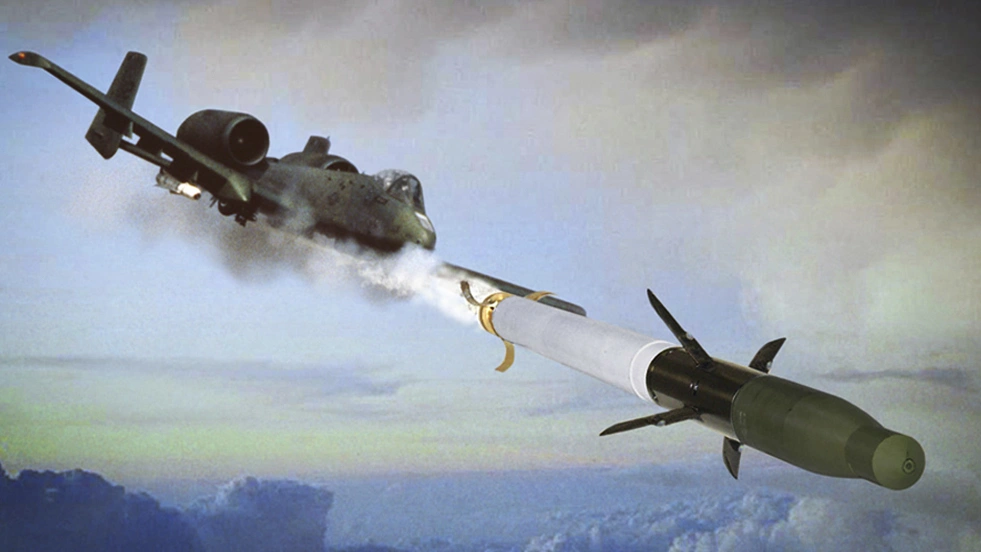
The GAU-8 Avenger and the Massive Cannon That Defines The A-10 Warthog Aircraft
Most aircraft carry weapons. The A-10 was built around one. 19FortyFive explains that the gun was originally designed to fire upwards of 4,200 rounds per minute, with the operational rate set at 3,900 rounds per minute. Each 30mm cartridge is larger than a typical beer bottle; two hydraulic motors are needed to spin the barrels.
The Avenger is mounted laterally off-centre in the nose to control recoil during strafing runs. As The National Interest reports, the barrel sits underneath the aircraft’s centre of gravity, preventing changes in pitch or yaw when fired. RealClearDefense notes the gun was tested in 1974 from altitudes between 100 ft and 25,000 ft, at speeds from 155 mph to 480 mph, and at up to 5G.
GAU-8 key figures:
- 30mm, seven-barrelled Gatling — fires armour-piercing incendiary (API) and high-explosive incendiary (HEI) rounds
- Up to 4,200 rounds per minute; operational rate 3,900 rpm — National Security Journal
- Carries 1,174 rounds; each round the size of a beer bottle
- Dispersion: five milliradians — ~80% of rounds within a circle at combat range
Capabilities Of The A-10 Thunderbolt II
The USAF’s official fact sheet describes the A-10 as able to loiter near battlegrounds, perform accurate targeting and weapon delivery, and take off and land from short runways — making it operable from improvised forward air bases close to the front line.
The A-10’s airframe is built around survivability. NBC News notes that all cockpit glass is bulletproof and titanium armour — a titanium “bathtub” — protects the pilot and critical flight control areas. Double-redundant hydraulic flight systems allow the aircraft to absorb catastrophic battle damage: loss of one engine, half of the tail, one elevator, and half a wing — and still return safely. Military Machine confirms the A-10 has been shot down only eight times in 50 years across seven conflicts.
Weapons the A-10 can carry include:
- GAU-8/A 30mm Avenger cannon (primary weapon, 1,174 rounds)
- Up to 10 AGM-65 Maverick air-to-surface missiles — Airforce-Technology
- LDGP Mk.82 226 kg unguided bombs
- Cluster munitions and Hydra 70 rocket pods
- Pave Penny laser guidance system
- Total: 11 store pylons, 7,260 kg external load
A Brief History of A-10’s Air Combat
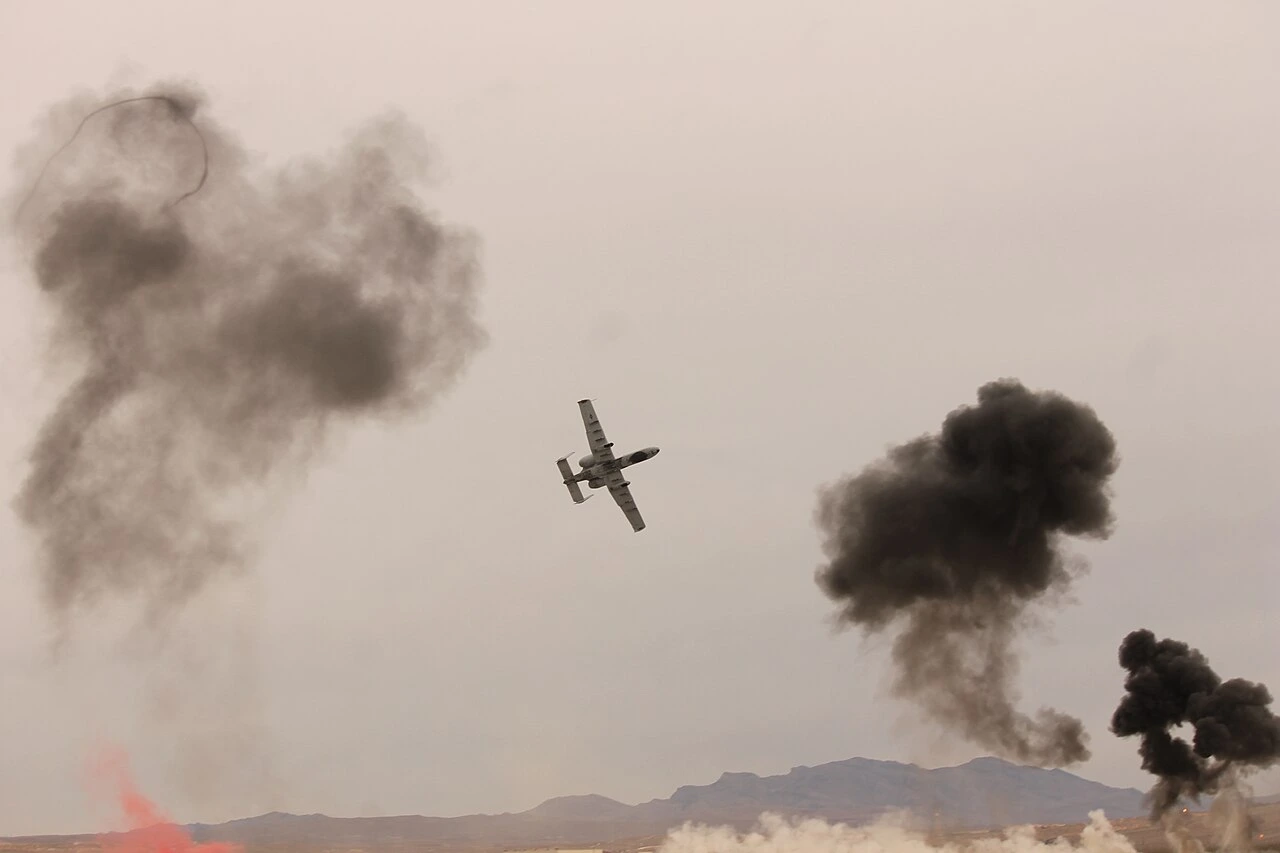
The A-10’s development traces directly to the Vietnam War, where America lacked a specialized attack aircraft with large payload, long loiter time, and precision ground target capability. After years of research and development, the first A-10 was accepted by Air Force Tactical Air Command on 30 March 1976. Fairchild Republic won the contract with a design offering practically unparalleled toughness, superior munitions leverage, and 10,000 lb fuel capacity near the wing roots.
A-10 was Operated in the Desert Storm as well as the Iran War in 2026
Gulf War 1991 — This is when the A-10’s debuted in combat. 19FortyFive reports that the A-10 flew over 8,100 sorties, destroyed 900+ Iraqi tanks, 2,000+ military vehicles, and 1,200+ artillery pieces, and shot down two Iraqi helicopters. The A-10 had a mission-capable rate of 95.7% during this war.
Balkans 1990s — When the A-10 was deployed in Operation Deliberate Force (Bosnia) and Operation Allied Force (Kosovo), approximately 60 aircraft flew 2,500 sorties.
Afghanistan & Iraq 2000s–2010s — According to Simple Flying, 120 aircraft flew 15,000 sorties in Afghanistan, while 100 flew 10,000 in Iraq. The A-10s were repeatedly selected over faster jets for CAS in complex terrain where loiter time and pilot visibility mattered.
Syria 2025 — A-10s were deployed to Jordan, flying missions over Syria striking ISIS targets and providing CAS overwatch to US ground forces. An A-10C returned from a CENTCOM deployment with two Shahed-type drone silhouettes painted on its nose.
Iran War 2026 — During Operation Epic Fury, Warthogs hunted Iranian Revolutionary Guard fast boats in the Strait of Hormuz, freeing F-15Es and F-35s for deeper strikes. One Warthog took a hit over Hormuz and the pilot flew it to Kuwait and ejected safely.
Variants Of The A-10 Thunderbolt II
YA-10A (1972) — Preproduction model. First flight 10 May 1972 at Edwards AFB. Twelve produced.
A-10A — Production close air support variant. USAF National Museum Later replaced by the upgraded A-10C.
OA-10A — Redesignated for forward air controller-airborne (FAC-A) duties.
YA-10B Night/Adverse Weather (N/AW) — The only two-seat Warthog ever built. One produced.
A-10C — Updated under the Precision Engagement Modification Program 2006–2010. Adds Missile Warning System, ROVER, and glass cockpit displays. Current operational standard.
There is a Retirement Debate Over the A-10
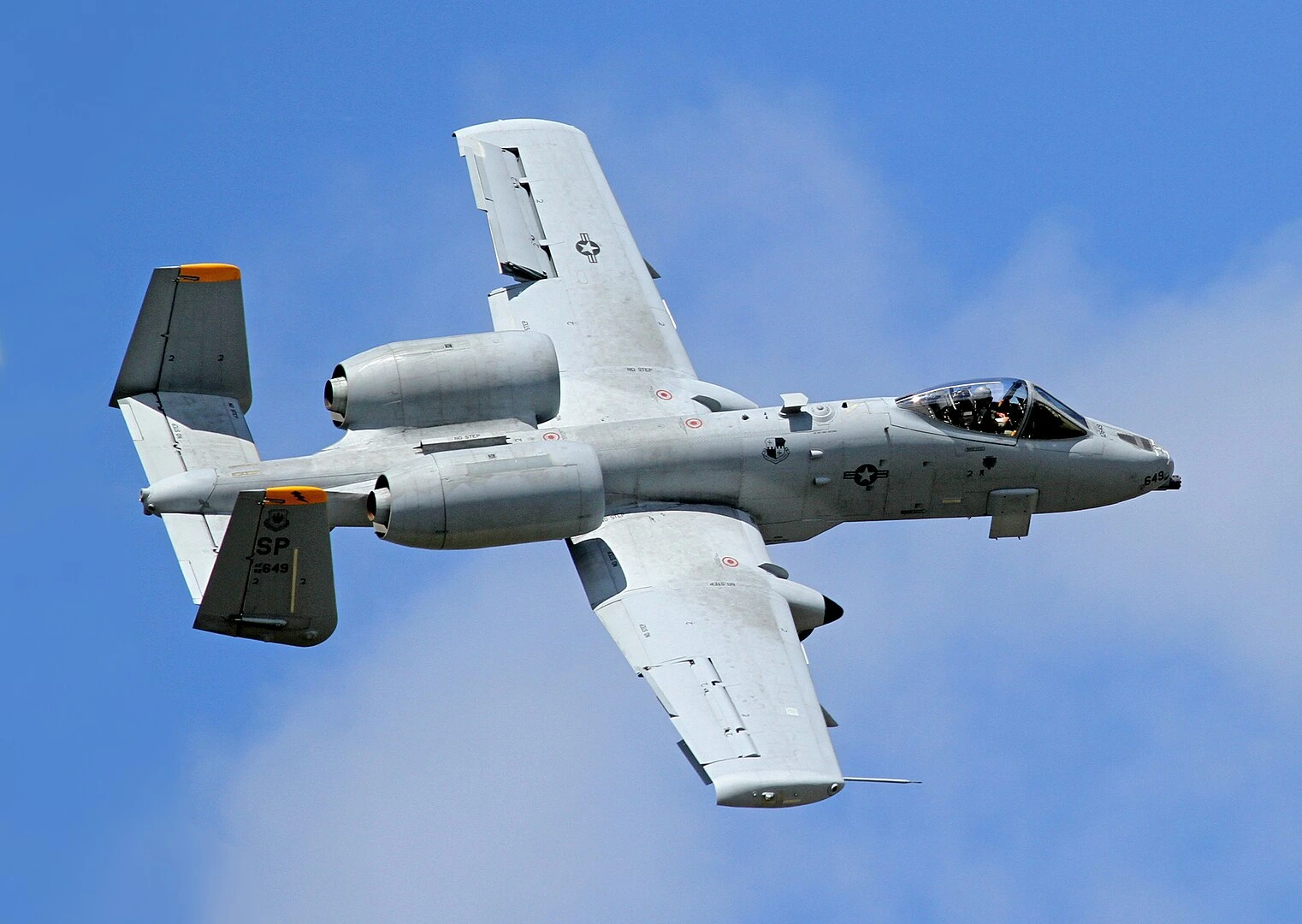
The U.S. Air Force has repeatedly attempted to retire the A-10 Thunderbolt II over the decades. According to Military Machine, the service has pursued the aircraft’s retirement several times since the 1980s, despite its continued use in combat and support of ground forces.
The FY2026 National Defense Authorization Act (NDAA), signed December 2025, blocked the USAF’s plan to retire all 162-remaining A-10s in a single fiscal year. Army Recognition reported that Congress established numeric thresholds below which the fleet cannot fall and required the USAF to produce a multi-year transition plan covering 2027–2029.
Following strong performance in the Iran War, Secretary of the Air Force Troy Meink announced the Warthog would remain in service until at least 2030, with 54 aircraft supporting three operational squadrons.