Emirates (EK), which was voted as the World’s Best International Airline voted by Forbes, has unveiled a new range of complimentary amenity kits for Premium Economy and Economy Class passengers on long-haul flights, designed to raise awareness about endangered wildlife.
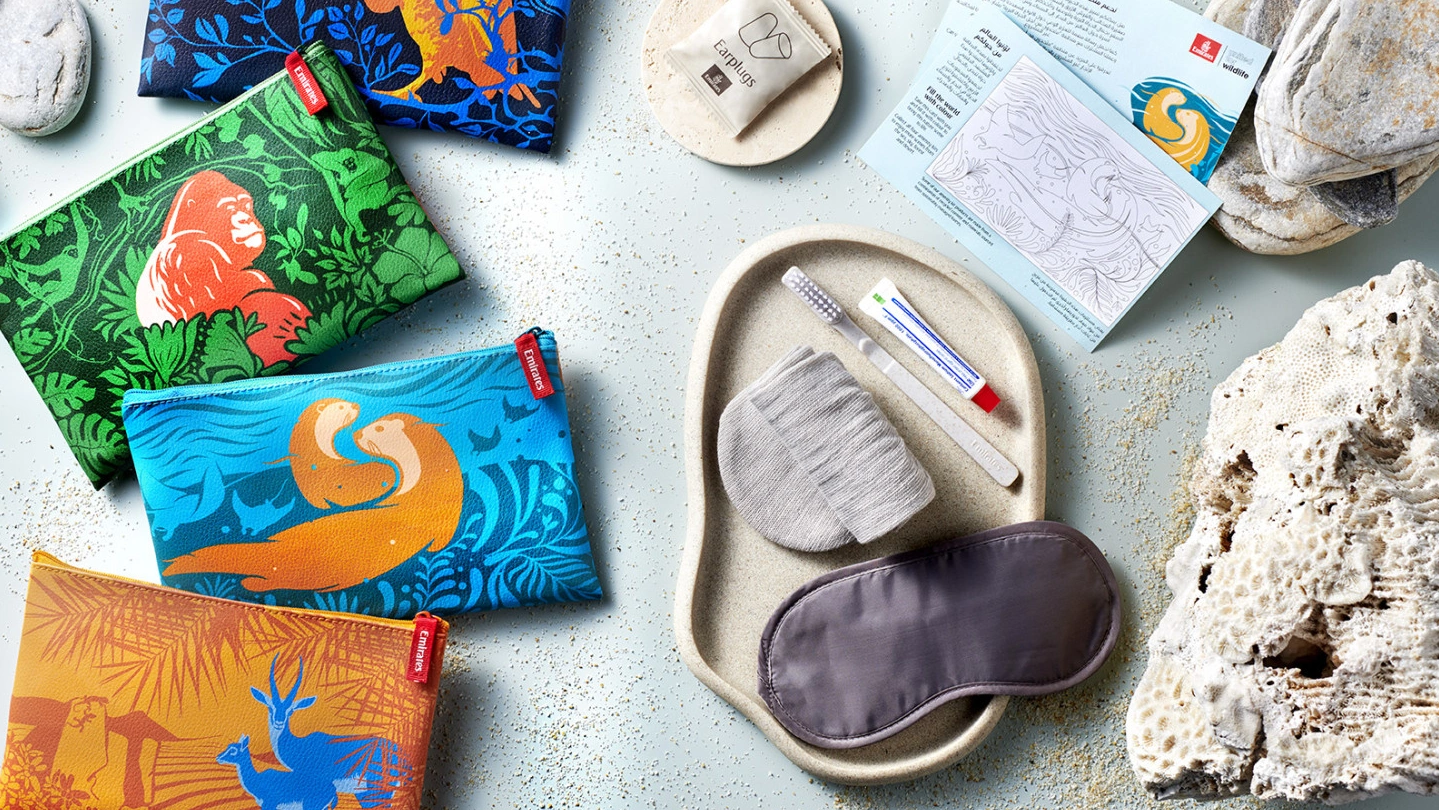
The airline’s initiative, launched in partnership with the conservation organisation United for Wildlife, features specially themed kits that spotlight 23 endangered species across four natural environments — the sea, sky, forest, and desert.”
Emirates’ Endangered Species Themed Amenity Kits details
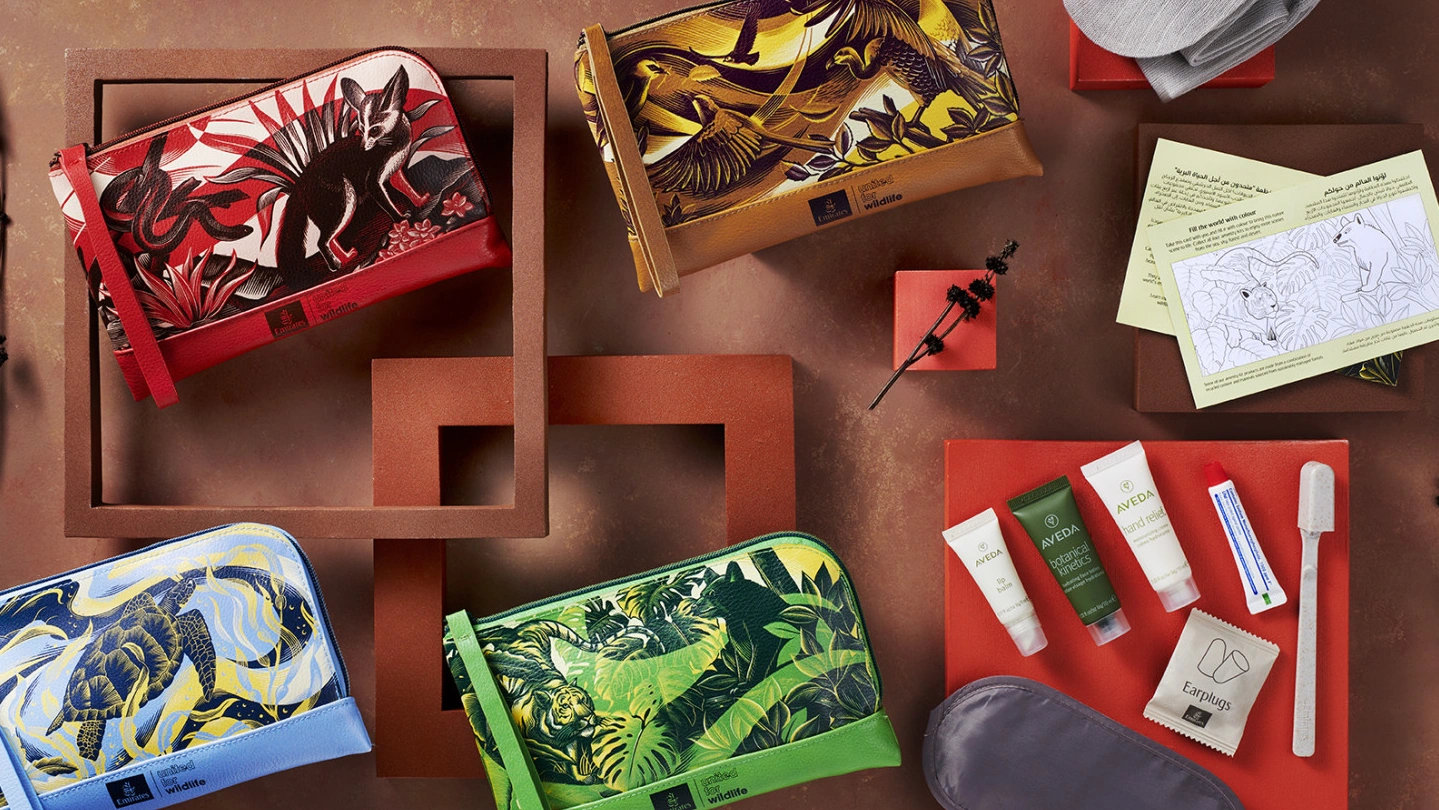
Emirates’ newest amenity kits incorporate a distinctive wildlife conservation theme and are provided free of charge to passengers flying in Economy and Premium Economy classes on qualifying long-haul flights. Each kit is designed to deliver both practical comfort and an environmental message focused on species preservation.
Some of the features of Emirates’ Endangered Species Themed Amenity Kids include the following:
-
The kits feature artwork representing eight endangered species: the green sea turtle, African elephant, blue macaw, gorilla, hammerhead shark, lion, pangolin, and black rhinoceros.
-
The pouches are reusable and washable, made from kraft paper printed with non-toxic, soy-based inks as part of an eco-friendly design ethos.
-
Contents include durable travel essentials such as socks, eye shades, and toothbrushes made with sustainable materials like recycled rPET and wheat straw components to minimise virgin plastic use.
The amenity kits also support Emirates’ wider efforts to raise awareness of wildlife conservation among passengers. David Fein, Co-Chair of United for Wildlife, previously praised the airline for its role in combating illegal wildlife trade, particularly by helping disrupt the transport networks used by traffickers.
The initiative therefore extends beyond the kits themselves, using a passenger amenity to highlight the airline’s broader commitments to wildlife protection and more responsible freight operations.
| Initiative | Description |
|---|---|
| United for Wildlife partnership | Emirates collaborates with this international organisation to highlight endangered species and counter illicit wildlife trafficking. |
| Wildlife Transport Taskforce membership | Emirates is part of a coalition of transport sector partners committed to disrupting illegal animal and wildlife product trade. |
| Emirates SkyCargo bans | A total prohibition on transporting hunting trophies of elephants, rhinoceros, lions, and tigers was implemented to eradicate airline-facilitated illegal trade pathways. |
| IEnvA certifications | The airline achieved IATA Environmental Assessment (IEnvA) Stage One and IEnvA Illegal Wildlife Trade module certifications, reinforcing its compliance with recognised sustainability standards. |
Endangered Mammals included in Emirates’ Amenity Kits
Endangered Mammals Included in Emirates’ Amenity Kits
| Species | Primary Threats | Why They Are Targeted | Unique Characteristics |
|---|---|---|---|
| Pangolins | Poaching for scales and meat | Misbelief in medicinal value | Only mammals with keratin scales; long tongues for eating ants and termites; curl into defensive balls |
| Bengal tigers | Illegal wildlife trade | Skin, claws, teeth, and bones used in Eastern medicine | Unique stripe pattern like a fingerprint; excellent swimmers; longest canine teeth of any feline; cultural symbol of nobility in India |
| Bornean orangutans | Exotic pet trade | High intelligence and rarity | Share ~97% human DNA; critical seed dispersers (“gardeners of the forest”); long, powerful arms for tree life |
| Western gorillas | Bushmeat and pet trade | Meat and infants sought by traffickers | Largest primates; complex social systems led by a silverback; use and make tools |
| Chimpanzees | Pet trade and poaching | Meat, hands, and skulls | Closest living human relatives, sharing ~98% DNA; advanced tool use and culture; self-awareness |
| Asian black bears | Organ harvesting and pet trade | Gall bladders, claws, and teeth | Arboreal; culturally symbolic (“Moon Bears”); crescent-shaped chest marking |
| Small-clawed otters | Pet cafés and private ownership | High demand for interactive pets | Highly social; use partially webbed paws to manipulate prey |
| Fennec foxes | Exotic pet trade | Compact size and appearance | Desert-adapted; large ears for heat regulation; furred feet to handle hot sand |
| Arabian oryx | Poaching and exotic collections | Horns, meat, and hides | Conservation success story, reintroduced after extinction in the wild; desert survival specialist |
| Arabian gazelles | Illegal hunting and private collections | Cultural and aesthetic value | Extreme heat adaptation; key ecosystem role |
| Gibbons | Exotic pet trade | Increasingly poached for their agility and appearance | Move through the canopy by brachiation; form long-term, monogamous pairs; live in close-knit family groups |
Endangered Birds Included in Emirates’ Amenity Kits
| Species | Primary Threats | Why They Are Targeted | Distinctive Traits & Ecological Role |
|---|---|---|---|
| Peregrine falcons | Live bird trafficking | Highly valued by collectors and falconry enthusiasts | World’s fastest animal; dive speeds exceed 200 mph; globally distributed except Antarctica |
| Cape vultures | Poisoning and traditional medicine trade | Body parts used in belief-based practices | Essential scavengers preventing disease spread; nest in large cliffside colonies |
| African grey parrots | Pet trade and traditional medicine | Desired for intelligence and feathers | Advanced vocal learning; contextual speech use; strong human bonding |
| Straw-headed bulbuls | Songbird trade | Exceptional singing ability | Largest bulbul in Southeast Asia; critically endangered due to trapping |
| Painted bats | Ornamental and taxidermy trade | Striking coloration | Key insect predators; low reproduction makes trade unsustainable |
Other Endangered Wildlife (Reptiles, Amphibians, Fish) Included in Emirates Amenity Kits
| Species | Category | Trade Pressure | Notable Biological Features |
|---|---|---|---|
| Blue sharks | Fish | Fins, liver oil, and meat | Highly migratory; fins used in luxury dishes |
| Manta rays | Fish | Gill plate trade | Large brain-to-body ratio; complex social behavior |
| Totoaba | Fish | Swim bladder trafficking | Trade endangers vaquita porpoise via bycatch |
| Green sea turtles | Reptile | Shells, meat, decoration | Herbivorous adults; temperature-dependent sex determination |
| Red sand boas | Reptile | Pet trade and superstition-driven demand | Burrowing snakes; rodent population control |
| Geckos | Reptile | Exotic pet collectors | Adhesive feet; tail regeneration |
| Glass frogs | Amphibian | Exotic pet market | Transparent skin; unique blood storage adaptation |