Aviation is rife with some unique vocabulary: ETOPS (Extended-range Twin-engine Operations Performance Standards) if often jocularly, colloquially referred to as “Engines Turn or Passengers Swim”, pilots assigned on certain duties are called “Deadheads”, “George” is the name given to the aircraft’s autopilot system, the Greenwich Meredian Time is known as “Zulu Time”, a military aircraft flying over water is christened “feet wet”. When reminiscing about this compendium of aviation terminologies, the senior manager at the Pilot Information Center, Ferdi Mack, even remarked “A lot of the ways we say things to be meaningful to other pilots is kind of monkey-see, monkey-do,”.

An addition, and a rather esoteric one at that, to this list would be “nausevats”- a hypothetical term that would be used to describe an “airsickness bag” in Latin, (had such barf bags existed in that era). The term was neologized by Eli Cox, a retired professor of marketing at the University of Texas, who has collected three hundred and seventy-four “impeccably organized bags” garnered from 136 airlines across 70 countries.
James Joyce’s often impenetrable Ulysses talks about the “The sea, the snotgreen sea, the scrotumtightening sea“. A postscript of a “barf-inducing sea“, might stomp on the poetics of the sentence, but some people who have resorted to air travel might have felt this way when seeing the vast stretches of ocean outside an aircraft. The realism of the levity that Sylvia Plath expresses in The Bell Jar when she says “There is nothing like puking with somebody to make you into old friends”, can’t quite be shared in the aircraft. But if you are a voracious traveler, who has got (or perhaps developed) a knack for collecting airsickness bags, it might just make you a Guinness World Record holder.
Niek Vermeulen and Gilmore T. Schjeldahl: the doyens of all airsickness bags
Niek Vermeulen, a Dutchman, holds the Guinness World Record for the largest collection of air sickness bags. As of February 28, 2012, he had collected 6,290 airline sickness bags from 1,191 airlines across nearly 200 countries. His passion for collecting these unique items dates back to the 1970s, the time when he and a friend “made a bet to see who could accumulate the most of any one item and set a world record“. Niek’s favorite bag is an airsickness bag from the NASA space shuttle Columbia, and some of these bags can also be seen in the Air and Space Museum:
“Bags like this were available on the space shuttle for use by astronauts experiencing nausea, or space sickness, a fairly common occurrence during the first day or two of spaceflight. The fabric pouch contained plastic “barf bags” for vomit and small wipes for cleanup. Used bags and wipes were then disposed of in the shuttle’s “wet trash” locker under the floor of the crew cabin. NASA transferred this and a variety of other crew items to the Museum when the space shuttle program ended in 2012.”
The world’s largest airsickness bag collector is now looking for a successor (buyer) to pass his collection. In addition to the airsickness bags, Niek also has a collection of 1,200 airline playing cards – the largest collection of of its kind in the Netherlands.
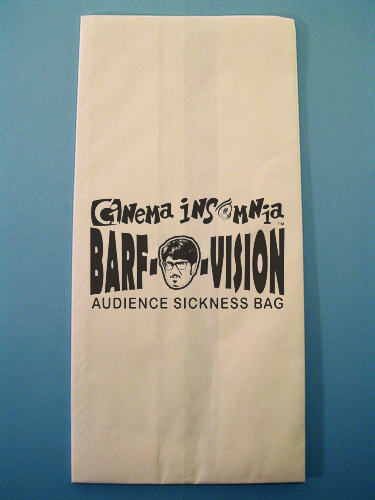
Airsickness bags were invented a couple of decades before Niek set out on his unusual hobby. It was the efforts of Gilmore T. Schjeldahl, who developed a new bag-making machine in his Minneapolis basement. He started his business venture at just $100, and it developed into Herb-Shelly Inc. Though the company went on to produce many products, such as air-supported plastic domes for offices, and one of the first communications satellites, its barf bags were its “most ubiquitous legacy“, reported Vox. Schjeldahl originally intended to make bags from flexible plastic material for holding food. However, the thermoplastic was later developed into air sickness bags.
Air sickness bags were first offered on flights by Northwest Orient Airlines, a US-based airline which merged with Delta Air Lines in 2010. Although research published at the turn of the millenium showed that only 0.5% passengers reported vomiting in flight, one can assume that this number was quite high during the early days of air travel. There are a few reasons behind this:
- exhaust gas or the smell of hot oil or burning was likely to leak into the cabin
- Poor ventilation exacerbated air sickness while flying
- “The rolling and pitching of an airplane in gusty weather may produce a feeling of nausea. But in some pupils, especially after a bumpy cross-country flight, actual vomiting may occur after landing” (quoted in a New York Times Article dated 1928).
- planes then flew around 5,000 ft high (compared to 35,000 in the present day) leading to bumpier rides and lurching
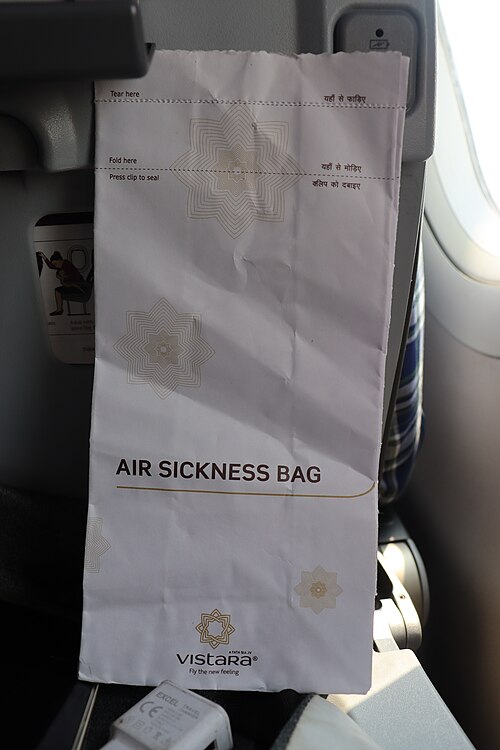
Psychology must have also played a part. After all, the first female flight attendant in the world, Ellen Church, became a flight attendant to placate passengers who were fearful of flying. To do away with the nausea associated with flying, experts were recommending passengers eat lightly and lay off booze.
Bruce Kelly, Steve Silberburg, and other doyens
Only one of every ten million people in the world is a barf bag collector, meaning that there are only around eight hundred or so barf bag collectors around the globe. While this may, statistically atleast, be a very small number, almost all the serious air sickness bag collectors started out this journey feeling that they were the only ones engaged in this pursuit.
That is the case of Bruce Kelly, the founder of Kelly’s World of Airsickness Bags, an online catalog of his collection of more than a few good thousand airsickness bags, who when talking to CNN said:
“I’ve spent many a time on international flights staring at the seat back in front of me, and eventually I thought, wouldn’t it be interesting to collect barf bags?…I’m sure no one else has ever thought of it. I’ll have the only collection in the world.”
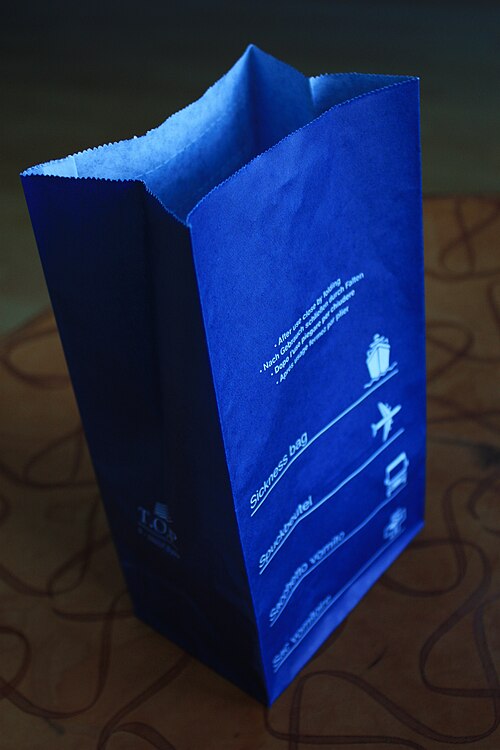
The same was true of Steve Silberburg, whose vanity plate reads “MAINE….BARF BAGS…Vacationland”. He initially had collections of styrofoam weights and sardine keys, but on a domestic cross-country flight stumbled onto collecting barf bags:
“When you’re young, you go, ‘Oh I’m going to collect something.’ But stamps and coins, everybody collects those..(I thought)Nobody collects these (Barf Bags).. This is what I’m going to do.”
Steven is the founder of airsicknessbags.com, a virtual museum of Air Sickness Bags that has the slogan “Serving your barf bag needs since 1997“. While we might not agree that his “hobby is an enormous waste of time“, we might second his opinion that “it’s a higher quality waste of time than many other places on the web“. His collection is an impressive 3575 bags. However, not all of these are from airlines, as some of them are also from “boats, trains, movies (mostly horror), video games, political campaigns and even a few banks“.
Eli Cox, the collector from Austin, Texas, about whom we mentioned briefly in the introduction (to this article) said that some of the students he knew during his teaching days helped amass a chunk of his 370-bag collection. He said that like all other hobbies, collecting air sickness bags is a dopamine producer.
How do avgeeks store so many airsickness bags?
With collectors owning more than 3,000 air sickness bags, and some of these prized collections being bags from the NASA space shuttle, one might wonder how the collectors manage to keep these items well put. Here are a few ways:
- The bags are stored in a dry, cool place to prevent any moisture or heat damage.
- Using binders with plastic sleeves to keep the bags flat and protected. Each bag is placed in its own sleeve to prevent it from getting bent or damaged. This is the method used by Silberberg.
- The use of clean, dry hands, and wearing gloves to avoid transferring oils and dirt, which can cause stains or degradation.
- Kept in frames or cases that protect them from dust and light. Bob Grove, a former general counsel from San Diego, has framed bags line the walls of his home.
- Collectors like Steve Silberberg and Bruce Kelly like to store their collections digitally, for which they have created websites named barfbags.com and kellysairsicknessbags.com, respectively.
Can air sickness bags be kept in a museum?
The anti-motion sickness drug called Dramamine was made in the same year as air sickness bags. Ironically, the drug that pushed air sickness bags out of many airlines, organized a campaign called “The Last Barf Bag,”. In addition to a 13-minute documentary about the subject, it also held a barf bag exhibit in New York City last year.
A collection of barf bags is unique and they offer glimpses of aviation history [of now-defunct airlines (like Farman Airways, Spanair, etc)]. For instance, the government-owned Chinese airline CAAC broke up into many different domestic airlines, each of which produced unique barf bags. Some of the designs of the airsickness bags of the newly formed airlines included:
- Illustrated cherry trees
- sturdy construction
- A design scheme best viewed from the perspective ]someone actively using it.
Not everyone will be interested in this unlikely hobby. We’ve previously mentioned that the airsickness bag used in NASA space shuttle Columbia has made its way to the Air and Space Museum.
Flight museums displaying memorabilia like airsickness bags might be much more interesting. Also, the online museums as set up by Bruce Kelly might also work the charm. An alternative would be to display such bags in airports and aerodrome around the world, as was the case with Virgin Atlantic, which in 2004:
“introduced a series of 20 limited edition sick bags, in association with the charmingly-named and now obsolete designforchunks.com website. The bags reportedly did not last as long as expected on the company’s aircraft as everyone took them home as souvenirs, however, the designs were later framed and displayed in the airline’s lounge at Heathrow.”
How much do the airsickness bags cost? As little as $500 to infinity
While legacy and budget carriers provide airsickness bags for free, the most notorious budget carrier, Ryanair made some headlines when it proposed that any passenger asking for an airsickness bag would be charged a sum. One might or might not quarrel with it because budget carriers provide no “frills”, though we can debate whether an airsickness bag is a frill. When another budget carrier refused giving a barf bag to a passengers’s daughter (who was also on the same flight) on the same account, the passenger retorted: ” No-frills shouldn’t mean no-dignity. … Perhaps Spirit should offer another add-on to customers: A little humanity”.
Some people have paid up to $500 for an airsickness bag. Barf bags of obscure airlines such as Anichave sold for $100-$200. But this might be barely scratching the surface. Eli Cox said that he had invested zero dollars, no less no more, in his collection of 370 airsickness bags. But his return of investment might be just way more, he said to Texas Monthly:
“Say these are worth a dollar each [and some are worth much more]. If you divide three hundred and seventy-four by zero, it’s infinite.”
Conclusion
If we were to call an airsickness bag with any other name such as a “Comfort” bag or more simply a “Sickness bag”, or an “emesis bag”, it wouldn’t really be a great pictoral description of its purpose. But no matter what it is called, we can say that collecting these is a highly unlikely hobby.