Air India (AI) is abandoning its “business class plus” Safran plan for a bespoke Airbus first class suite—featuring double beds and 1-1-1 layouts—though the product may not debut until around 2030, One Mile At a Time reported.
According to data from planespotters.net, Air India doesn’t currently have an Airbus A350-1000 in its fleet. has six Airbus A350-900s in its fleet and these average 2.5 years. Air India’s A350s also make the cut of operating some of the longest A350 routes in the world as they toggle between Delhi – Newark and Delhi – New York.
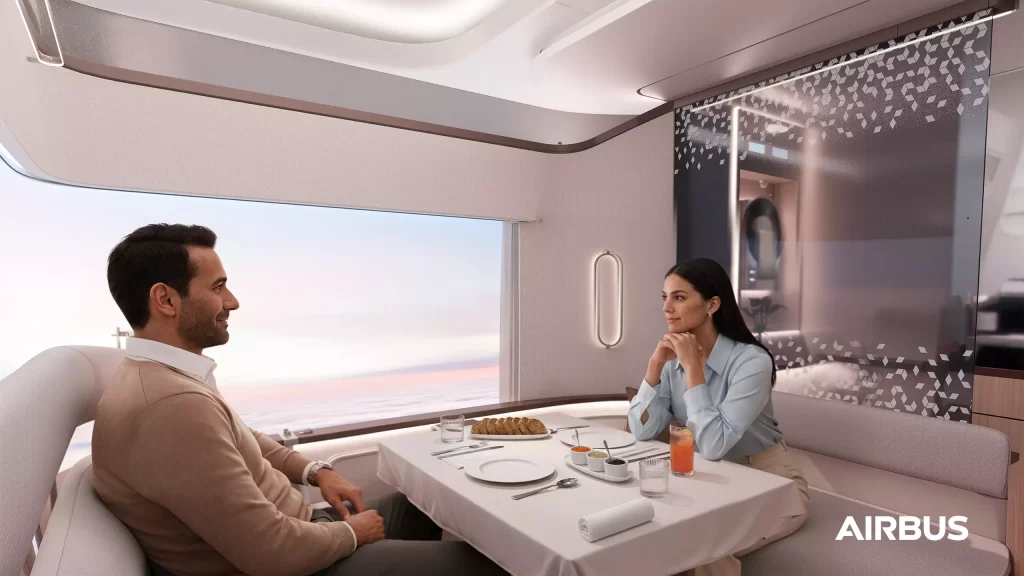
Air India’s First Class Vision for its Airbus A350-1000s
Air India is overhauling its premium strategy, opting to develop a custom first class suite in partnership with Airbus for its Airbus A350-1000 fleet—scrapping earlier plans to use Safran’s Unity platform due to supply chain challenges.
Originally, Air India intended to deploy Safran’s Unity seats across both the A350-1000 and Boeing 777 fleets. Under that plan, first class would have been an incremental upgrade over business class, leveraging additional bulkhead space rather than introducing a distinct cabin.
However, supply chain disruptions forced the airline to reconsider. These issues—affecting seat manufacturers and delivery timelines globally—ultimately led Air India to abandon the Unity platform altogether.
As a result, the airline selected the Recaro R7 suite for business class on the A350-1000, a modern staggered seat with privacy doors already being adopted by carriers like Iberia and LATAM.
But this left a gap: Air India needed a completely new approach for first class.
Airbus Stepped in with a Clean-Sheet Concept
To fill that gap, Air India has partnered directly with Airbus, adopting a customized version of the manufacturer’s “First Class Experience” concept, first showcased at Aircraft Interiors Expo 2026. At the heart of this concept is the “Master Suite”, a radically different approach to first class design.
Instead of simply refining a seat, Airbus has reimagined the cabin layout itself—introducing:
- A 1-1-1 configuration (three suites per row)
- A central “Master Suite” between aisles
- Relocated lavatories and crew spaces to free up passenger room
This redesign allows airlines to maximize usable cabin space while simultaneously enhancing privacy and exclusivity.
According to Airbus itself, “the large size and high ceilings of the A350-1000 make it the ideal choice for airlines to install their most premium product“:
Moreover, its unique interior proportions can be further enhanced (above and beyond today’s in service A350s) by new fascia and sculptured ceiling panels which provide an even greater sense of space, as well as an integrated welcome lighting panel at Doors 1 for extra ambience. The ‘icing on the cake’ are the suite’s virtual panoramic windows to create the ultimate premium travel experience.
Inside Airbus’ First Class “Master Suite”
The Airbus concept pushes first class toward a private-jet-style experience, with features rarely seen in commercial aviation.
According to Airbus, the Master Suite includes:
- A full double bed for two passengers
- A dedicated lavatory and changing area
- Lounge-style seating and integrated bar elements
Crucially, Airbus achieves this without sacrificing cabin efficiency by relocating infrastructure like storage units and crew rest access into a new central module near Door 1.
The result is not just a better seat—but a restructured premium cabin environment.
What Air India’s Version Will (and Won’t) Include
Air India is expected to customize the Airbus concept rather than fully replicate it.
Early indications suggest:
- A 1-1-1 layout is highly likely
- A more restrained interpretation of the Master Suite
- No full “bedroom-style” extravagance seen in the most ambitious configurations
Even so, this product will be significantly more advanced than the earlier Safran-based “business plus” concept, as well as Air India’s current first class on legacy Boeing 777 aircraft.
Air India’s First Class on the A350-1000s Won’t Arrive Immediately
While Air India’s A350-1000 aircraft are expected to enter service from 2026, the new first class product will take considerably longer to materialize.
Industry timelines suggest that the first A350-1000 deliveries will start this year, while the first class product entry: closer to 2030. This delay reflects the complexity of designing, certifying, and manufacturing entirely new first class suites—processes that can take up to 7 years from concept to service. This timescale was something that Air India’s former CEO Campbell Wilson echoed.
According to Airbus, Air India is one of the ten customers who have signed up for installing first-class on the A350-1000s”
While the existing products are not utilising the next-generation concepts being proposed by the First Class Experience concept (such as the new lavatory, sidewall panels, or the enhanced welcome area), around five airlines are currently in the customisation phase – and these are the ones who could be considering the implementing elements included in the concept. The first of these would enter service from around 2030. In addition, several more airlines at the pre-sales stage are in talks to become A350 first class operators.
Where Are Air India’s A350-1000s Set to Fly
Air India’s A350 fleet is already being deployed on key long-haul routes, including a service we’ve touched upon before: Delhi with London and New York—markets where premium demand is strongest.
The A350-1000, with its larger cabin and range, is expected to become the airline’s flagship aircraft on these routes, making it the natural home for its most advanced first class product.
Air India’s move comes amid a broader industry shift, as airlines invest heavily in premium cabins to capture high-yield passengers. Airbus itself notes that at least 10 airlines have opted for first class cabins on A350 aircraft, with several already in customization phases.
At the same time, carriers worldwide are redesigning premium cabins—whether through enclosed suites, ultra-long-haul configurations, or entirely new seating concepts.
What About the Air India’s Boeing 777?
One major uncertainty remains: Air India’s Boeing 777 fleet*. Because the Airbus-designed suite is platform-specific, it cannot be directly transferred to the 777. Here’s a look at the carrier’s fleet of the triple sevens:
*Note:
| Aircraft Type | In Service | Stored | Total | Avg. Age |
|---|---|---|---|---|
| Boeing 777-200 | 1 | — | 1 | 16.9 Years |
| Boeing 777-300ER | 16 | 3 | 19 | 15.4 Years |
This leaves the airline with two options: It can either develop a separate first class product for the 777 or limit its most advanced offering to the A350-1000. For now, Air India has not clarified its approach. According to Live from the Lounge,
It is known that the airline has always intended to equip its long-haul aircraft (the A350-1K, the Boeing 777, and the Boeing 777-9) with First Class. The airline has also been open about inducting some A350-1000 aircraft without First Class. Which is what will happen to VT-JRO, the first A350-1000, which was contractually delivered to Air India last year, but will only get into service later in 2026 (because, no seats!)
All in All
Air India’s decision to abandon Safran’s Unity platform in favor of a bespoke Airbus-designed suite signals a clear shift—from incremental upgrades to genuine premium ambition.
The airline is no longer trying to match competitors. It is attempting to redefine its position at the top end of long-haul travel.
But the real test lies ahead.
A world-class seat is only part of the equation. Delivering a consistent, high-end experience—across service, catering, and ground operations—will determine whether Air India can truly compete with the best.
