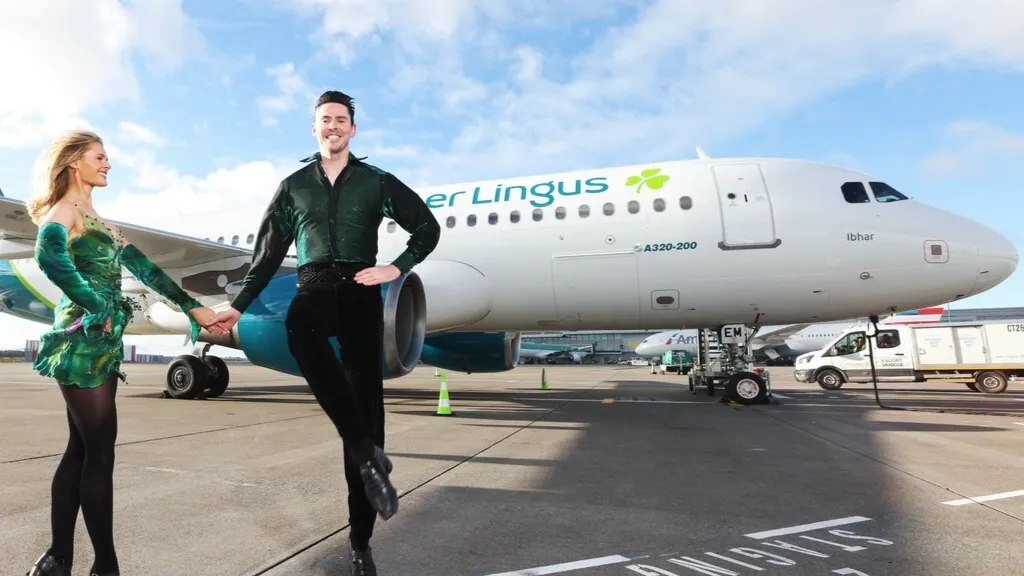
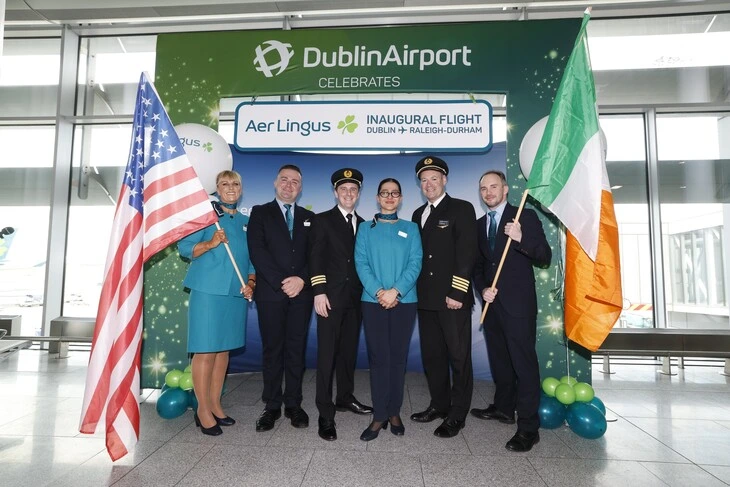
Aer Lingus (EI), which recently introduced free Wi-Fi on transatlantic flights, has officially launched its first-ever direct route between Dublin Airport (DUB) and Raleigh-Durham International Airport (RDU) in North Carolina. The service operates up to five times weekly and is flown using the airline’s next-generation Airbus A321XLR aircraft, designed for long-range efficiency on medium-capacity routes. With this addition, Raleigh-Durham becomes Aer Lingus’ 23rd North American destination.
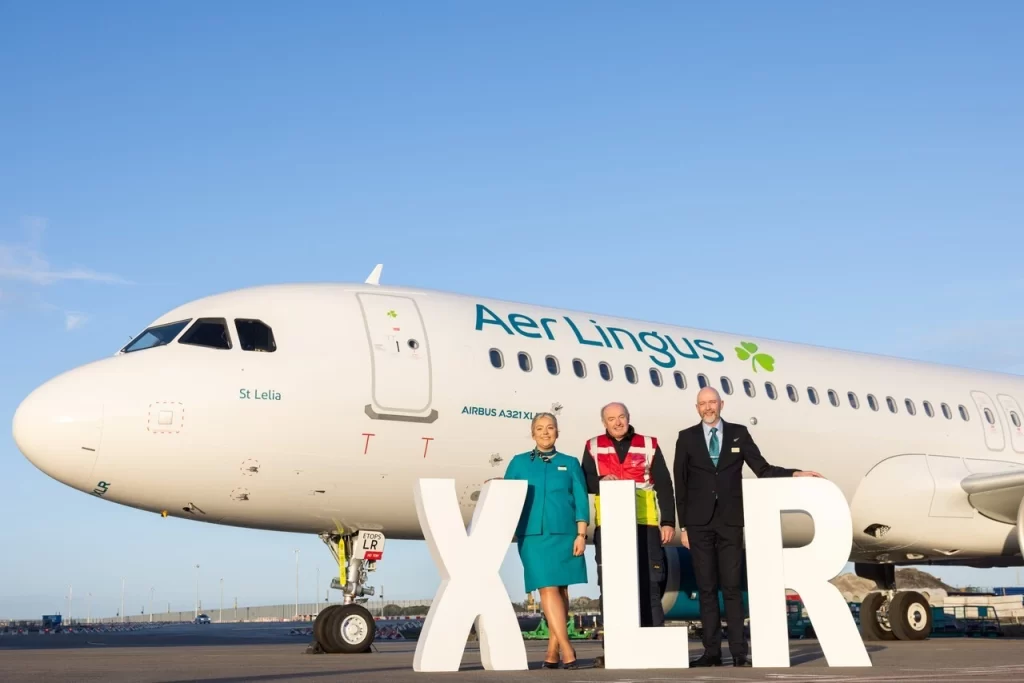
Aer Lingus Strengthens its Dublin Hub on its A321XLR
The new route reinforces Aer Lingus’ long-standing strategy of positioning Dublin as a transatlantic connecting gateway between North America and Europe. Through Dublin Airport, passengers arriving from the Research Triangle region gain access to more than 20 onward European and UK destinations, expanding one-stop connectivity across the continent.
Key onward connections include major cities such as Glasgow, Paris, Rome, Amsterdam, London, and Madrid, allowing Raleigh-Durham travelers to seamlessly access both leisure and business markets across Europe.
The carrier’s A321XLR offers a range of up to 8,700km, and will serve thousands of US passengers as the Aer Lingus College Football Classic attracted almost 23,000 visitors in 2025.
On the occassion of the launch of the route, Lynne Embleton, Chief Executive Officer at Aer Lingus, said: said that the carrier was “making it even easier for customers to travel to Dublin and onwards to destinations across the UK and Europe”:
The Raleigh-Durham region is a hub for technology, innovation and research, and this additional connectivity to that region will allow the business and educational ties on both sides of the Atlantic to flourish. Launching ahead of the 2026 Aer Lingus College Football Classic makes this service especially timely, and we’re really looking forward to welcoming UNC fans to Ireland this August as the Tar Heels take to the field at the Aviva Stadium in Dublin.

Linking Ireland to the U.S. Research Triangle
The new service directly connects Ireland to one of the most influential innovation corridors in the United States: the Research Triangle, which encompasses Raleigh, Durham, and Chapel Hill.
At the heart of this region is Research Triangle Park (RTP)—one of the world’s largest research parks—hosting hundreds of companies in the technology, biotechnology, and life sciences sectors.
The region is also anchored by leading academic institutions, including:
- North Carolina State University (Raleigh)
- Duke University (Durham)
- University of North Carolina at Chapel Hill
This concentration of universities and high-tech industries creates strong demand for transatlantic travel tied to education, research collaboration, and corporate mobility, making Raleigh-Durham a strategic addition to Aer Lingus’ U.S. network.
Echoing this sentiment, Tammie Hall-Roberts, Chair of the Raleigh-Durham Airport Authority Board, said:
Dublin is one of the most sought-after international destinations for Research Triangle-area travelers, and the nonstop Aer Lingus service makes for a quick and convenient journey. RDU is proud to welcome an exciting new route that connects our community to new adventures and business opportunities in Ireland and beyond
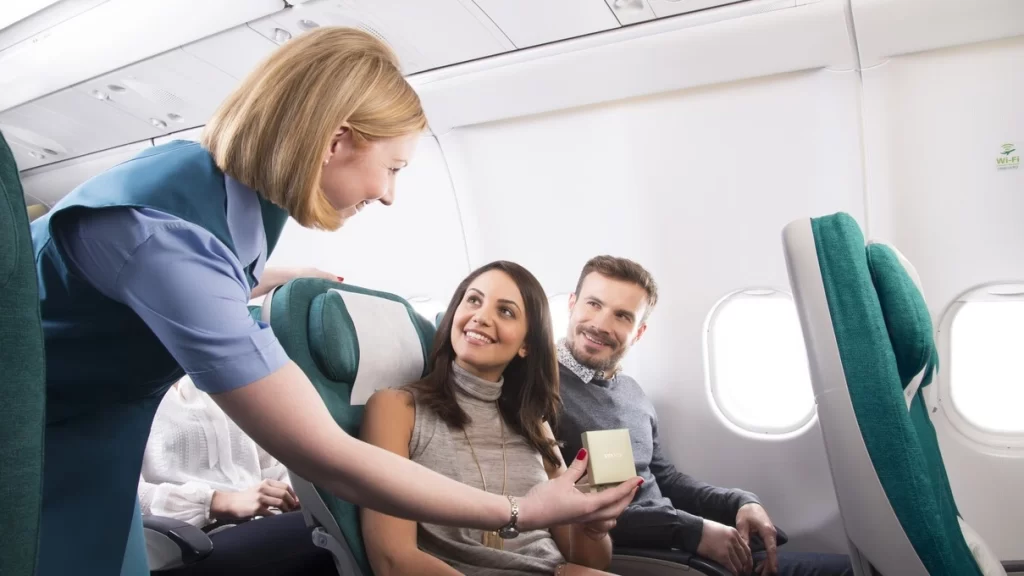
Aer Lingus’ DUB-RDU route Arrived Ahead of a Major Sports-Driven Travel Surge
The launch is strategically timed ahead of the 2026 Aer Lingus College Football Classic, scheduled for August at Dublin’s Aviva Stadium.
In this high-profile fixture, the University of North Carolina (UNC) will face Texas Christian University (TCU) in the opening weekend of the NCAA season—marking the international debut for both teams.
The College Football Classic has become a major driver of inbound U.S. tourism to Ireland, attracting nearly 23,000 American visitors in the 2025 edition alone.
The new Raleigh-Durham route is expected to capture a significant share of travel demand from UNC supporters traveling to Dublin for the 2026 matchup.
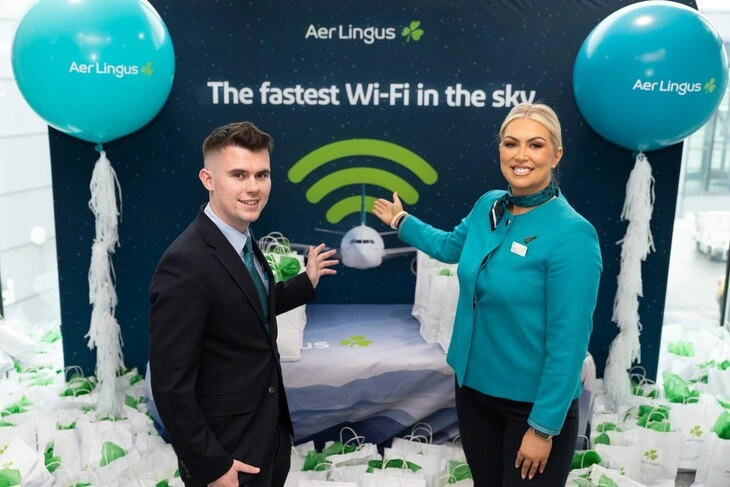
Details of Aer Lingus’ A321XLR on the North Carolina Route
Founded in 1936, Aer Lingus is the flag carrier of Ireland and currently operates more than 100 routes from its bases in Dublin, Cork, Shannon, and Knock across Europe and North America.
The airline holds a 4-star Skytrax rating and is part of the International Airlines Group (IAG), alongside carriers such as British Airways and Iberia.
For the Raleigh-Durham route, Aer Lingus is deploying the Airbus A321XLR, a next-generation narrowbody aircraft designed for long-haul missions. Its extended range allows airlines to serve mid-sized U.S. cities efficiently without the need for wide-body aircraft, improving operational flexibility and fuel efficiency.
Here’s how the carrier has configured its A321XLR:
Aer Lingus A321XLR Cabin Comparison
| Feature | Economy Class | Business Class |
|---|---|---|
| Seat type | Recaro ergonomic seats | Thompson Aero Seating premium seats |
| Seat width | 18 inches | 22 inches |
| Seat pitch (legroom) | 30–31 inches | 46–47 inches |
| Seat comfort | Padded seats, wider backrests | Ergonomic design with enhanced comfort |
| Recline | Reclined position for relaxation | Fully lie-flat bed (6 ft 5 in) |
| Headrest | Six-way adjustable headrest | Not specified (premium design implied) |
| Seat controls | Standard | Advanced controls with massage option |
| Workspace | Fold-out tray with device holder | Fully retractable table for dining/work |
| Storage | Limited | Dedicated storage for laptop, tablet, shoes |
| Charging ports | USB-A and USB-C | USB-A and USB-C |
| Entertainment screen | 12-inch 4K touchscreen | 18-inch 4K touchscreen |
| Entertainment content | Standard content library | 120+ hours (movies, box sets, documentaries, business shows) |
| User interface | Updated UI, easy navigation | Updated UI, easy navigation |
| Extra features (IFE) | Interactive maps, accessibility features, Bluetooth | Interactive maps, accessibility features, Bluetooth |
| Dining | Complimentary meal + buy-on-board snacks (Bia range) | Premium dining with Irish produce + seasonal menus |
| Drinks | Full bar + beverages (some paid) | Complimentary drinks throughout flight |
| Overall experience | Comfortable long-haul economy with modern features | Premium long-haul experience with lie-flat luxury and fine dining* |
*Notes
- Space & Comfort: Business Class offers significantly more space, with wider seats and nearly 50% more legroom, plus lie-flat beds.
- Entertainment Upgrade: Both cabins feature 4K screens, but Business Class provides larger displays and a richer content library.
- Dining Difference: Economy includes a complimentary meal, while Business delivers a full premium dining experience with curated menus and drinks included throughout.
- Product Positioning: Economy focuses on modern comfort and value, while Business is designed as a true long-haul premium product on a narrowbody aircraft.
North Carolina is A Destination of Growing Global Appeal
The launch also highlights North Carolina’s rising profile as a tourism and business destination. The state offers a diverse mix of mountain landscapes, Atlantic coastline, and fast-growing urban centers, making it attractive for both leisure and business travel.
Key regions include:
- The Blue Ridge and Great Smoky Mountains, known for hiking and scenic drives
- The Outer Banks, a 301-mile stretch of barrier islands along the Atlantic coast
- Urban hubs like Raleigh, Charlotte, and Durham, which anchor the state’s economic and cultural activity
The state also carries historical significance, including landmarks such as the Wright Brothers National Memorial in Kill Devil Hills, marking the site of the first powered flight in 1903.
Stretching from the misty peaks of the Blue Ridge Mountains to the sunlit shores of the Atlantic, North Carolina offers one of the most geographically diverse travel experiences in the United States. Often called the Tar Heel State, it blends outdoor adventure with deep-rooted history and a thriving food culture.
What makes North Carolina particularly compelling is its year-round appeal. From spring wildflower blooms and summer beach escapes to autumn foliage and winter festivities, the state delivers a constantly evolving travel experience shaped by its varied landscapes and rich heritage.

North Carolina’s Three Distinct Regions
North Carolina is naturally divided into three regions, each offering a completely different travel experience.
| Region | Key Highlights | Travel Experience |
|---|---|---|
| Mountain West | Blue Ridge Mountains, Great Smoky Mountains National Park, Blue Ridge Parkway (252 miles) | Scenic drives, hiking, waterfalls, outdoor adventure |
| Piedmont (Central) | Cities like Charlotte and Raleigh, major universities, cultural institutions | Urban experiences, museums, sports, business hubs |
| Coastal Plain | Outer Banks, Cape Hatteras National Seashore (301 miles of coastline) | Beaches, water sports, coastal relaxation |
What to Do in Each Region
Mountain Region (Blue Ridge & Smokies)
- Drive along the Blue Ridge Parkway for panoramic Appalachian views
- Explore Pisgah and Nantahala National Forests with extensive hiking trails
- Kayak or fish in the New River, one of the oldest rivers in the world
Coastal Region (Outer Banks & Atlantic Coast)
- Relax on protected beaches at Cape Hatteras National Seashore
- Visit summer hotspots like Kitty Hawk and Corolla
- Stay in beachfront homes or waterfront hotels during peak season
Piedmont Region (Cities & Culture)
- Experience whitewater rafting at Charlotte’s National Whitewater Center
- Visit the NASCAR Hall of Fame
- Explore Raleigh’s academic and cultural scene, including major universities and art museums
Best Time to Visit North Carolina
| Season | What to Expect | Highlights |
|---|---|---|
| Spring (Mar–May) | Blooming landscapes, mild weather | Wildflowers, mountain blooms, gardens like Biltmore and Elizabethan Gardens |
| Summer (Jun–Aug) | Peak tourism season | Beaches, water sports, Outer Banks travel |
| Autumn (Sep–Nov) | Cooler temperatures, vibrant foliage | Mountain hiking, scenic drives, fall colors |
| Winter (Dec–Feb) | Mild coast, colder mountains | Skiing in western peaks, holiday light displays |

Cultural History and Landmarks
North Carolina’s identity is deeply shaped by its cultural and historical layers. It is the ancestral homeland of the Cherokee people, with living history preserved in places like the town of Cherokee and the Oconaluftee Indian Village, where traditional life is recreated.
The state also played a key role in early American history. English settlers arrived in 1587, and North Carolina became one of the original 13 colonies in 1729. Landmarks such as Tryon Palace and Old Salem offer immersive glimpses into colonial and early American life.
The state’s global historical significance is cemented at Kill Devil Hills, where the Wright Brothers achieved the world’s first powered flight in 1903—an event that changed the course of aviation forever.
Major Festivals and Events
- North Carolina State Fair (Raleigh): agricultural exhibits, rides, live music
- Wilmington Azalea Festival (April): Parades, blooming gardens, concerts
- Asheville Beer Week (May): Celebration of craft brewing culture
- Coca-Cola 600 (Charlotte Motor Speedway): One of the biggest NASCAR events in the U.S.
Food and Drink: What to Try
| Category | Must-Try Experience |
|---|---|
| Barbecue | Whole-hog pork barbecue with vinegar-based sauce |
| Iconic Brands | Krispy Kreme donuts, Cheerwine soda (since 1917) |
| Farm-to-table | Grass-fed burgers with pimento cheese in Asheville |
| Global fusion | Southeast Asian-inspired dishes in Chapel Hill |
| Experiential dining | Foraging tours for wild ingredients in the countryside |