British Airways (BA) has changed its crew rest rules for long-haul flights. The airline now allows cabin crew to sleep in empty First Class and Business Class seats during scheduled rest breaks. The change applies only to aircraft that lack dedicated crew rest bunks: BA’s Boeing 787-10 Dreamliners and a portion of its Boeing 777-200ER fleet. The policy follows talks between BA management and cabin crew union BASSA, according to AeroXplorer.
The new rules took effect in late June 2026. Crew may use any vacant passenger seat, including First Class, as long as no paying passenger is asked to move. The new guidance also requires crew to remove or cover uniform items and to use the bedding provided for that cabin. The change replaces a system where crew on these aircraft rested only in fold-down jumpseats inside the galley.
Why British Airways Aircraft Lack Crew Bunks in the First Place
Most modern widebody jets come with hidden crew rest bunks. These are usually tucked above or below the passenger cabin. Bunk facilities are actually an optional extra offered by aircraft manufacturers Airbus and Boeing, which airlines must pay extra to install.
BA chose to skip this option on part of its fleet. British Airways’ Boeing 787-10 Dreamliners do not have crew bunk facilities, and the airline has also operated a sub-fleet of Boeing 777-200 widebody jets without them for decades. Skipping the bunks was not cost-free for passengers, either. The decision allowed British Airways to install three extra Economy Class seats on each 787-10.
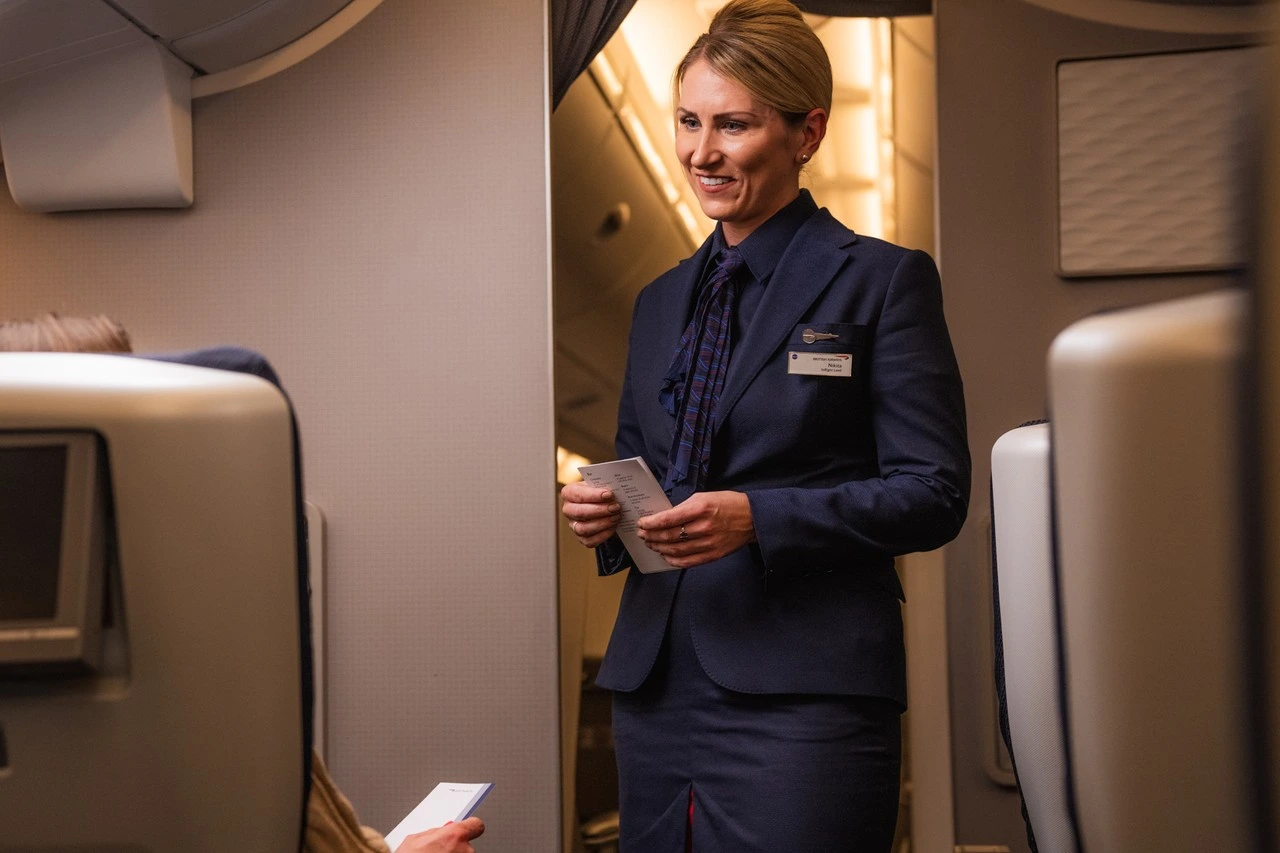
Crew on these jets previously had only one rest option. On these flights, crews are expected to rest in galley jump seats, separated from the cabin by a curtain and referred to as “high-comfort attendant seats,” which are not actually comfortable. Crew members have long complained that these seats offer poor support for real sleep, especially on overnight, multi-time-zone routes.
What the New Policy Actually Allows
The updated guidance gives crew three tiers of rest options, depending on what is available on a given flight.
- Designated crew-rest seats, where these already exist on the aircraft.
- High-comfort attendant jumpseats in the galley, the previous default option.
- Any vacant passenger seat in any cabin, including First Class and Club World (BA’s Business Class brand), provided no passenger is moved to free up the seat.
If a flight is fully booked in every cabin, crew must still fall back on the jumpseats. The policy is therefore conditional, not a guaranteed upgrade for staff on every flight.
BA is also exploring a longer-term fix. The airline plans to place a soft block on seats 40 D, E, F, and G on some Boeing 777s and seats 47 and 48 D, E, and F on Boeing 787-10s for crew use. A soft block reserves these Economy seats for crew only if the flight is not full, rather than removing them from sale outright. According to FlyerTalk Forums, the airline’s booking systems have not yet been updated to support this feature.
Why This Matters for Crew Fatigue and Flight Safety
Crew rest is not just about comfort. Quality of rest directly affects crew alertness, and several studies in commercial aviation link fatigue to reduced performance during critical phases of flight. Properly rested cabin crew respond faster to in-flight medical events, security issues, and emergencies.
UK aviation rules set a floor for crew rest but leave airlines room to decide how to deliver it on shorter long-haul routes. Under European aviation regulations, adopted by the UK after Brexit, dedicated bunk facilities are only legally required on longer-range flights where crew must be given the chance for lie-flat rest in a private space. BA’s affected 787-10s and 777-200ERs fly shorter long-haul sectors, which do not trigger this bunk requirement. The new seat-based policy is therefore a voluntary upgrade, not a response to a regulatory gap.
BA is not the only airline managing this trade-off. United Airlines has taken a stricter approach on its own non-bunked long-haul jets. In the U.S., United Airlines hard-blocks certain Economy Class rows on its non-bunked long-haul aircraft for flight attendant rest, meaning those seats are pulled from sale entirely rather than offered only when space allows.
Passenger Reaction and Privacy Concerns
Reaction among frequent flyers has been mixed. Many travelers on dedicated aviation forums say an empty seat helping a tired crew member is a fair trade, since it does not cost them anything if the cabin already has space to spare.
Some passengers paying premium fares may still be surprised to see crew sleeping or taking formal rest breaks in the same cabin, even when the seats used are otherwise empty.
Others point to the optics of a premium product. A near-empty First-Class cabin is often marketed around privacy and exclusivity. Using it as a staff break room undermines that image, even though the airline says crew are instructed to cover or remove uniform items and stay inconspicuous.
BA has not commented publicly on the privacy criticism beyond confirming the discretion requirements built into the guidance itself.
The Seats Crew Will Actually Use
The comfort level crew can access depends heavily on which cabin has space, and BA’s premium seats vary in size between aircraft types.
- Club World (Business Class) flat beds on the 787-10 measure 21 inches wide and stretch to 79 inches once converted, laid out four-abreast.
- Some Boeing 777s use a less generous 2-4-2 Club World layout.
- First Class seats are 22 inches wide upright and widen to 29 inches once converted into a bed.