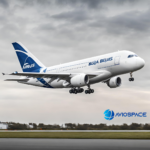
Emirates (EK), the carrier that won the best international airline award, is restoring its Airbus A380 superjumbo to 11 international routes between 26 June and 1 August 2026, operating from Dubai International Airport (DXB). The returning destinations include Düsseldorf, Copenhagen, Frankfurt, London Gatwick, Manchester, Munich, Perth, Glasgow, Prague, Osaka Kansai, and Washington Dulles, with services resuming between 26 June and 1 August 2026, Simple Flying reported.
Emirates suspended multiple routes that ordinarily see the Airbus A380, due to both the ongoing war in Iran and the reconfiguration of two-class 615-seat aircraft to three-class, 569-seaters. The restoration is phased across two waves: six European routes by 1 July and five long-haul destinations by 1 August.
Why Emirates Grounded the A380 On These Routes in the First Place?
Emirates revised its June 2026 network plan by withdrawing the Airbus A380 from six routes across five countries, including Copenhagen, Osaka, Washington Dulles, Munich, Manchester, and London Gatwick, with 286 one-way A380 flights originally planned for June now operated by the Boeing 777 or the newly inducted Airbus A350.
Emirates now had 14% fewer services year-over-year compared to June 2025. The carrier had entered 2026 with capacity growth of more than 5% year-on-year and was tracking above pre-pandemic benchmarks as recently as January. The scale of that retreat was stark: the daily seat offering fell from 237 departures to 200, with 480,000 departing seats removed in a single week. This is equivalent to 16,000 seats per day wiped from the schedule.
A separate factor compounded the pressure. The European Union Aviation Safety Agency (EASA) ordered urgent inspections of 16 Airbus A380 aircraft after cracks were discovered in wing structural components. The emergency airworthiness directive, issued on 22 June and taking effect on 24 June, required operators to inspect wing mid spars on affected aircraft. Of the 16 aircraft covered by the directive, 15 belong to Emirates and one is operated by Qantas, whose A380 fleet remains central to its long-haul operations.
Six European Routes Return By 1 July 2026
The first phase of restoration focuses heavily on Europe, the airline’s most mature A380 market. According to schedule data compiled by Cirium Diio and reported by Simple Flying, the following six routes are scheduled to see the superjumbo return between 26 June and 1 July 2026:
- Düsseldorf International Airport (DUS): A380 returns from 26 June, daily, initially in 615-seat two-class configuration, switching to a 517-seat layout from 25 October, when a second daily service is added
- Copenhagen Airport (CPH): Returns on 1 July, daily, in the 615-seat layout until 3 July, then transitioning to the new 569-seat three-class configuration
- Frankfurt Airport (FRA): Returns on 1 July, with the airline already operating Frankfurt in its roster prior to this restoration window
- London Gatwick Airport (LGW): A380 returns on 1 July at one daily frequency, down from the previous two daily services
- Manchester Airport (MAN): A380 returns on 1 July at one daily service as EK017/018, down from three daily previously
- Munich Airport (MUC): Returns on 1 July at one daily A380, revised from two daily
Barcelona-El Prat Airport (BCN) is not included in this list because the airline has decided not to withdraw the A380 from that route at all. As the type has been deployed to BCN for all of June, this route will simply continue to operate.
Perth, Glasgow, Prague, Osaka, And Washington Dulles by 1 August 2026
Four destinations follow in a second wave timed for 1 August, with Perth arriving slightly earlier on 27 July. According to Simple Flying, Emirates is due to resume A380 flights to four destinations on 1 August: Glasgow International Airport (GLA) at a daily 519-seat configuration, Václav Havel Airport Prague (PRG) at a daily 569-seat configuration, Osaka Kansai International Airport (KIX) at a daily 468-seat configuration, and Washington Dulles International Airport (IAD) at a daily 489-seat configuration.
The latest plan will see the double-decker resume service from DXB to Perth International Airport (PER) on 27 July, with a daily flight on the four-class, 468-seat configuration available. Perth’s return date had already slipped once. The revised plan placed the A380’s return to Perth no earlier than 1 July, a full month behind the previously announced 1 June reinstatement date, before being pushed to 27 July.
Perth carries particular strategic weight for Emirates. Booking data for 2025 shows that 79% of Perth’s transit passengers connected to and from Europe. London, Manchester, Dublin, Rome, and Glasgow were the five most popular segments. The airline first introduced the A380 to Perth on 1 May 2015, upgrading one of three daily services from a Boeing 777-300ER and adding 136 seats per flight and 1,904 seats per week in the process.
Glasgow similarly relies on the Dubai hub for long-haul connectivity. Data shows that approximately 64% of Glasgow passengers continued elsewhere via DXB. The ten most popular markets were Bangkok, Singapore, Mauritius, Melbourne, Sydney, Perth, Hong Kong, Brisbane, Tokyo, and Phuket. Aviospace.org has previously covered Emirates’ history at Glasgow extensively, including the full scope of June capacity cuts.
Glasgow is a Route with Over Two Decades of Emirates History
The return of Glasgow to the A380 schedule is notable given how long the route has existed and how much has changed around it. The Gulf giant began Glasgow flights more than 22 years ago, on 10 April 2004. The Airbus A330-200 was initially used, followed by the 777-300ER. The A340-300 appeared in 2012, while the 777-200LR was used at times. The A380 operated a one-off service on 10 April 2014, to celebrate the carrier’s tenth anniversary at the airport. Regular A380 flights began in 2019 and returned in 2023.
Data from the UK Civil Aviation Authority shows that Emirates transported 316,335 passengers to and from Glasgow in 2025. As Cirium shows 377,376 seats for sale, the airline achieved a seat factor of 83.8%, which was higher than the carrier’s network-wide result of 78.4%. That load factor makes Glasgow one of Emirates’ better-performing European routes by utilisation, which justifies the A380’s return.