Yeti Airlines (YT), Nepal’s second-largest domestic carrier by passengers carried, has formally appointed NIMB Ace Capital Limited as its issue and sales manager for an upcoming Initial Public Offering (IPO), marking the most consequential procedural step yet toward the airline’s public listing on the Nepal Stock Exchange (NEPSE).
The agreement, finalised in a signing ceremony in Kathmandu, saw Chief Financial Officer Anup Acharya represent Yeti Airlines and Deputy Chief Executive Officer Sachindra Dhungana sign on behalf of NIMB Ace Capital, according to Global Pana. The IPO, when launched, will mark the first time a domestic aviation company in Nepal offers shares to the general public, broadening an equity market currently dominated by banking, insurance, and hydropower.
The airline’s path to a public offering follows a period of significant corporate restructuring, a major institutional shareholding acquisition by Asian Life Insurance, and a steady revenue recovery following the catastrophic Pokhara crash of January 2023. NIMB Ace Capital will steer all aspects of the securities issuance process, from drafting the prospectus to securing regulatory clearance.

Yeti Airlines Appoints NIMB Ace Capital
According to ICT Frame, NIMB Ace Capital’s mandate covers prospectus preparation, regulatory filings with SEBON, and the final share allotment oversight for the general public offering of Yeti Airlines’ ordinary shares.
The appointment of a dedicated issue manager is a prerequisite under Nepali securities law before any company can formally apply to SEBON for IPO approval. NIMB Ace Capital — a subsidiary of NMB Bank — brings institutional credibility to a sector that has historically struggled to attract retail investor confidence in Nepal.
The prospectus, which will include audited financials, fleet valuation, route economics, and management disclosures, will be released to the public only after SEBON grants final approval. Prospective investors are advised to ensure their Demat accounts are active and their Know Your Customer (KYC) credentials updated within Nepal’s Mero Share platform ahead of the application window.
Yeti’s Premium-Valued IPO Reflects Strong Institutional Confidence
Yeti Airlines is pursuing what Nepal’s capital market regulators classify as a “premium IPO” — a structure that allows shares to be priced above their face value of NPR 100 per share, in contrast to standard par-value offerings. Tourism Info Nepal reports that this approach signals strong confidence in the airline’s valuation and projected earnings trajectory, and that funds raised will support fleet expansion, technological upgrades, and operational improvements.
The premium pricing also echoes the 70 percent premium Asian Life Insurance itself paid when acquiring its stake in late 2023, establishing a precedent for the airline’s above-par market valuation.
Ansu Invest noted that Yeti Airlines lifted its domestic market share from 17 percent to 21 percent between 2023 and 2024. The IPO launch is targeted for the current fiscal year 2024/25, though formal opening dates remain subject to SEBON’s approval timeline.

Yeti Airlines’ Financial Recovered from the Pokhara Crash
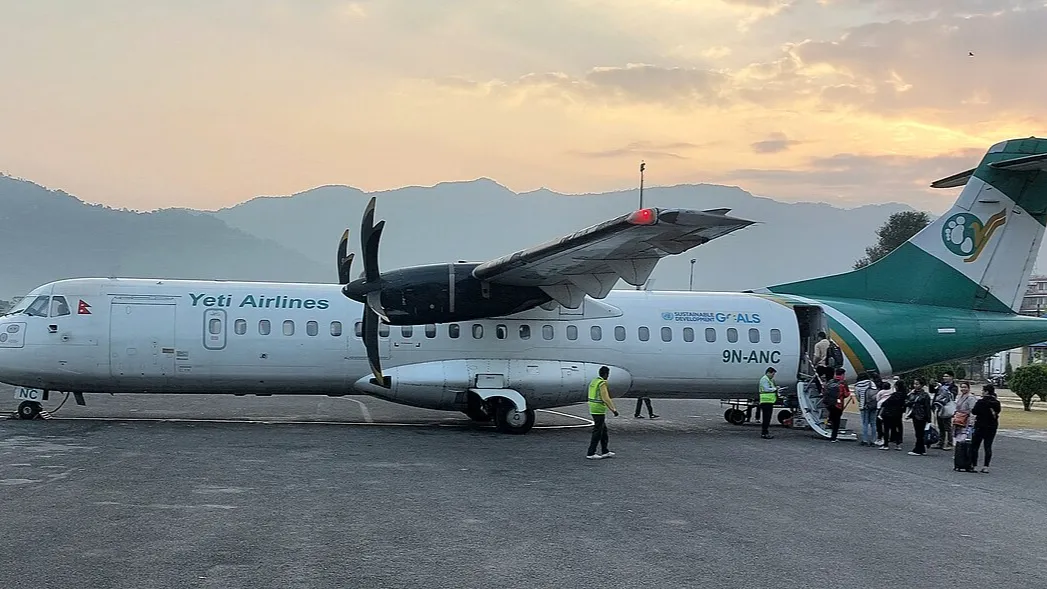
The financial case for the IPO is inseparable from the airline’s recovery following the January 15, 2023 crash of Flight YT691. The ATR 72-500 (registration 9N-ANC), operating from Tribhuvan International Airport (KTM) to Pokhara International Airport (PKH), stalled and crashed near the Seti Gandaki River on final approach, killing all 72 people on board.
According to Tourism Mail, Yeti Airlines achieved a turnover of NPR 4.25 billion in FY 2023/24, up from NPR 3.77 billion in 2023 — a year when the Pokhara crash had suppressed both passenger numbers and market confidence. Yeti’s net profit stood at 2 percent in FY 2023/24 and improved to 5.47 percent by 2025, with passenger numbers rising 14 percent and overall business growing 27 percent between 2023 and 2025.
New Business Age further reported that NPR 4.11 billion in operational revenue was recorded in just the first nine months of FY 2024/25, underpinned by the addition of two new ATR 72 aircraft representing a capital investment of NPR 1.7 billion.
Asian Life Insurance Becomes Key Investor in IPO
The IPO narrative traces directly to Asian Life Insurance’s acquisition of Yeti Airlines shares in late 2023. According to aviation intelligence platform ch-aviation, Asian Life Insurance paid NPR 1.75 billion (approximately USD 13.2 million) for a stake in the airline — a transaction executed at a 70 percent premium to the NPR 100 face value. New Business Age confirmed the final confirmed stake at 46.82 percent (12.5 million shares), with Chairman Lhakpa Sonam Sherpa holding 25.03 percent and Chanda Sherpa 20.06 percent.
The strategic investment was part of a broader plan to convert Yeti into a public limited company, expand the fleet, and then launch an IPO. Yeti Airlines CEO Subhas Sapkota, installed by Asian Life Insurance following the acquisition, told The HRM Nepal: “We are now moving forward toward an Initial Public Offering. Our objective is to strengthen the balance sheet.”
He also disclosed that the airline had completed a private placement round with institutional and select retail investors before proceeding to a general public market offering.

Photo: Karan Bhatta | aviospace.org
Yeti Airlines Competes for Market Share Ahead of IPO
Yeti Airlines occupies a well-defined second-tier position within Nepal’s domestic aviation market. Fiscal Nepal reported that Buddha Air, Yeti Airlines, and Shree Airlines together command over 93 percent of Nepal’s domestic aviation. Buddha Air dominates with a 60 percent market share and NPR 13.22 billion in 2024 operating revenue, dwarfing Yeti’s NPR 4.25 billion. The 3:1 revenue gap reflects Buddha Air’s larger fleet of 16 aircraft across 14 destinations.
Critically, neither Buddha Air nor Shree Airlines has publicly disclosed plans for a NEPSE listing, leaving Yeti Airlines as the sole aviation-sector IPO candidate currently in play. This first-mover advantage on the exchange may attract investors seeking sectoral diversification beyond the bank-heavy NEPSE index.
However, one has to note a material concentration risk: 47 percent of Yeti’s revenue derives from just three route pairings:
- Kathmandu to Pokhara (KTM–PKH)
- Pokhara to Kathmandu, and Biratnagar
And this is despite the fact that the airline operates across 20 routes in total.