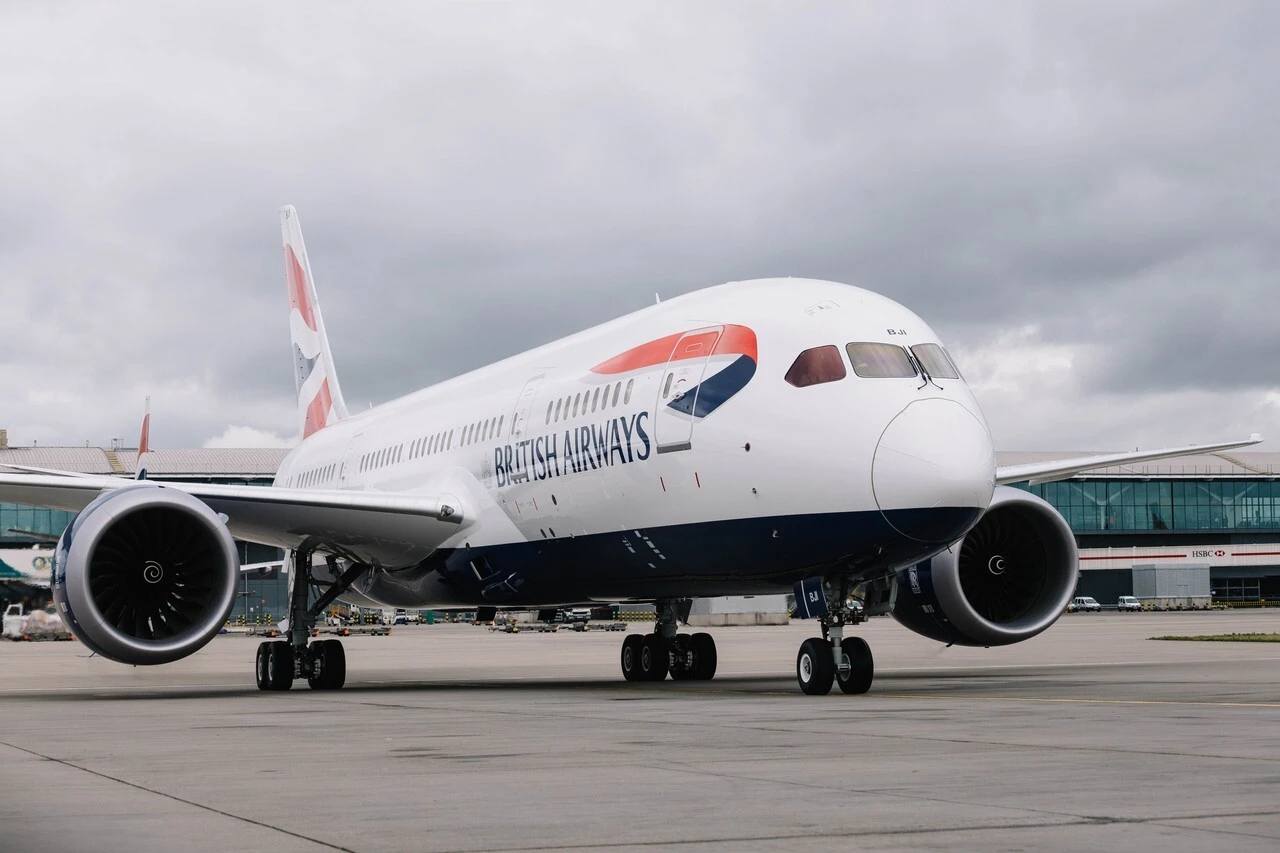
British Airways (BA) announced on Thursday, 8 May 2026, a set of new passenger restrictions governing the carriage and use of portable power banks aboard all its flights, effective immediately. According to Paddle Your Own Kanoo, the airline has prohibited passengers from:
- storing power banks in overhead lockers at any point during a flight
- the use of in-seat power supplies to charge such devices and capped the permissible number of power banks per passenger at two units, each not exceeding 100 watt-hours (Wh) in rated capacity.
The rules, which came into force without advance notice to travelers, mirror guidelines published by the International Civil Aviation Organization (ICAO) and constitute the most significant revision to lithium battery carriage policy in the airline’s recent history.
The new restrictions place British Airways alongside a growing coalition of international carriers that have aligned their onboard safety policies with ICAO’s updated Technical Instructions- The Directorate General of Civil Aviation (DGCA) in India enforced a change in their power bank policy and so did Hanjin Group in South Korea.
The Air Busan Fire that Reshaped International Aviation Policy
On the evening of 28 January 2025, Air Busan Flight BX391 — an Airbus A321-200 registered HL7763 — was preparing to depart Gimhae International Airport for Hong Kong International Airport (IATA: HKG) when a fire erupted near the aircraft’s tail. All 169 passengers and seven crew members evacuated via emergency slides; 27 people sustained injuries and the aircraft itself was destroyed — rendered a total loss by the fire.
South Korean investigators, in an update published by the Transportation Ministry on 14 March 2025, indicated that a power bank stored in a passenger’s overhead bin was the most probable cause of the blaze. Passenger testimony, as reported by The Korea Herald, described a “crackling sound” emanating from an overhead luggage compartment moments before smoke appeared — consistent with the early stages of lithium-ion thermal runaway.
The incident occurred against a backdrop of 89 verified lithium battery incidents aboard aircraft in 2024 alone — a 16 percent year-on-year increase. By mid-2025, Reuters reported that the Federal Aviation Administration had recorded 50 further incidents on U.S. flights involving lithium-ion battery smoke, fire, or extreme heat, some causing passenger injuries and others prompting emergency diversions.
In October 2025, an Air China flight was forced to divert after a passenger’s battery ignited in flames inside an overhead locker — this time with the aircraft airborne — graphically demonstrating the inadequacy of then-prevailing carriage rules. The FAA, issuing Safety Alert for Operators SAFO 25002, warned carriers that “thermal runaway can occur without warning” and that “effective mitigation requires preparation, training, and clear communication with passengers.”
The chemistry underlying these incidents is well understood by aviation safety researchers. FAA Fire Safety Branch Manager Robert Ochs, in a demonstration conducted for CNN at the FAA’s William J. Hughes Technical Center for Advanced Aerospace, explained that lithium batteries
“can go into what’s called thermal runaway — all of a sudden, it’ll start to short circuit… It will get warmer and warmer and warmer until the structure of the battery itself fails. At that point, it can eject molten electrolyte and flames and smoke and toxic gas.”
ICAO’s March 2026 Was the First Coordinated International Standard for Limiting Power bank Use on Flights
The regulatory response to these escalating incidents culminated in a landmark decision by ICAO. New power bank specifications, approved by all 36 ICAO Council member states, came into global effect on 27 March 2026 — representing the first coordinated international standard on portable battery limits in aviation history.
The ICAO framework establishes that passengers on international flights are limited to:
- two power banks in the cabin
- in-flight charging of power banks is categorically prohibited
- power banks must remain accessible and unobstructed at all times
The urgency underpinning the framework is quantified by a stark statistic from IATA. Speaking at the WSOC safety conference in October 2025, IATA stated that passengers carry on average up to four lithium battery devices per person, amounting to over 1,800 lithium battery devices aboard a single fully loaded Airbus A380 with 469 seats, AirLine ratings flagged. Safety and Service Manager Josh Wood of the same publication articulated the regulatory logic plainly, stating:
“These rules exist because the alternative is a fire at 35,000 feet with no easy way to stop it. Lithium battery fires are one of the fastest-escalating safety risks in commercial aviation, and a coordinated global standard is long overdue.”
A separate IATA survey found that 44 percent of passengers currently travel with a power bank.
The technical rationale for prohibiting overhead locker storage is straightforward: an overheating power bank concealed within a closed overhead compartment is invisible to cabin crew until smoke or flames emerge through the locker’s ventilation gaps — by which point suppression becomes markedly more difficult.
A device stored on a passenger’s person, in a seat pocket, or under the seat ahead remains within line of sight throughout the flight, enabling crew to detect and address the earliest warning signs of thermal runaway.
As the IATA guidance document for operators notes, power banks differ from other lithium-powered consumer devices precisely because they contain none of the following:
- active thermal management circuitry
- temperature sensors
- software capable of monitoring for abnormal power draw
British Airways’ New Specific Rules About Powerbanks
British Airways’ new policy, as published on 8 May 2026, closely replicates the ICAO baseline. Passengers travelling with the airline must observe the following conditions, effective immediately:
- A maximum of two power banks per passenger is permitted, with each unit’s rated capacity not exceeding 100 Wh.
- Power banks are prohibited from overhead lockers at any point during the journey, including while boarding and disembarking.
- The in-seat power supply must not be used to charge power banks under any circumstances.
- Power banks must remain easily accessible throughout the flight — meaning they should be kept in the passenger’s personal item, seat pocket, or on their person.
- Power banks cannot be used to charge other devices during takeoff or landing.
- Any passenger carrying power banks whose watt-hour rating is not visibly marked on the device risks having those devices refused at the gate.
Power banks and all lithium battery-powered devices remain banned from checked luggage.
Critically, passengers who exceed the permissible number of power banks will not be permitted to transfer the excess units to their checked baggage as an alternative; they must dispose of the devices before boarding. For power banks rated between 100 Wh and 160 Wh, carriage remains possible but requires explicit prior approval from British Airways. Units exceeding 160 Wh are prohibited from passenger aircraft under all circumstances.
The Broader Industry Response Towards the ICAO Baseline
Various airlines such as Lufthansa, American Airlines, Emirates, Qatar Airways, Singapore Airlines etc. have already aligned with the new ICAO regulations. Several carriers, however, have imposed stricter restrictions than ICAO requires.
Emirates (EK) and Southwest Airlines each limit passengers to a single power bank — half the ICAO maximum — while the Lufthansa Group implemented its two-power-bank limit and in-flight charging ban as early as January 2026, ahead of the ICAO effective date, with identical rules cascading across subsidiary carriers including SWISS, Austrian Airlines, and Brussels Airlines.
The pace of adoption varied significantly by region. Australia’s three major carriers — Qantas, Jetstar, and Virgin Australia — introduced uniform restrictions from mid-December 2025, prohibiting in-flight use, capping devices at two, and banning overhead bin storage before the ICAO mandate, as did Fiji Airways simultaneously.
Singapore Airlines adopted the two-power-bank limit from 15 April 2026, following a directive from the Civil Aviation Authority of Singapore, with in-flight charging and use banned on all Singapore Airlines and Scoot services. United Airlines, responding specifically to the Air China overhead bin fire of October 2025, moved power banks out of overhead bins from 1 March 2026, requiring passengers to store them on their person, in a seat pocket, or in an under-seat personal item.
A Brief Guide to Brish Airways Rules on Batteries, electric and electronic devices
At the time of writing, British Airways instructs that passengers may carry up to 15 personal electronic devices containing lithium batteries, including laptops, smartphones, tablets, cameras, music players, and smart baggage tags such as Apple AirTags. Devices must be protected against accidental activation, and damaged batteries or electronics are prohibited.
In the cabin, devices may be used during the flight when permitted by crew instructions. In checked baggage, however, devices must be fully powered off rather than left in sleep or hibernation mode. Smart luggage tags may remain active only if their lithium content does not exceed 0.3g for lithium metal batteries or 2.7Wh for lithium-ion batteries.
Airlines also require all batteries to display a watt-hour (Wh) rating — or have one that can be calculated — otherwise they cannot be accepted onboard. Spare lithium batteries are not allowed in checked baggage and must always be carried in hand luggage. The rules for the batteries change according to their Wh rating: