Lufthansa Group has announced an immediate capacity reduction across its German operations, including the withdrawal of Lufthansa CityLine aircraft from April 18, 2026, and the planned grounding of six widebody jets later this year.
The decision, disclosed by Lufthansa, responds to escalating fuel costs (which has had severe impact of doubling airfares in the country that houses the world’s most dangerous airport – Nepal, increased fuel surcharges in India, the axing of routes by Korean budget carrier among other things), geopolitical instability, and ongoing labour disruptions, (that led Lufthansa flight attendants and pilots organize strikes affecting hundreds of flights) with the airline warning that the measures are necessary to prevent further financial deterioration.
Effective tomorrow, Lufthansa will eliminate all operational capacity from its regional arm Lufthansa CityLine (CL) as it also withdraws six widebody aircraft from service by October, Flight Global reported. Lufthansa’s expedited restructuring programme also includes phasing out the remaining Airbus A340-600 fleet and sidelining two Boeing 747-400 aircraft.

Lufthansa Axes CityLine: CRJ Phase-Out
Lufthansa will permanently remove all 27 operational aircraft from its CityLine subsidiary’s flight programme as of April 18. The move effectively accelerates the wind-down of the regional unit’s flying operations.
The airline stated that the Canadair CRJ fleet has reached the limits of its economic viability. “The Canadair CRJ aircraft are nearing the end of their technical operational capability and have comparatively high operating costs,” the group said in its official communication. Here’s a look at CityLine’s CRJ series aircraft:
| Reg | Delivered | Aircraft Name | Age |
|---|---|---|---|
| D-ACNA | Jan 2015 | Amberg | 17.1 Years |
| D-ACNB | Feb 2015 | Wermelskirchen | 17 Years |
| D-ACNC | Mar 2015 | Weil am Rhein | 16.9 Years |
| D-ACND | Mar 2015 | Meersburg | 16.9 Years |
| D-ACNE | Apr 2015 | Helmstedt | 16.8 Years |
| D-ACNF | May 2015 | Montabaur | 16.7 Years |
| D-ACNG | Feb 2016 | Rothenburg ob der Tauber | 16.6 Years |
| D-ACNH | Mar 2016 | Herzogenaurach | 16.5 Years |
| D-ACNI | Apr 2016 | Xanten | 16.5 Years |
| D-ACNJ | May 2016 | Seeheim-Jugenheim | 16.4 Years |
| D-ACNK | May 2016 | Merseburg | 16.4 Years |
| D-ACNL | Jun 2016 | Landsberg am Lech | 16.2 Years |
| D-ACNM | Mar 2017 | — | 16.1 Years |
| D-ACNN | Oct 2016 | Nordenham | 16.1 Years |
| D-ACNO | Jun 2015 | Bad Mergentheim | 16 Years |
| D-ACNP | Oct 2017 | Hattersheim | 15.4 Years |
| D-ACNQ | Oct 2017 | Hallbergmoos | 15.3 Years |
| D-ACNR | Oct 2016 | Ratingen | 15.3 Years |
| D-ACNT | Nov 2016 | Torgau | 15.1 Years |
| D-ACNU | Dec 2016 | Uetersen | 14.9 Years |
| D-ACNV | Jan 2017 | Vilshofen | 14.9 Years |
| D-ACNW | Jan 2017 | Westerland / Sylt | 14.9 Years |
| D-ACNX | Mar 2017 | — | 14.8 Years |
Data: planespotters.net
These aircraft average 16 years and are configured with 90 all-economy seats, offering a seat pitch of 31 inches, a width of 17.5 inches, and a recline of 2 inches. Lufthansa had previously signaled a long-term plan to phase out CityLine operations, but the current macroeconomic environment has forced an earlier execution of that strategy.
Lufthansa’s Chief Financial Officer Till Streichert was quoted in Flight Global to have said that the carrier’s goal was to “focus our short- and medium-haul platforms more clearly and make them more competitive“
In this regard, we had already identified the prospective removal of CityLine from our programme as part of our strategic development for some time, independently of the current geopolitical crisis. The current crisis is now forcing us to implement this measure earlier.
Lufthansa’s Airbus A340-600 and Boeing 747-400 Retirement Plan
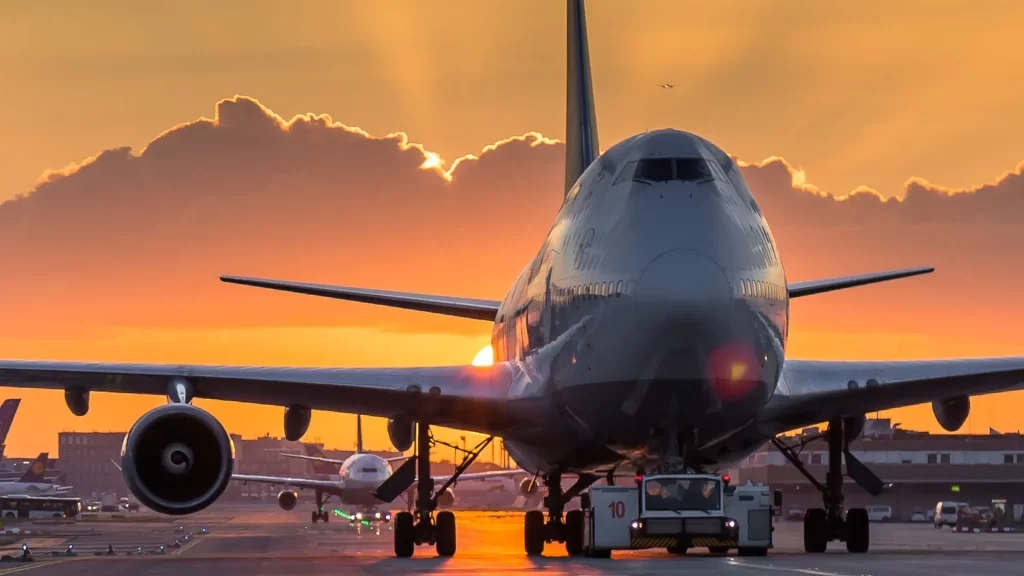
The group will ground six long-haul aircraft at the end of the summer 2026 schedule, including its remaining four Airbus A340-600 jets and two Boeing 747-400 aircraft.
The A340-600 fleet will exit service entirely in October, marking the end of a type that has been central to Lufthansa’s long-haul network for over two decades. Lufthansa’s aircraft of this type of average 17.2 years:
| Reg | Delivered | Age |
|---|---|---|
| D-AIHW | Dec 2008 | 17.4 Years |
| D-AIHX | Feb 2009 | 17.2 Years |
| D-AIHY | Mar 2009 | 17.1 Years |
| D-AIHZ | May 2009 | 17 Years |
Lufthansa configures its Airbus A340-600 in two different ways: one that has a total of 281 seats across four classes. The First Class cabin accommodates 8 passengers, each with a seat pitch of 81 inches, a width of 30.5 inches, and full-flat recline capability at 180 degrees. The Business Class section comprises 56 seats, offering a pitch of 64 inches, a width of 19.7 inches, and a fully flat 180-degree recline. Premium Economy features 28 seats with a pitch of 37 inches, a width of 18 inches, and a recline of 5 inches. The Economy Class cabin includes 189 seats, configured with a pitch of 31 inches, a width of 17 inches, and a recline of 3 inches.
Here is the other way the carrier configures this aircraft type:
- First Class: 8 seats with 81-inch pitch, 30.5-inch width, and 180° recline.
- Business Class: 44 seats with 64-inch pitch, 19.7-inch width, and 180° recline.
- Premium Economy: 32 seats with 37-inch pitch, 18-inch width, and 5-inch recline.
- Economy Class: 213 seats with 31–32-inch pitch, 17-inch width, and 3-inch recline.
The airline confirmed that the final retirement of the 747-400 is scheduled for 2027. Lufthansa’s 747s are some of the oldest aircraft type in its fleet: the eight 747-400s average 26 years while the 747-8s average 12.4 years. Lufthansa emphasized that these retirements align with its broader objective of reducing fleet complexity and eliminating inefficient sub-fleets.
Fuel Costs and Labor Disruption Drive Lufthansa Restructuring
The restructuring follows a sharp rise in kerosene prices, which Lufthansa says have more than doubled since the onset of the Iran conflict. The carrier also faces mounting operational disruption from labour disputes across its German divisions.
Chief Financial Officer Till Streichert stated:
The package for accelerated implementation of fleet and capacity measures is unavoidable in light of the sharply increased kerosene costs and geopolitical instability.
He added that the airline aims to streamline its short- and medium-haul platforms to improve competitiveness. The group’s passenger airlines remain approximately 80% hedged against crude oil price volatility, but unhedged exposure continues to exert pressure.
The rising fuel costs have already forced Untied AIrlines (UA) to increase their checked baggage fees by $10.
Lufthansa Network Consolidation and A350 Allocation Strategy
As part of the restructuring, Lufthansa will also remove capacity equivalent to five aircraft from its core brand operations. This reduction stems from a consolidation of short- and medium-haul traffic across its six primary hubs.
Simultaneously, the group has accelerated the deployment of nine additional Airbus A350 aircraft to its leisure-focused subsidiary, Discover Airlines. Note that the Airbus A350 is used to operate the longest non-stop as well as one-stop flights in the world.
The reallocation reflects a strategic pivot toward more efficient aircraft and higher-margin operations, particularly in long-haul leisure markets. Here’s a look at the carrier’s current fleet:
| Aircraft Type | In Service | Parked | Total (Active) | Future | Historic | Avg. Age | Grand Total |
|---|---|---|---|---|---|---|---|
| Airbus A319 | 34 | — | 34 | — | 7 | 23.5 Years | 41 |
| Airbus A320 | 67 | 6 | 73 | — | 62 | 11.2 Years | 135 |
| Airbus A321 | 64 | 7 | 71 | 1 | 12 | 16.6 Years | 84 |
| Airbus A330 | 5 | — | 5 | — | 19 | 15.3 Years | 24 |
| Airbus A340 | 15 | 1 | 16 | — | 46 | 24.0 Years | 62 |
| Airbus A350 XWB | 31 | — | 31 | 2 | — | 5.9 Years | 33 |
| Airbus A380 | 6 | 2 | 8 | — | 6 | 14.0 Years | 14 |
| Boeing 747 | 23 | 3 | 26 | — | 54 | 16.6 Years | 80 |
| Boeing 787 Dreamliner | 16 | — | 16 | 12 | 1 | 2.8 Years | 29 |
| Bombardier CRJ-900 | 14 | 9 | 23 | — | 12 | 16.0 Years | 35 |

All in All
The capacity cuts carry significant implications for Lufthansa’s workforce, particularly within CityLine. The group stated that it has offered affected employees opportunities for redeployment within other divisions.
“This is a painful step, particularly with regard to the colleagues at Lufthansa CityLine,” Streichert acknowledged, underscoring the human impact of the restructuring.
The airline’s broader turnaround programme, launched in 2024 to restore profitability in its German operations, now enters a more aggressive phase as external pressures intensify.