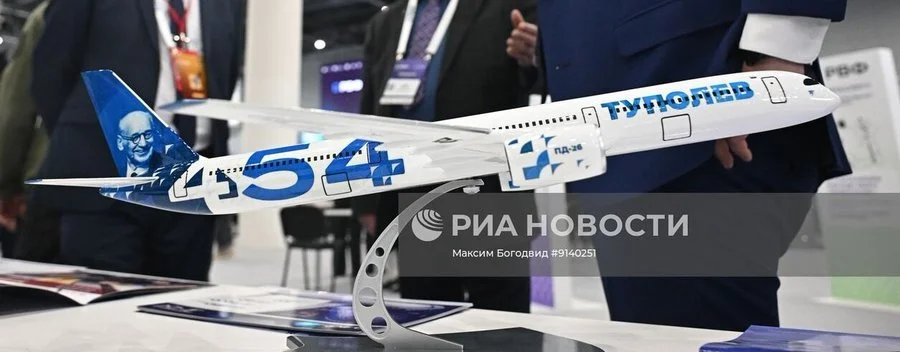
At a time when China has produced the Comac C919 as a rival to Airbus and Boeing, Russia’s United Aircraft Corporation (UAC) has unveiled a conceptual long-haul airliner, the Tupolev Tu-454, at the 20th Russian Venture Forum in Kazan. The aircraft, presented by UAC’s Tupolev division, signals an early-stage effort to re-enter the widebody commercial aircraft segment and compete with aircraft such as the Boeing 787 Dreamliner or the Airbus A350, which operates the longest non-stop flights in the world. The programme remains largely undisclosed in terms of specifications, timeline, and certification pathway.

Tupolev Tu-454 Unveiled at Russian Venture Forum in Kazan
The Tu-454 concept was formally introduced at the Russian Venture Forum, where senior government figures, including Minister of Science and Higher Education Valery Falkov and presidential aide Andrei Fursenko, visited the Tupolev exhibition stand, Aerospace Global News reported. The project was presented by Kirill Aseev, deputy chief designer at Tupolev, to regional leadership including Rustam Minnikhanov.
The presence of high-ranking officials indicates that the programme carries political as well as industrial significance. Russia has increasingly prioritized domestic aviation manufacturing as sanctions continue to restrict access to Western-built aircraft and components.
Publicly available information suggests that the Tu-454 has not previously appeared in official UAC programme documentation, reinforcing the notion that it remains at a conceptual or early development stage.
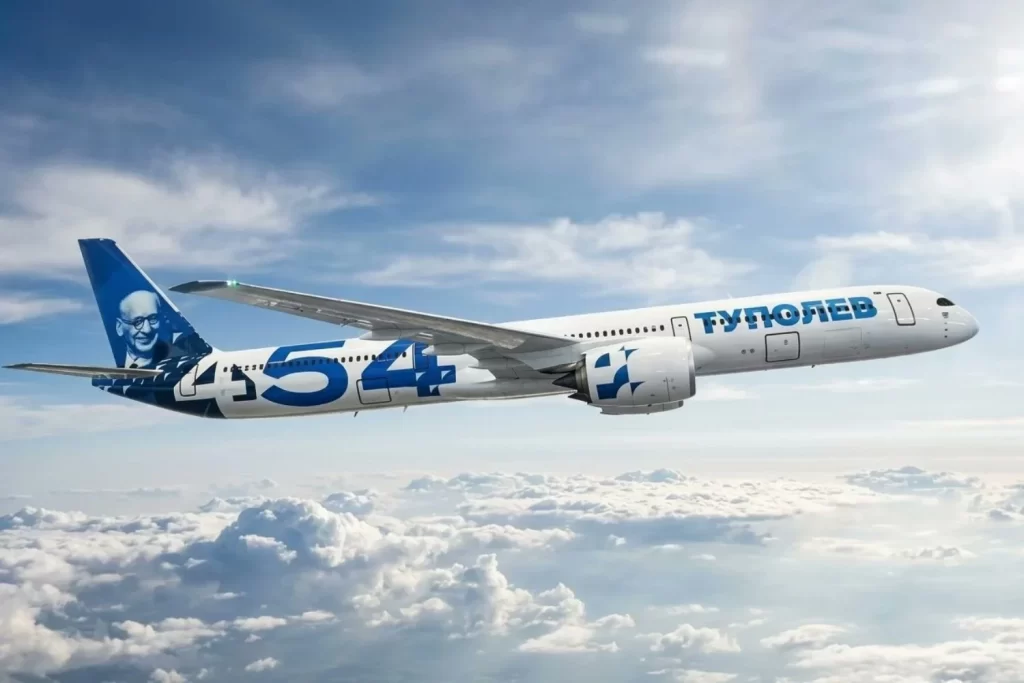
Tupolev Tu-454 Positioned as Competitor to Boeing 787 and Airbus A350
Industry observers have interpreted the Tu-454 as a potential competitor to long-haul widebody aircraft such as the Boeing 787 Dreamliner and Airbus A350. Some reports suggest its size and role may also align with aircraft like the Boeing 767-400.
| Parameter | Boeing 787 Dreamliner | Airbus A350 XWB |
|---|---|---|
| First flight | 2009 | 2013 |
| Composite materials | 50% | 52% |
| Fuel efficiency improvement | 20–25% reduction vs predecessors | Not specified (designed for high efficiency) |
| Passenger capacity | 250–350 passengers | 250–350 passengers |
| Maximum range | Up to 15,000 km | Up to 15,000 km |
This positioning of Tu 454 as a competitor to the two aircraf above reflects a broader ambition within Russia’s aerospace sector to re-establish a presence in long-haul commercial aviation. However, no official performance metrics, seating capacity, or range figures have been released, limiting any definitive comparison with established Western platforms.
The absence of technical disclosures suggests that the Tu-454 is still undergoing conceptual evaluation rather than active production planning.
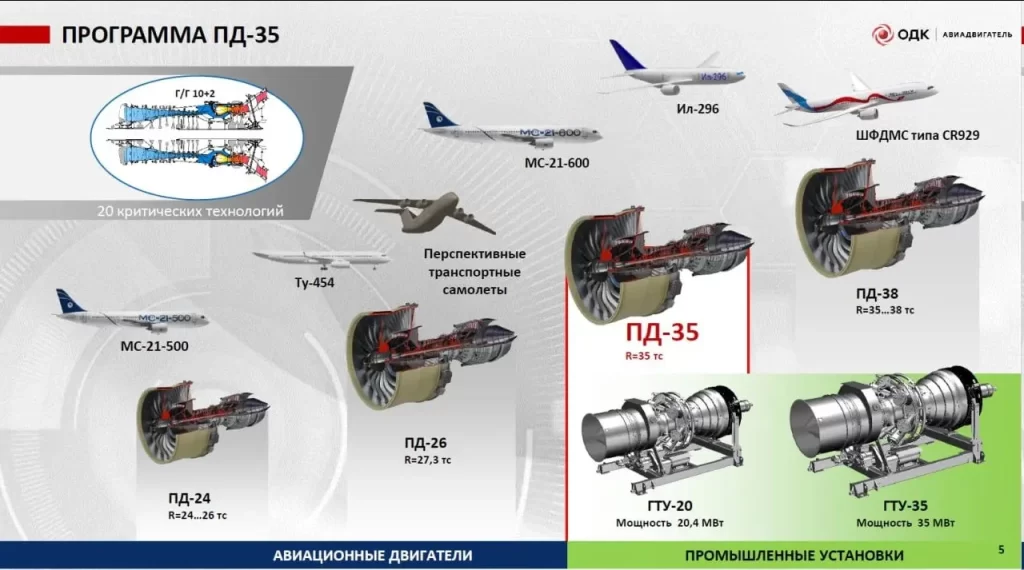
PD-26 Engine Development to Power Tupolev Tu-454
According to presentation materials attributed to United Engine Corporation, the Tu-454 is expected to be powered by the PD-26 engine. This next-generation high-thrust turbofan is currently under development and is projected to enter production by 2030.
The PD-26 builds on the technological foundation of the PD-35 engine programme, incorporating a modular core architecture, ceramic composite materials, and an active blade cooling system. These features are intended to improve efficiency and durability under high-load operating conditions.
Testing of the PD-26 demonstrator has reportedly commenced, although detailed performance parameters remain undisclosed. The engine is also expected to power future heavy military transport aircraft, indicating cross-sector applicability.
Tupolev Continues Focus on Tu-214 Production Amid New Programme Development
Despite unveiling the Tu-454 concept, Tupolev’s immediate production focus remains on the Tupolev Tu-214. The programme has experienced delays, with initial delivery targets slipping beyond 2024 as testing and certification efforts continue.
In late 2025, Russia granted a type certificate for a domestically produced Tu-214, marking a milestone in import substitution efforts. The programme gained further momentum when the S7 Group signed a memorandum of cooperation for 100 aircraft.
Alexey Shadanov, project manager at Tupolev, stated via UAC’s official communication channels that the company remains focused on scaling Tu-214 production while continuing parallel work on new designs and technologies.
In a Telegram Post, According to Alexey Shadanov, project manager at JSC Tupolev said the following regarding the event in Kazan:
We are focused on our primary objective—scaling up serial production of the Tu-214. At the same time, our design team’s work to improve this aircraft and develop new designs and technologies never ceases. We collaborate with leading industry institutes and research centres, taking into account all global trends. This forms an important foundation of the Tupolev school.
Previous Russian Widebody and Long-Haul Aircraft Development Efforts
Russia has historically attempted to maintain an indigenous widebody aircraft capability, although success has been limited in the post-Soviet era. The most notable example is the Ilyushin Il-96, which entered service in the 1990s but failed to achieve widespread international adoption.
More recently, Russia pursued the CRAIC CR929 programme in partnership with China, aimed at developing a new-generation widebody jet. However, the collaboration has faced repeated delays and uncertainty, particularly following geopolitical tensions and shifting industrial priorities.
These precedents illustrate the structural challenges associated with developing competitive widebody aircraft outside established global supply chains.
Previous Russian Widebody Development Programmes
Russia has produced some of the most iconic aircraft in the world – perhaps the An-225 (that was destroyed in the Ukraine-Russia war) being the most iconic one. Russia also created the first supersonic airliner in the world- the Tu-144. The following table gives us a cue about the previous widebody development programs from Russia:
| Aircraft / Programme | Manufacturer | First Flight / Launch | Status | Notes |
|---|---|---|---|---|
| Ilyushin Il-96 | Ilyushin | 1988 | Limited production | Operated mainly by Russian state entities |
| Tupolev Tu-204 / Tu-214 | Tupolev | 1989 | Limited commercial success | Narrowbody / mid-range focus |
| CRAIC CR929 | CRAIC (Russia-China JV) | N/A | Delayed / uncertain | Intended widebody competitor to A350/787 |
| Irkut MC-21 | Irkut (UAC) | 2017 | In development | Narrowbody, not widebody but key domestic programme |
According to Air Data News, :
Russia’s domestic aviation sector has struggled to meet production targets even for smaller aircraft. Programs such as the Tu-214 have delivered only limited numbers while new aircraft such as the MC-21, SJ-100, and Il-114-300 are still awaiting certification.
All in All
The unveiling of the Tu-454 reflects Russia’s continued ambition to rebuild a vertically integrated aerospace industry. Sanctions imposed on the country have disrupted access to Western aircraft, spare parts, and maintenance services, forcing a pivot toward domestic manufacturing.
However, developing a competitive widebody aircraft presents substantial technical, financial, and certification challenges. Western manufacturers benefit from decades of global supply chain integration, regulatory alignment, and customer trust—advantages that are difficult to replicate in isolation.
The Tu-454’s success will ultimately depend on the maturity of its supporting ecosystem, including engines, avionics, and production infrastructure.