
Korean travelers are facing widespread disruption as airlines scale back operations amid escalating Middle East tensions, rising fuel costs, and constrained jet fuel supply chains. The crisis, unfolding through March–April 2026, has triggered flight cancellations, route suspensions, and airspace closures across key global transit hubs, directly impacting passengers departing from or connecting via South Korea.
Airlines—particularly South Korea’s low-cost carriers—have begun cutting routes and reducing frequencies to mitigate soaring operational costs linked to jet fuel price spikes and supply disruptions. The situation has increased the likelihood of last-minute itinerary changes, leaving travelers stranded or facing prolonged delays across multiple regions.
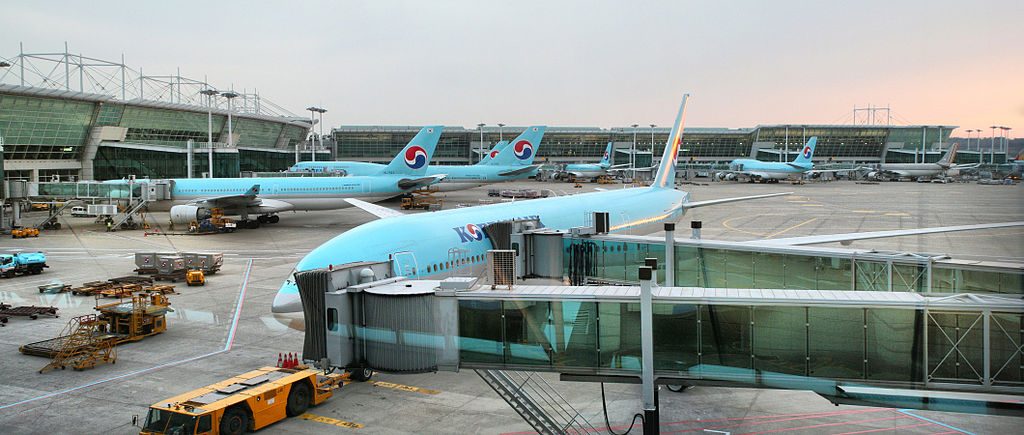
Photo: John Martinez Pavliga|Wikimedia Commons
Incheon International Airport (ICN) is the disruption hub for Korean travelers
Incheon International Airport (ICN), South Korea’s principal aviation hub, has emerged as a focal point of disruption as airlines restructure schedules in response to volatile fuel markets.
| Attribute | Details |
|---|---|
| Full Name | Incheon International Airport |
| IATA Code | ICN |
| Location | Incheon, South Korea |
| Role | Primary international gateway for South Korea |
| Impact | Flight cancellations, reduced long-haul and regional connectivity |
| Key Airlines Affected | Korean Air, Air Premia, Eastar Jet, Jeju Air, T’way Air |
Some airlines from South Korea have reduced long-haul frequencies to North America, while Southeast Asian routes face operational constraints due to refueling limitations. Compounding this is the fact that passenger uncertainty has increased amid dynamic schedule revisions.
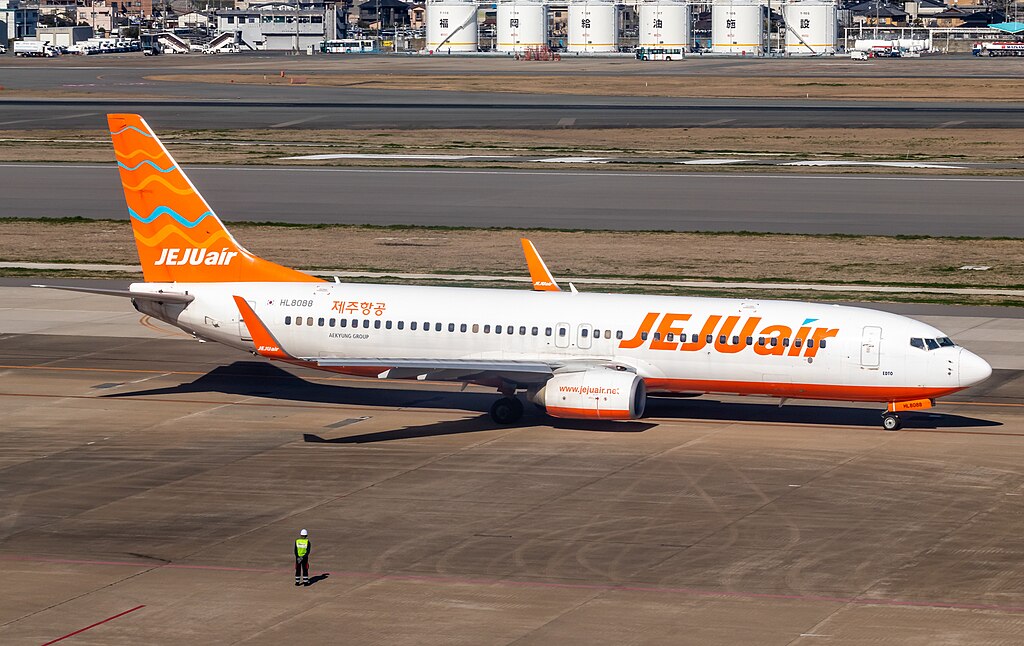
Photo: Anton Homma |Wikimedia Commons
The airport’s reliance on global transit connectivity has amplified the cascading effects of disruptions originating in the Middle East that has already led to United Airlines increasing the check in bag fees by $10, while IndiGo (6E), India’s biggest carrier, has increased surcharges.
Airline capacity cuts and fuel crisis reshape Korean aviation sector
South Korean carriers are actively reducing capacity as jet fuel prices surge to unsustainable levels. Industry data indicates that fuel costs—already accounting for a significant share of airline expenses—have risen sharply due to supply chain disruptions linked to geopolitical instability.
Key operational responses include:
- Air Premia suspending multiple transpacific flights, including services to Los Angeles, San Francisco, and New York. Korea JoongAng Daily reported that slashing took place of “10 flights on its Incheon-San Francisco and Incheon-New York routes in May, following an earlier decision to cancel 26 flights on the Incheon-Los Angeles route and six on the Incheon-Honolulu route between April 20 and May 31″
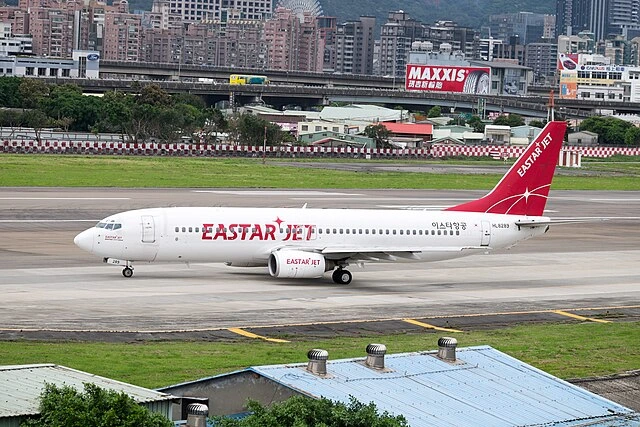
- Eastar Jet canceling 50 flights on the Incheon–Phu Quoc route due to refueling challenges.
- Jeju Air, Jin Air, and T’way Air evaluating further reductions across Southeast Asia.
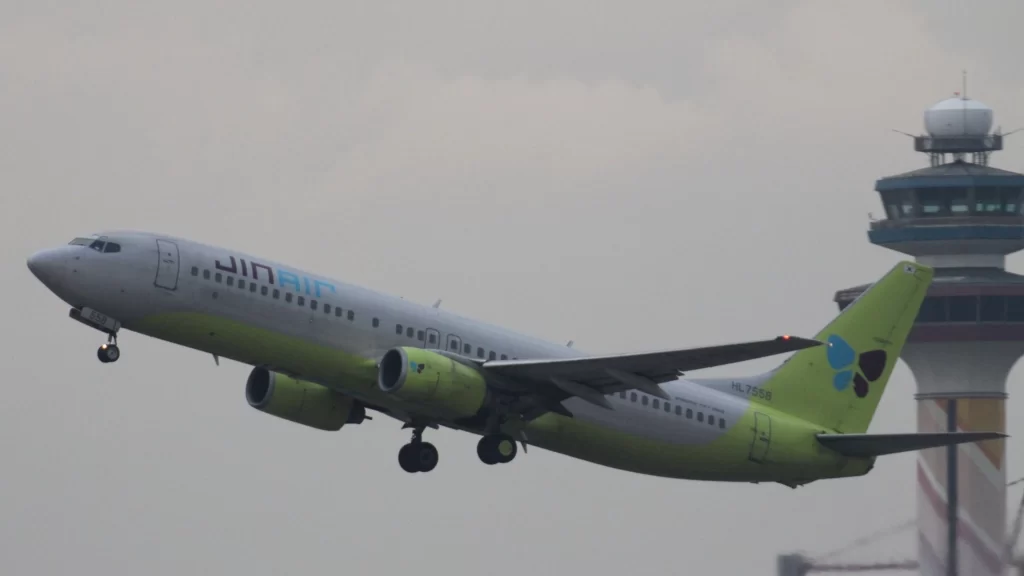
Photo: Aeroprints.com | Wikimedia Commons
https://commons.wikimedia.org/wiki/File:HL7558_Boeing_737_Jin_Air_(7595864140).jpg
Full-service carriers might also follow the same trajectory, as data from International Air Transport Association (IATA) suggests that “fuel prices in Asia and Oceania rose 16.6 percent to $204.95 per barrel in the week of March 13 to 20 compared to the previous week and were sharply higher than the prior month’s average“.
Middle east conflict disrupts global jet fuel supply chains
The root cause of the disruption lies in the Middle East, where escalating conflict has affected critical energy transit routes and refinery output. According to Reuters, disruptions linked to the Strait of Hormuz—a chokepoint accounting for roughly 21% of global seaborne jet fuel trade—have tightened supply across Asia-Pacific markets.
- Asian refineries, including those in South Korea, have curtailed exports.
- Airlines are increasingly forced to carry additional fuel or reroute flights.
- Operational costs have surged due to both fuel scarcity and longer flight paths.
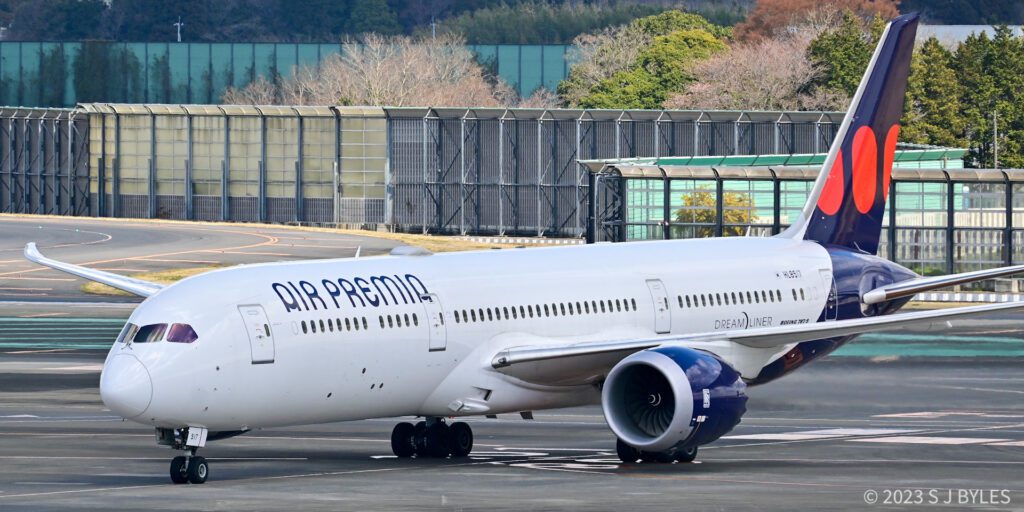
Air Premia calls itself “the First and Only HSC (Hybrid Service Carrier) Airline in Korea”.
Photo: Steven Byles | Wikimedia Commons
These constraints have compelled airlines globally—not just in Korea—to trim schedules, raise fares, and reconsider route viability. According to Reuters, here’s how carriers in Asia have been affected:
| Issue | Details | Airlines / Countries Affected | Measures Taken |
|---|---|---|---|
| Jet fuel shortage | Middle East conflict reduces supply via Strait of Hormuz; Asia highly dependent on imports | Vietnam, Myanmar, Pakistan, Malaysia, South Korea, China, Thailand | Airlines load extra fuel at home airports (“tankering”), add refueling stops, cut cargo or reduce flight frequency |
| Domestic flight cuts | Shortage-driven reduction in service | Vietnam Airlines: 23 domestic flights/week cut; Myanmar airlines suspended flights for part of March and reduced April capacity | Flight reductions to conserve fuel and maintain safety margins |
| Export restrictions | China & Thailand halted jet fuel exports; South Korea capped exports at last year’s levels | Asian airlines reliant on imports | Carried extra fuel from origin airports; managed fuel allocation proactively |
| Operational adjustments | Handling limited fuel at destination airports | AirAsia X: loading extra fuel in Malaysia for Vietnam flights; Air India: refueling in Kolkata for Yangon-Delhi return; Tahiti International Airport restricted refueling for international flights | Added refueling stops, reduced onboard cargo, prioritized essential fuel use |
| Flight cancellations | Rising jet fuel costs + supply limits push airlines to reduce capacity | Batik Air Malaysia: 36% domestic cut | Proactive flight cancellations to mitigate operational and financial risks |
| Economic impact | Jet fuel prices more than doubled since Iran war; fare increases applied | Asian airlines | Implemented fuel surcharges; flight reductions partially offset supply constraints, but only ~50,000–100,000 barrels/day of jet fuel saved |
The Number of Korean Stranded Passengers Intensity Amid Airspace Closures
Beyond cost pressures, direct operational disruptions have compounded traveler difficulties. Airspace closures across Iran, the United Arab Emirates, and Qatar have halted flights through major transit hubs, stranding thousands of passengers.
According to Reuters reporting, more than 20,000 flights were canceled within days of the escalation, affecting key airports such as Dubai, Doha, and Abu Dhabi.
“…about 60 Koreans remain in Iran and around 600 in Israel, including roughly 100 short-term visitors, with no Korean casualties reported as of Monday. Justice Minister Jung Sung-ho said Monday that the Korea Immigration Service would operate dedicated immigration counters at Incheon International Airport and deploy additional screening officers to expedite entry for returning Koreans and accompanying foreign nationals.”
Outlook for airlines and travelers amid prolonged uncertainty
Industry analysts warn that the current disruption may persist if geopolitical tensions remain unresolved. Airlines are already adjusting pricing strategies, with some carriers increasing fares and fuel surcharges to offset rising costs.
Key forward-looking trends include:
- Continued capacity rationalization on marginal routes.
- Increased fuel hedging and operational efficiency measures.
- Potential fare volatility, particularly on long-haul routes.
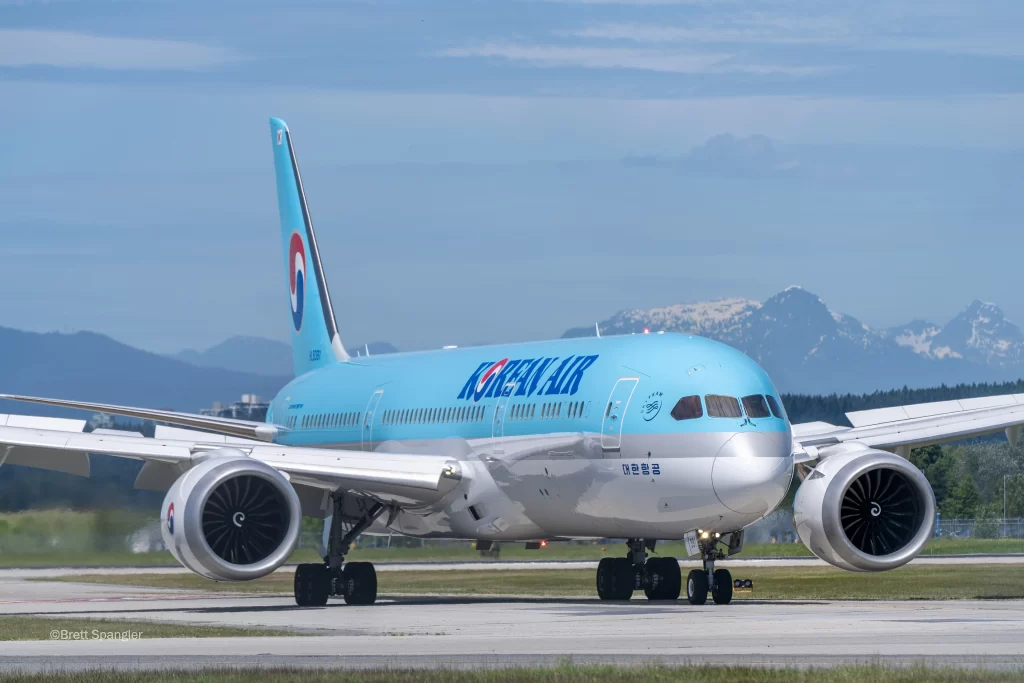
Photo: Brett Spangler | Wikimedia Commons
https://commons.wikimedia.org/wiki/File:Korean_Air_-_Vancouver_-_2024_-_DSC5182.jpg
Despite these challenges, demand for international travel remains resilient, suggesting that disruptions will manifest more in pricing and availability than in a collapse of passenger volumes.
In another report published by Korea Joong Ang Daily, it was said that “Both oil prices and exchange rates are key determinants of profitability” for carriers in Korea: