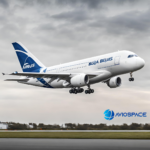
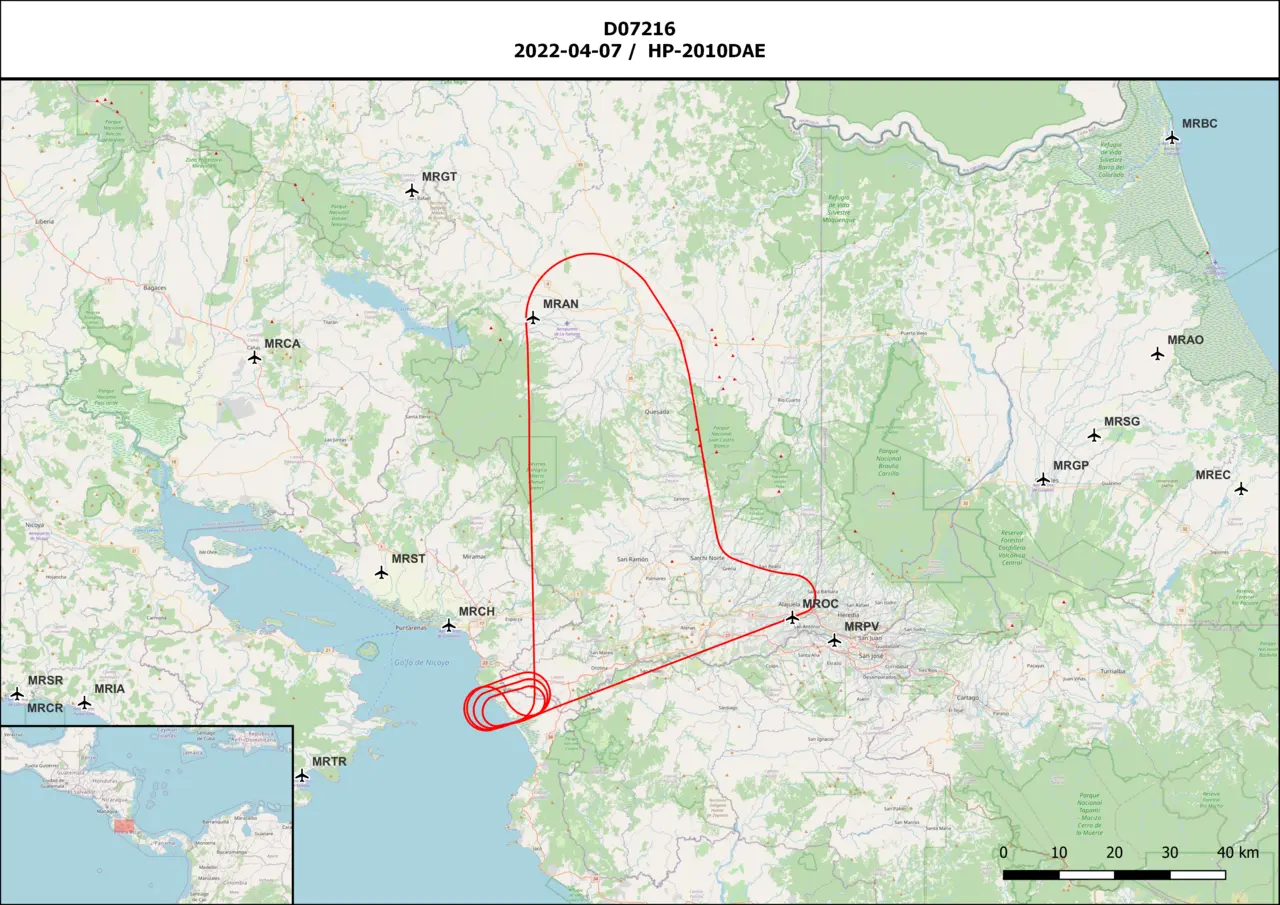
A Boeing 757-200 cargo freighter operated by DHL Aero Expreso broke into two pieces while landing at Juan Santamaría International Airport (SJO) in Alajuela, Costa Rica, on April 7, 2022. The aircraft, registered HP-2010DAE and flying as DHL de Guatemala Flight 7216, had departed SJO at 9:34 a.m. local time bound for La Aurora International Airport (GUA) in Guatemala City when the crew declared an emergency for hydraulic problems over the Costa Rican town of Muelle de San Carlos. Both pilots survived without serious injury, though one underwent a precautionary medical check after landing.
The crew returned to SJO and touched down at 10:24 a.m. local time, but lost directional control seconds later. The aircraft veered off Runway 07, spun roughly 180 degrees, and crashed into a ditch near the airport’s fire station, with the fuselage breaking in two at the tail section. Investigators later traced the failure to a fractured hydraulic hose in the left main landing gear, a finding that triggered a wider safety bulletin recommendation for the global 757 freighter fleet.

What Triggered the Emergency Aboard DHL de Guatemala Flight 7216
The flight crew first noticed trouble shortly after departure. According to the final accident report, the pilots encountered a hydraulic system failure combined with an unintended lever movement, and about an hour after departure they notified the control tower of the hydraulic issue and requested permission to return to SJO. The aircraft had been carrying only about two and a half hours of fuel, so the crew flew a holding pattern to burn down fuel before attempting the return landing.
Costa Rica’s deputy director of civil aviation, Luis Miranda, said the aircraft had traveled only about 35 miles from the airport when it requested clearance to turn back, and confirmed the two pilots were the only people on board. The flight was operating as DHL de Guatemala Flight 7216, using IATA flight number L37216, on behalf of DHL Aero Expreso (ER), the group’s Central and South American cargo subsidiary based at Tocumen International Airport (PTY) in Panama.
The root mechanical cause took 18 months to confirm. Fatigue and wire stress damage in the left landing gear hydraulic actuator hose caused a loss of hydraulic fluid, which led to failure of the left hydraulic system. That single failure had a cascading effect on the aircraft’s controls:
- The autobrake system became inoperative
- The left thrust reverser was disabled
- Rudder ratio control was affected
- Four of the twelve spoilers stopped functioning
- Nose wheel steering was lost
Despite losing these systems, the flight crew followed correct procedures for the emergency as laid out in the aircraft manual, applying reverse thrust on the right engine only along with manual spoilers and brakes, and using rudder and differential braking for steering during the initial landing sequence.
How the Runway Excursion Unfolded
The landing itself appeared to be under control until the aircraft slowed to around 60 knots. At that point, right reverse thrust was deactivated while left forward thrust simultaneously increased to 91 percent, an asymmetric thrust condition that caused the aircraft to accelerate and enter a right turn the crew could not control. The 757 then departed the runway to the right, spun 180 degrees, and came to rest with its left main landing gear collapsed, its fuselage broken into two pieces, and the left engine still producing thrust.
Emergency crews reached the wreckage within minutes. Costa Rica Fire Department director Héctor Chaves told reporters that “units mobilized to remove the pilot and co-pilot,” and that crews “applied foam to prevent a spill” while building “an earthen dike to avoid any fuel from reaching the drainage system.” There was no post-crash fire, and the crew exited with assistance from emergency responders without serious injury. Red Cross worker Guido Vasquez added that the two Guatemalan pilots were sent to hospital only as a precaution, noting both crew members “remember everything vividly.”
Investigators later confirmed there was no human impairment involved. Blood alcohol tests for both surviving pilots came back negative.
Investigators Rule Out Three Explanations for the Thrust Spike
The central mystery for accident investigators was why the left engine’s thrust increased at the exact moment the aircraft needed to decelerate. Investigators explored three hypotheses to explain the left engine’s increased thrust:
- Mechanical failure in the throttle system. This was rejected after a Boeing analysis showed the engine control had correctly responded to a manual throttle input.
- Mistaking the left throttle for the speedbrake control. This theory was also rejected, since flight data recorder information showed the left throttle and right reverser levers had been moved simultaneously.
- Inadvertent synchronized lever movement caused by muscle memory. Investigators considered this the most likely cause, concluding the crew unintentionally moved both levers together out of habituated motion rather than a deliberate or mistaken input.
The Cockpit Voice Recorder and Flight Data Recorder confirmed the simultaneous movement of the right reverse thrust lever and the left engine control thrust lever was not part of the standard landing roll or after-landing checklists. Even so, investigators ultimately ruled out human error as a formal cause, instead framing it as an unintentional consequence of the aircraft’s degraded control state following the hydraulic loss.
The Aircraft and its History
The aircraft involved was a 22-year-old Boeing 757-27AF, registration HP-2010DAE, with serial number 29610 and line number 904, named Ciudad de David. Its service history spanned several operators before it joined the DHL network:
- First delivered to Far Eastern Air Transport in December 1999 as a passenger aircraft
- Leased to EVA Air from May 2002 to January 2004 before returning to its original Taiwanese owner
- Withdrawn from passenger service and converted into a freighter in October 2010
- Taken over by DHL Aero Expreso in November 2010
The two pilots were experienced on type. The captain, 58, had logged 16,381 total flight hours including 6,233 hours on the Boeing 757, while the first officer, 43, had 10,545 total hours including 2,337 on the type.
The aircraft was declared a total loss. It became the twelfth hull loss of a Boeing 757, and was never repaired. The fuselage remains were later preserved by the airport and placed next to the fire station as a training tool for firefighters.
What DHL Said in the Immediate Aftermath
DHL confirmed the incident within hours through an official statement, taking a measured tone consistent with early-stage accident communications. A DHL spokesperson stated:
“We can confirm that a DHL DE GUATEMALA, S. A. B757 sustained damage upon landing at Juan Santamaria airport in Costa Rica. We are pleased to report that the crew were physically unharmed in the incident. One crew member is undergoing medical checks as a precaution. We are coordinating with the airport authorities on moving the aircraft from the runway so that normal airport operations can be resumed as soon as possible.”
The company confirmed it would launch its own internal investigation alongside regulators. Separately, the US National Transportation Safety Board confirmed it would assist the investigation under the international treaty provision that allows the country of manufacture to participate, with an NTSB investigator and technical experts from Boeing and the FAA traveling to Costa Rica. Panama’s civil aviation authorities also joined the inquiry, alongside Costa Rica’s own regulators, given the aircraft’s Panamanian registration.
Disruption at the Airport
The crash forced a temporary shutdown of one of Central America’s busiest gateways. Airport administration confirmed the runway would remain closed to incoming and outgoing flights until at least 6 p.m. local time, with some flights diverted to Daniel Oduber Quirós International Airport (LIR) in Liberia, roughly 125 miles northwest of San José. The closure disrupted about 30 commercial and cargo flights before normal operations resumed.
The environmental cleanup extended well beyond the immediate disruption. The accident caused damage to nearby slopes and canals spanning about 605 square meters, while nearly 8.32 cubic meters of hydrocarbons leaked into the soil, affecting 800 square meters of green space near taxiway Alpha and the southern access road. An additional 7,400 square meters of grassland suffered damage from the impact and subsequent containment work.
Final Report and the Wider 757 Fleet
Costa Rica’s Civil Aviation Technical Council (CETAC) closed its investigation more than a year after the accident. The final report was released on 22 September 2023, carrying the case reference CR-ACC-CO-002-2022, and confirmed the dual causal chain: a fatigue-driven hydraulic hose failure combined with an unintended thrust lever movement during the landing roll.
The report’s most consequential finding concerned existing Boeing guidance that had gone unenforced for two decades. CETAC recommended that the FAA make compliance with Boeing’s service bulletin 757-29-0056 mandatory rather than voluntary.
The bulletin had been published more than 20 years earlier, on 8 February 2001, and addressed improvements to the same type of hydraulic hose that failed on the accident aircraft. Investigators went further than just citing the bulletin, recommending operational changes for DHL specifically. DHL was encouraged to replace the hoses more frequently than Boeing’s own recommended interval, and to institute maintenance training that emphasizes installing flexible hydraulic hoses in a way that minimizes kinking and stress fatigue.