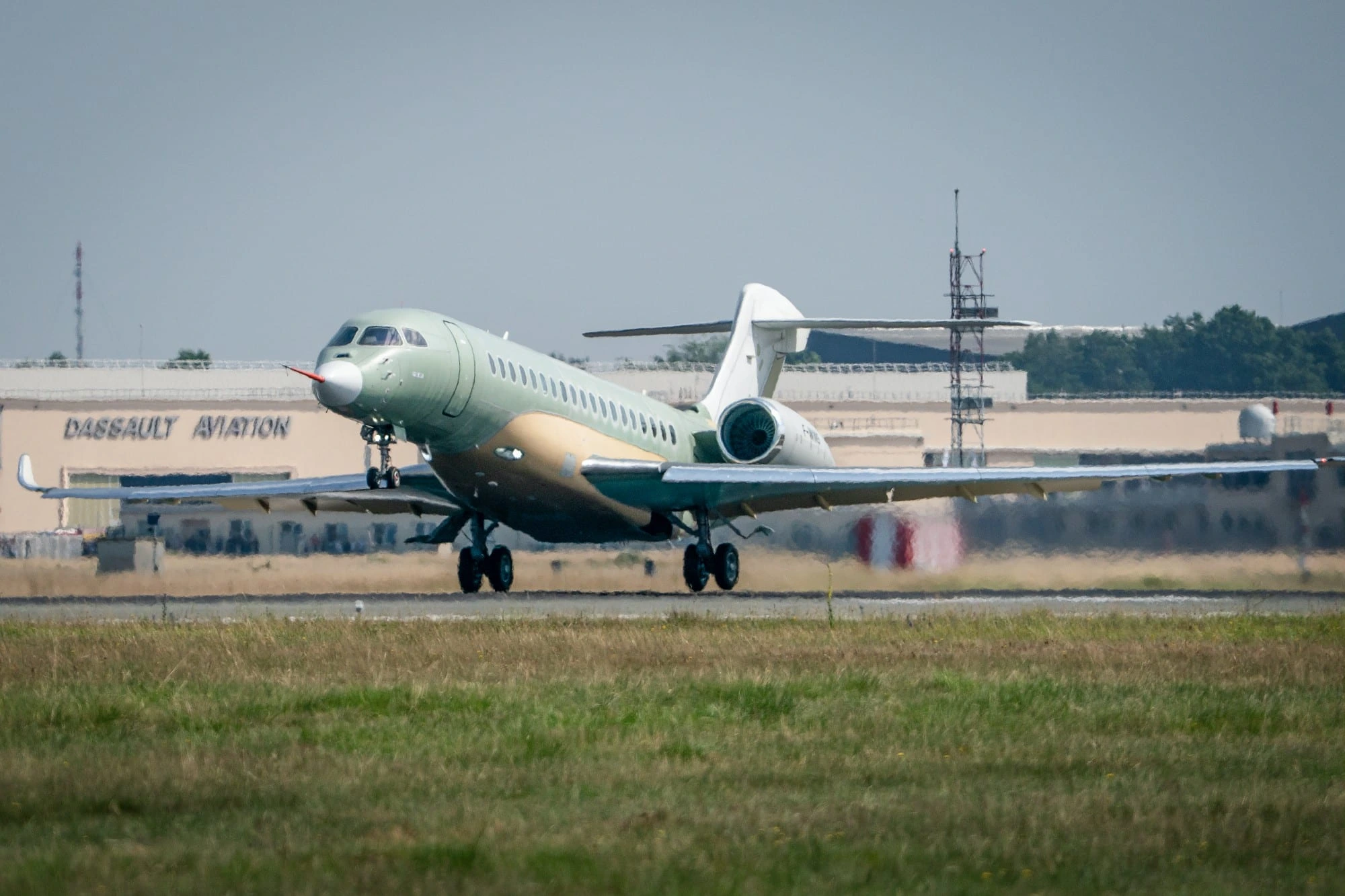
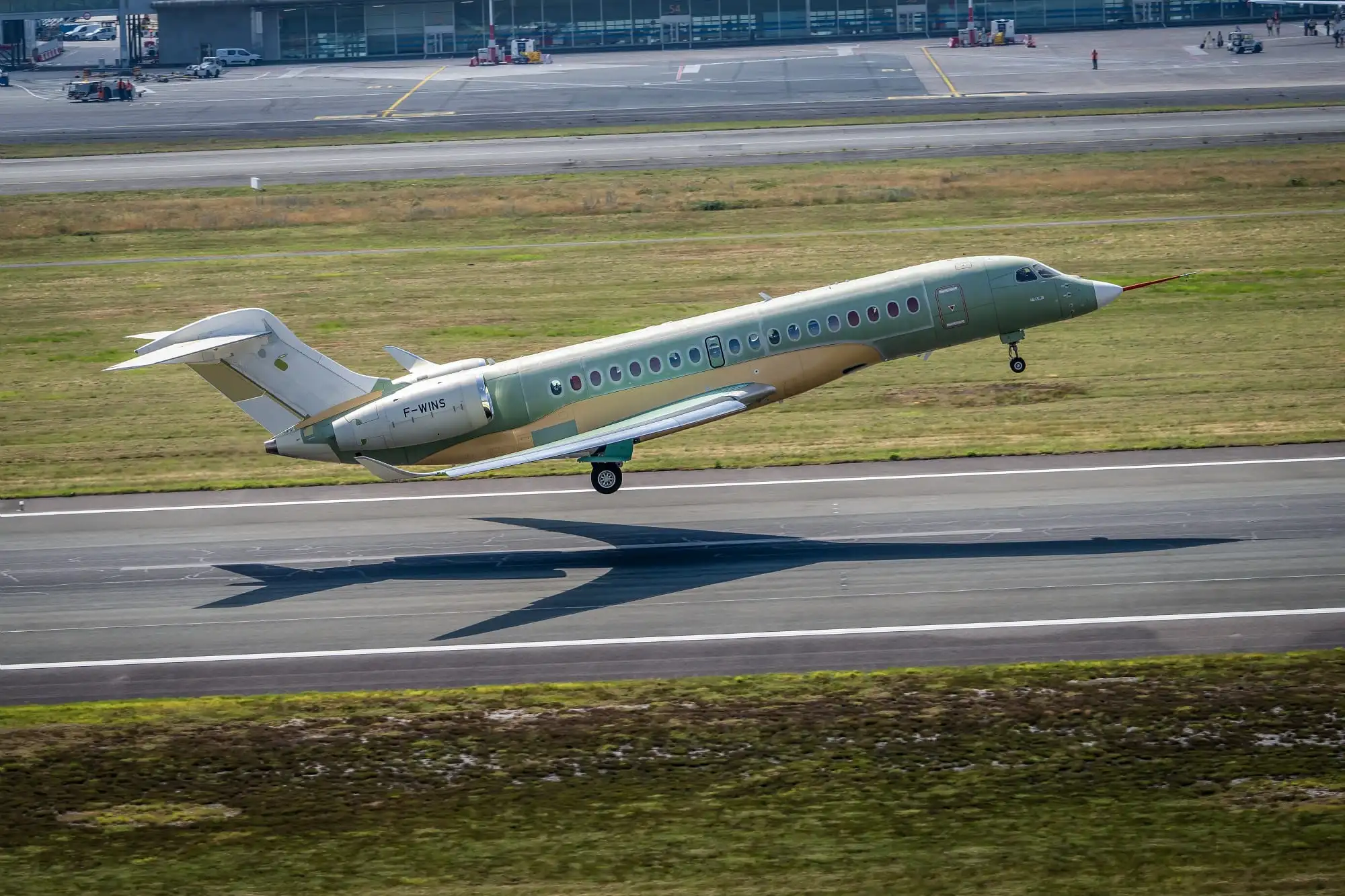
Dassault Aviation’s new Falcon 10X completed its first flight on June 19, 2026, taking off from Bordeaux-Mérignac Airport (BOD), France. The flight launches the test campaign for Dassault’s largest and most expensive business jet, an ultra-long-range aircraft designed to compete with the Gulfstream G700 and Bombardier Global 7500.
Test pilots Sébastien Dupont de Dinechin and Fabrice Dougnac flew the aircraft for two hours and 30 minutes, testing handling and systems before climbing to 40,000 feet and accelerating to Mach 0.82. The milestone comes five years after Dassault unveiled the jet in 2021 and roughly a year behind its originally planned 2025 entry into service.
How the Falcon 10x’s First Flight Went
The aircraft took off from runway 23 at Bordeaux-Mérignac at 11:10 a.m. local time. The crew first evaluated handling qualities and onboard systems at 15,000 feet.
The pilots then retracted the landing gear and movable surfaces before climbing to 40,000 feet, where they accelerated the jet to Mach 0.82. The flight ended with a landing back at Bordeaux-Mérignac at 1:40 p.m.
Test pilot de Dinechin described the flight as the result of years of effort. He said: “Today’s flight was the culmination of years of work by thousands of Dassault employees and partners. It paid off in a flight that went as planned and was a delight to fly.”
What Dassault’s Chairman Said About the Milestone
Dassault Aviation Chairman and CEO Eric Trappier framed the flight as a sign of the program’s progress. He said:
“This inaugural flight is another milestone for Dassault. It is a reflection of the dedication and high skill of our engineering, production, and flight teams, and also the quality of our global network of partners.”
He also pointed to what comes next for the program. He added:
“All of us are excited to see this day as we launch into a new phase for the 10X.”
Dassault said it is currently the only aircraft manufacturer in the world with a completely new aircraft type flying in 2026.
What Comes Next in the Falcon 10x Flight Test Campaign
A second test aircraft is nearing completion and will join the flight program shortly. A third aircraft, fitted with a full interior, will focus mainly on systems and cabin reliability testing.
Dassault has not yet confirmed a new certification date, though the aircraft was originally due to enter service at the end of 2025. Industry tracking now points to deliveries beginning in 2027.
Falcon 10x: Specifications and Cabin Features
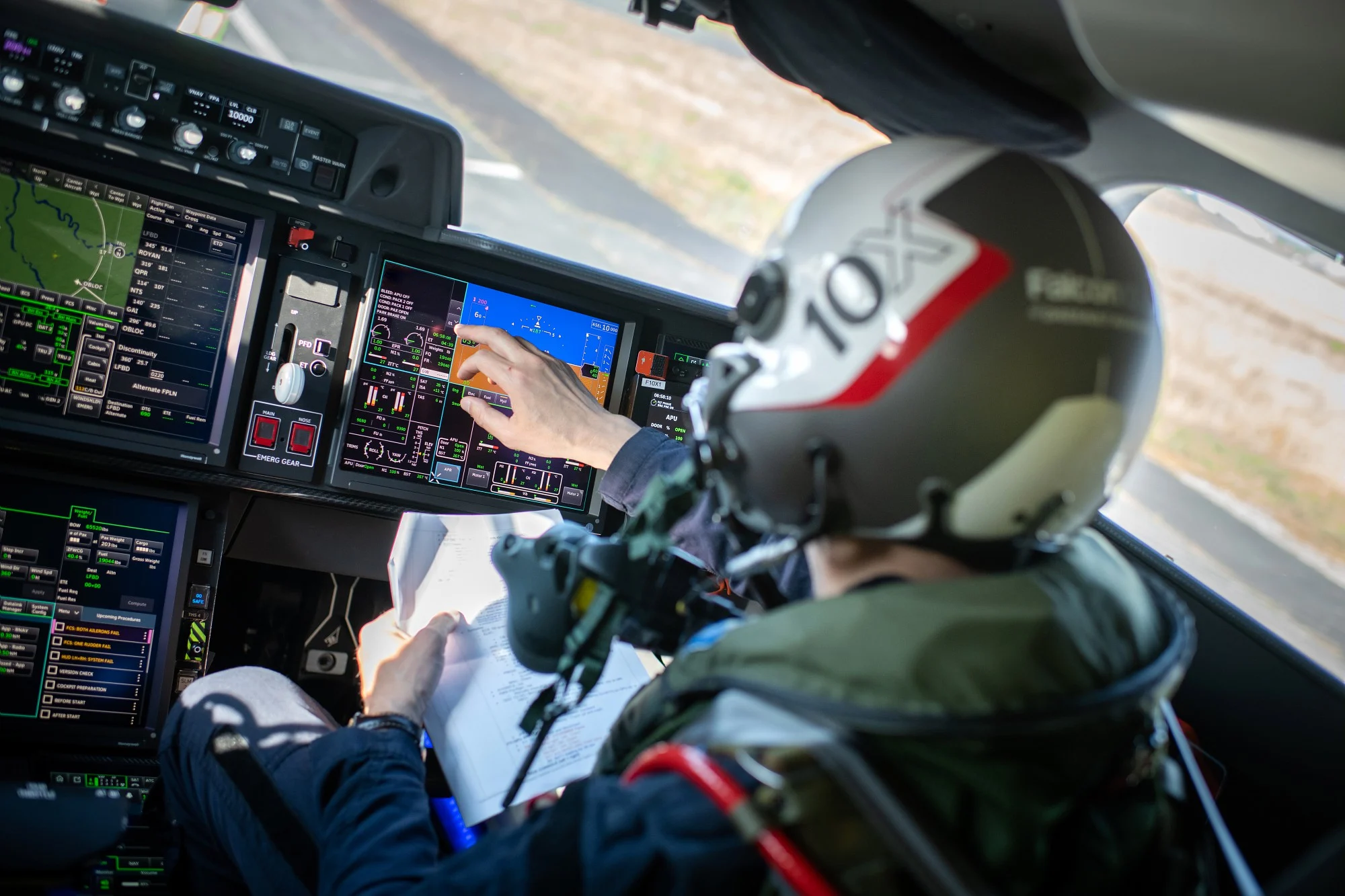
The Falcon 10X is powered by two Rolls-Royce Pearl 10X engines, each producing more than 18,000 pounds of thrust. Key specifications include:
- Range: 7,500 nautical miles, enough for nonstop flights such as New York to Shanghai or Los Angeles to Sydney
- Top speed: Mach 0.925
- Cabin width: 9 feet, 1 inch (2.77 m)
- Cabin height: 6 feet, 8 inches (2.03 m)
- Windows: 38, roughly 50 percent larger than those on the Falcon 8X
- Cabin altitude: 3,000 feet at a 41,000-foot cruise altitude
Dassault designed the cabin with up to four interior zones, which buyers can configure for dining, conference use, entertainment, or a private suite with a stand-up shower. The jet’s wing uses carbon-fibre composite construction, a first for a Dassault business jet.
Comparing the Falcon 10X With Rival Ultra-Long-Range Jets
The Falcon 10X is expected to carry a list price of around $75 million, placing it in direct competition with the Gulfstream G700 and Bombardier Global 7500. Dassault has positioned cabin size as its main point of difference against these established rivals.
At 9 feet, 1 inch wide, the Falcon 10X’s cabin is nearly a foot wider than the Gulfstream G700’s 8 feet, 2 inches, and more than a foot wider than the Bombardier Global 7500’s 8 feet. Dassault also claims the cabin is the tallest in its class.
Aerospace Global News reported that Dassault describes its cabin as “eight inches wider and two inches taller than its nearest competitor”. All three manufacturers, however, report broadly similar range and speed figures, meaning the contest between them centres on cabin comfort and technology rather than raw performance.
Dassault’s Wider Business Aviation Strategy
Dassault Aviation has delivered more than 10,000 military and civil aircraft, including 2,800 Falcon jets, in over 90 countries during its 110-year history. The company reported 2025 revenues of €7.4 billion and employed about 15,000 people.
Dassault is the only manufacturer that designs and builds both fighter jets and business jets. It has applied technology from its Rafale fighter program to the Falcon 10X, including its Smart Throttle and Digital Flight Control System.