In Toulouse, the Airbus A350F program is quietly entering one of its most consequential phases yet: ground testing during final assembly. This stage is where the aircraft’s freighter-specific systems are pushed, validated, and sometimes creatively challenged before certification and entry into service.
What makes the A350F unusual is not just that it is a cargo aircraft derived from a passenger platform, but the extent to which it has been re-engineered. Roughly 40% of the serial ground test instructions used on the standard A350 have had to be newly created or significantly modified for this variant alone.
Airbus A350F – Key Specifications and Capabilities
| Category | Specification |
|---|---|
| Payload capacity | 111 tonnes |
| Main deck container capacity | 30 containers |
| Lower deck container capacity | 40 LD3 units |
| Overall length | 70.80 m |
| Wingspan (geometric) | 64.75 m |
| Overall height | 17.08 m |
| Maximum range | 4,700 nm |
The A350F is Rebuilt Around the Cargo Mission
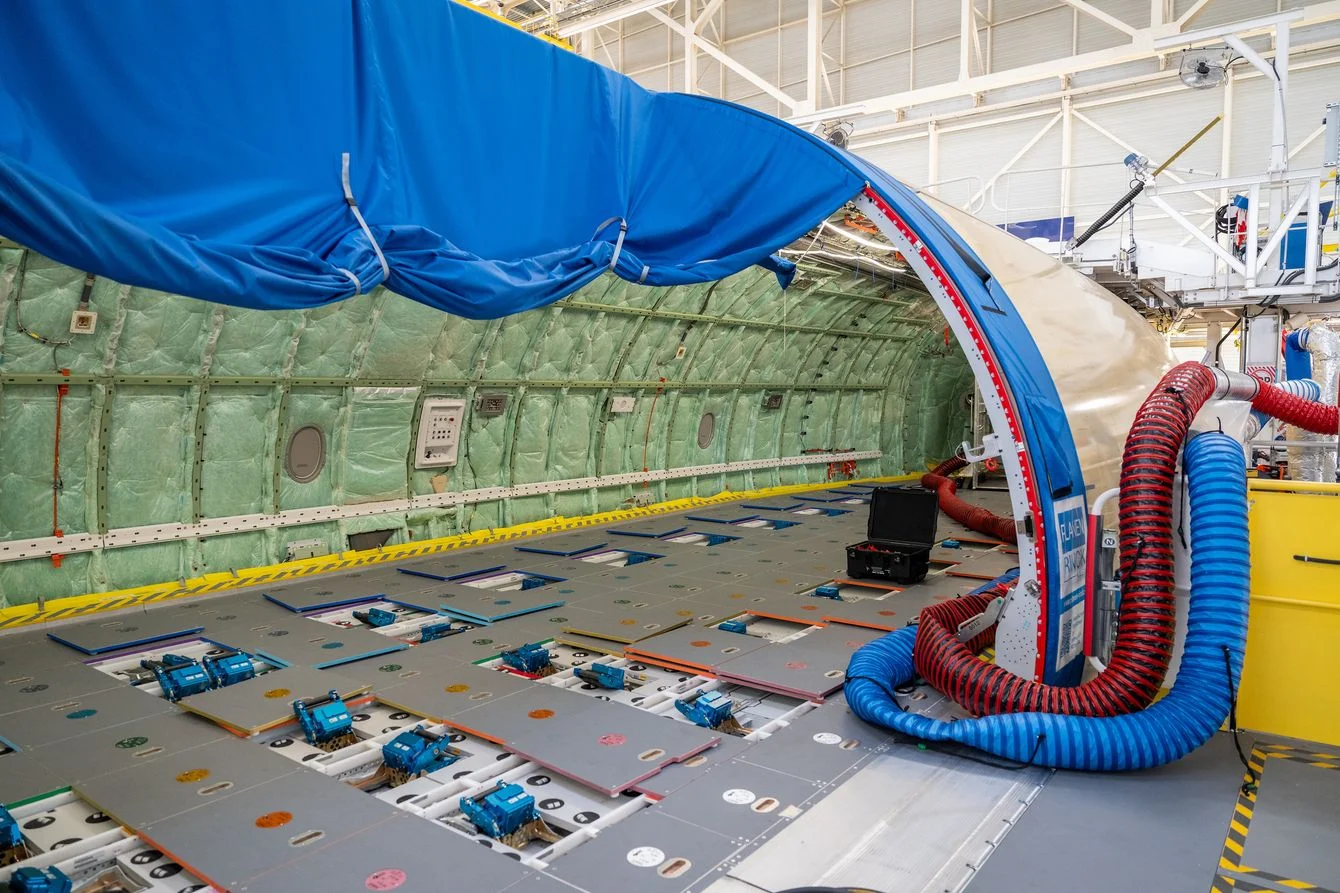
The Airbus A350F introduces a suite of systems concentrated almost entirely in the main deck and cargo environment—essentially transforming the aircraft’s “middle section” into a highly instrumented industrial workspace.
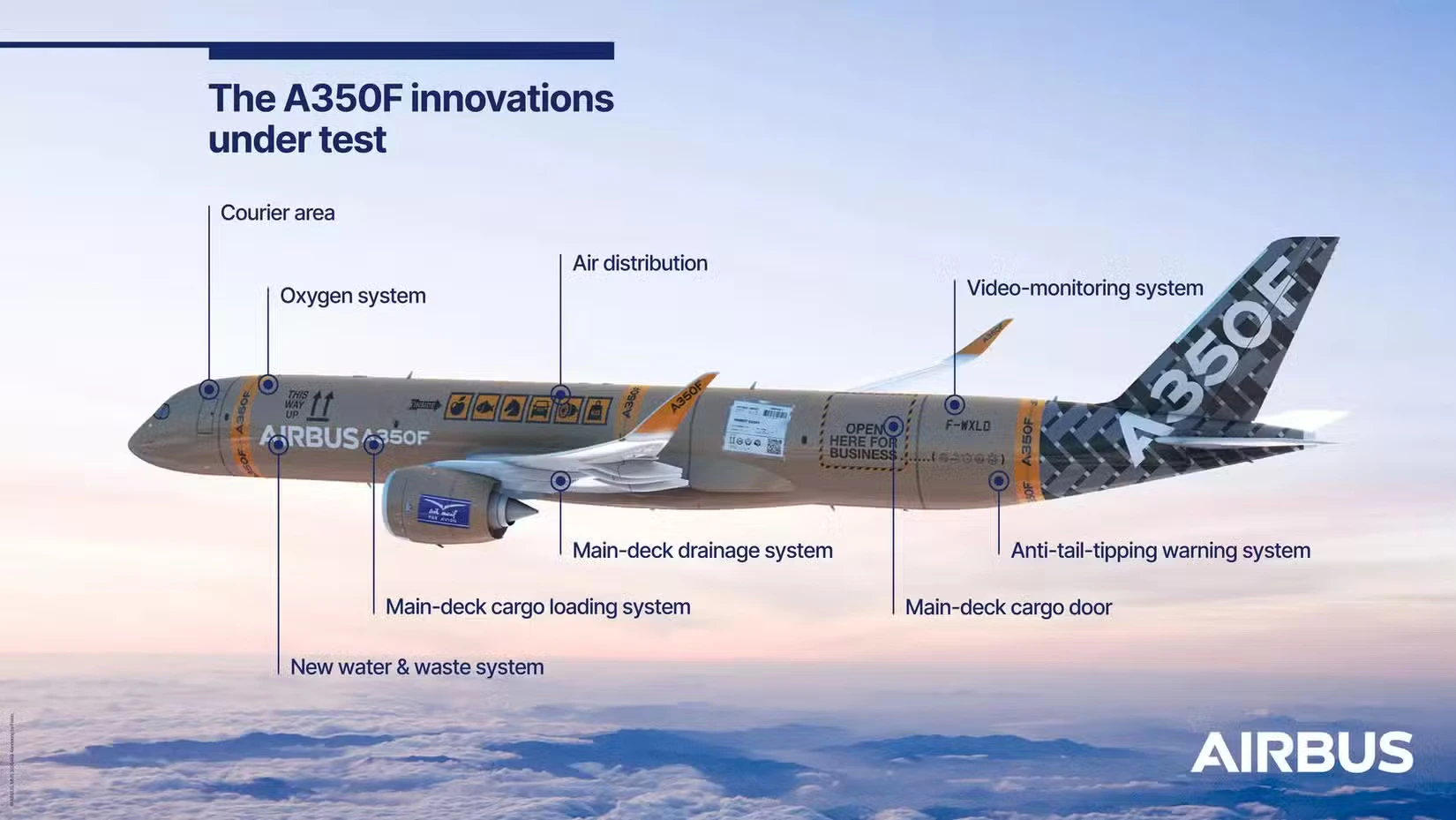
Among the systems undergoing verification are:
- Main-deck cargo loading system
- A large cargo door
- A dedicated courier area for up to 10 occupants
- Anti-tail-tipping warning logic
- Multi-zonal air distribution
- Drainage and oxygen systems
- Avideo-monitoring setup
- Airbus’ connected “Smart Freighter” platform
Each of these systems interacts with structural, electrical, and software layers in ways that make ground testing less of a checklist exercise and more of a systems-integration simulation.
Cargo System & Design Features
| Category | Specification | Paraphrased Detail |
|---|---|---|
| Main deck cargo door | XL cargo door (industry largest class) | Features one of the largest cargo doors in the industry, with a 175-inch cut-out width and 169.5-inch clear opening |
| Cabin air system | Segregated airflow design | Air conditioning system separates cargo and crew airflow to prevent odour transfer into cockpit, courier area, and crew rest zones; capable of cooling down to 4°C |
How is Testability Designed into the A350F?
One of the defining shifts in the A350F program is that testing was not treated as a downstream activity. Instead, Airbus began designing ground test strategies as early as 2021, during the aircraft definition phase.
This “co-design” approach brought together the Final Assembly Line (FAL) Ground Test Design teams and Chief Engineering from the outset. The objective was simple but ambitious: ensure that test requirements shaped the aircraft’s architecture early enough to prevent bottlenecks later on.
Guillaume Terrien, who leads ground test design activities, describes this collaboration as a way to embed “testability constraints” directly into preliminary design—reducing friction once aircraft reach final assembly:
“As early as 2021, at the A350F’s definition phase – close collaboration was initiated between the FAL Ground Test Design and Chief Engineering teams….The goal was to share FAL testability constraints so they could be taken into account from the preliminary aircraft design stage, thus facilitating future ground tests at the FAL stations. This approach is known as ‘co-design’.
A350F’s 1,300-Wire Problem is Solved in Software
Nowhere is this co-design philosophy more visible than in the Cargo Loading System (CLS).
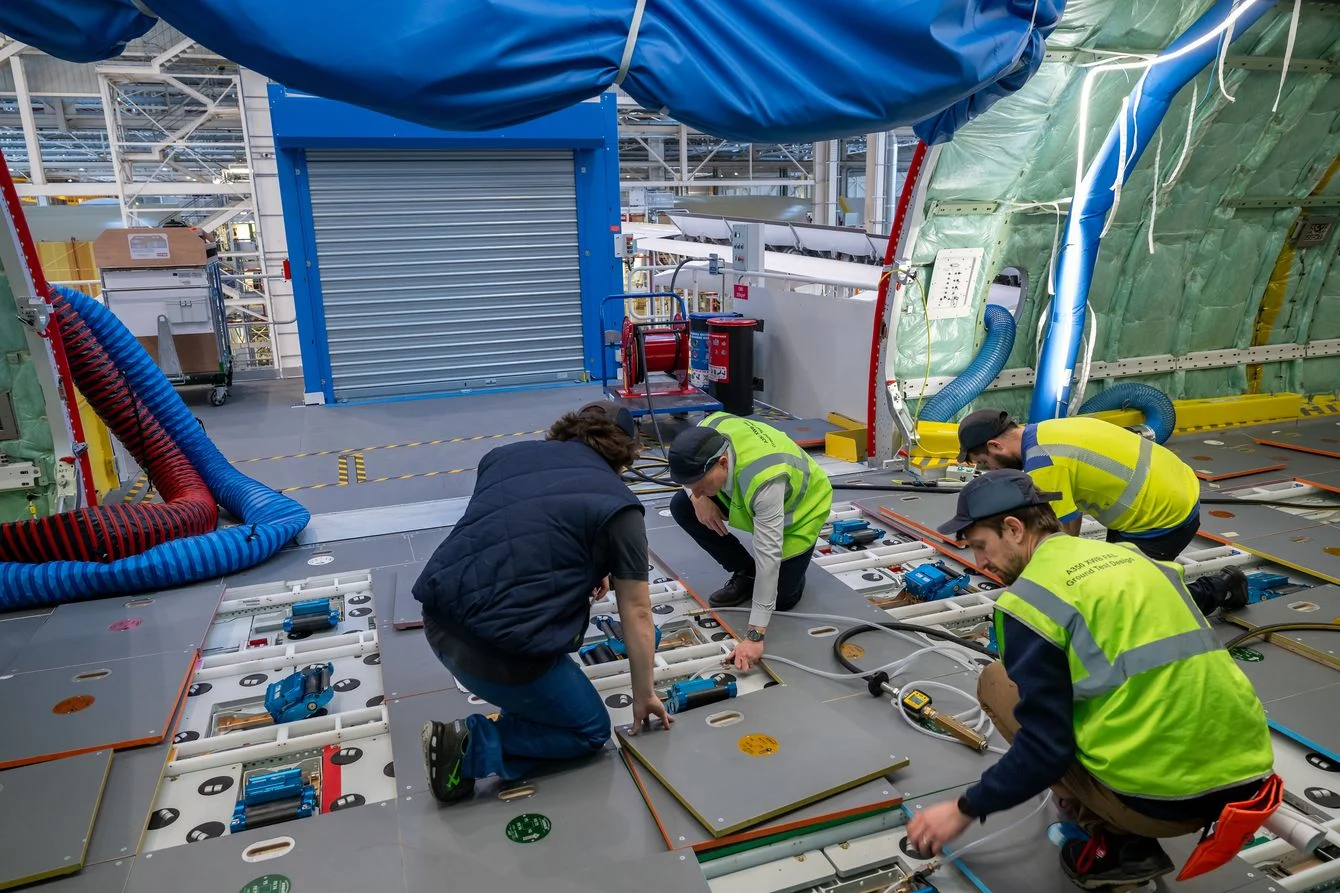
The CLS contains hundreds of electrical components embedded within the aircraft floor structure. Traditionally, verifying such a network would require extensive manual continuity checks—slow, repetitive, and error-prone.
Instead, Airbus engineered an automated wiring self-test that runs directly from the cockpit. Once electrical power is applied on the final assembly line, onboard software can automatically check more than 1,300 interconnected wires within minutes.
What once represented hours of manual inspection has effectively been reduced to a software-driven diagnostic sequence—illustrating how deeply digitalisation now sits inside aircraft production workflows.
180 Liters of Water, 50 Meters of Aircraft, and Controlled Chaos
If the wiring test is an exercise in precision electronics, the drainage system test is its physical counterpart.
To validate the aircraft’s ability to evacuate liquids safely from the main deck, Airbus engineers flood the approximately 50-metre-long cargo compartment with more than 180 litres of water.
The aircraft is positioned at a zero-degree inclination, and specialised equipment forces water through all drainage pathways to verify tightness and evacuation performance.
Despite appearing straightforward, this is one of the most technically demanding tests in the entire programme. The challenge lies not in pouring water, but in controlling flow behaviour across complex internal geometries designed to handle everything from cleaning fluids to environmental condensation.
Simulating Danger Without Risking the Aircraft
Another critical system under validation is the Tail Tipping Warning System (TTWS), designed to prevent the aircraft from rotating backward during cargo operations.
Instead of physically risking instability, engineers use specialised ground equipment that simulates landing gear compression conditions. This effectively “tricks” onboard sensors into detecting a tail-tipping scenario.
The system is then verified for correct behaviour: cargo loading must immediately stop, and both visual and audible warnings must activate without delay.
It is a controlled illusion designed to ensure that a real-world hazard never needs to occur during testing.
Ground testing on the A350F is split into two parallel streams, which are described in the table below
| Aspect | Production Line (Serial Testing) | Certification Campaign (Flight-Test Aircraft) |
|---|---|---|
| Overall purpose | Ensures every aircraft produced meets design and operational standards during assembly | Validates the aircraft for regulatory certification and final approval for entry into service |
| Test stream type | Serial Ground Test Instructions (GTIs) | Ground Test Requirements (GTRs) |
| Scale of testing | ~200 GTIs executed per aircraft | 55 GTRs across dedicated test aircraft |
| Freighter-specific adaptation | ~40% of GTIs are newly created or modified specifically for the A350F | Tests are purpose-built for certification of the freighter configuration |
| Test platforms | Conducted on the production line during final assembly | Conducted on dedicated flight-test aircraft: MSN 700 and MSN 701 |
| Example activity | Main Deck Cargo Door Cycling test—repeated opening/closing in manual and electrical modes to validate sensors, actuators, and alert logic | One-off certification validation activities required by regulators such as EASA |
| Core focus | Repeatable system checks integrated into manufacturing flow | High-intensity validation of aircraft performance and compliance |
The 111-tonne Stress test Loads Reality into the A350F
Among the most visually striking certification exercises is the maximum payload test.
The A350F is loaded up to its full structural payload capacity of 111 tonnes—roughly equivalent to 18 elephants—to confirm system integrity and operational sequencing, particularly around the main-deck cargo door.
Beyond the symbolism, the test ensures that mechanical sequencing, sensor feedback, and structural responses behave consistently under extreme loading conditions.
Pressurisation and Sensors, and Commonality with the A350
Another development test focuses on how the aircraft behaves during pressurisation cycles.
Engineers equip the main cargo door area with cameras, displacement sensors, and microphones to monitor structural movement and acoustic signatures as cabin pressure changes.
This adds a layer of observational data beyond standard pressurisation checks, helping validate door integrity under repeated stress conditions.
The Airbus A350 is an aircraft the is used to operate some of the longest non-stop flights in the world. For instance, Singapore Airlines covers its 9,537-mile journey between Singapore and New York on the A350-900 URL, and the A350F shares many of its attributes with this civilian airliner:
| Category | Specification | Paraphrased Detail |
|---|---|---|
| Engine spares & tooling commonality | 100% with A350-1000 | Full interchangeability of engine-related tools and spares across A350-1000 and A350F |
| Airframe tooling commonality | 99% | Nearly identical airframe tooling reduces operational complexity |
| Spare parts commonality | 98% | High level of parts interchangeability reduces inventory requirements |
| Operational benefit | Fleet-wide efficiency | Designed to minimize additional investment, streamline maintenance, and improve airline profitability through shared systems |
All in All
The A350F is often described in terms of payload, range, or efficiency. But its current testing phase reveals something less visible: a machine defined by system density and interdependency.
According to Airbus, Examples of engines that the A350F is able to accommodate on its main deck include:
- PW4168
- PW4100
- RR Trent 700
- CF6-80E1 RR Trent 7000
- RR Trent 1000
- RR Trent 900 & EA GP7200 CFM56 ,
- IAE2500 CFM LEAP
- PW GTF
And in split configuration:
- RR Trent XWB Ge90
- Ge9X