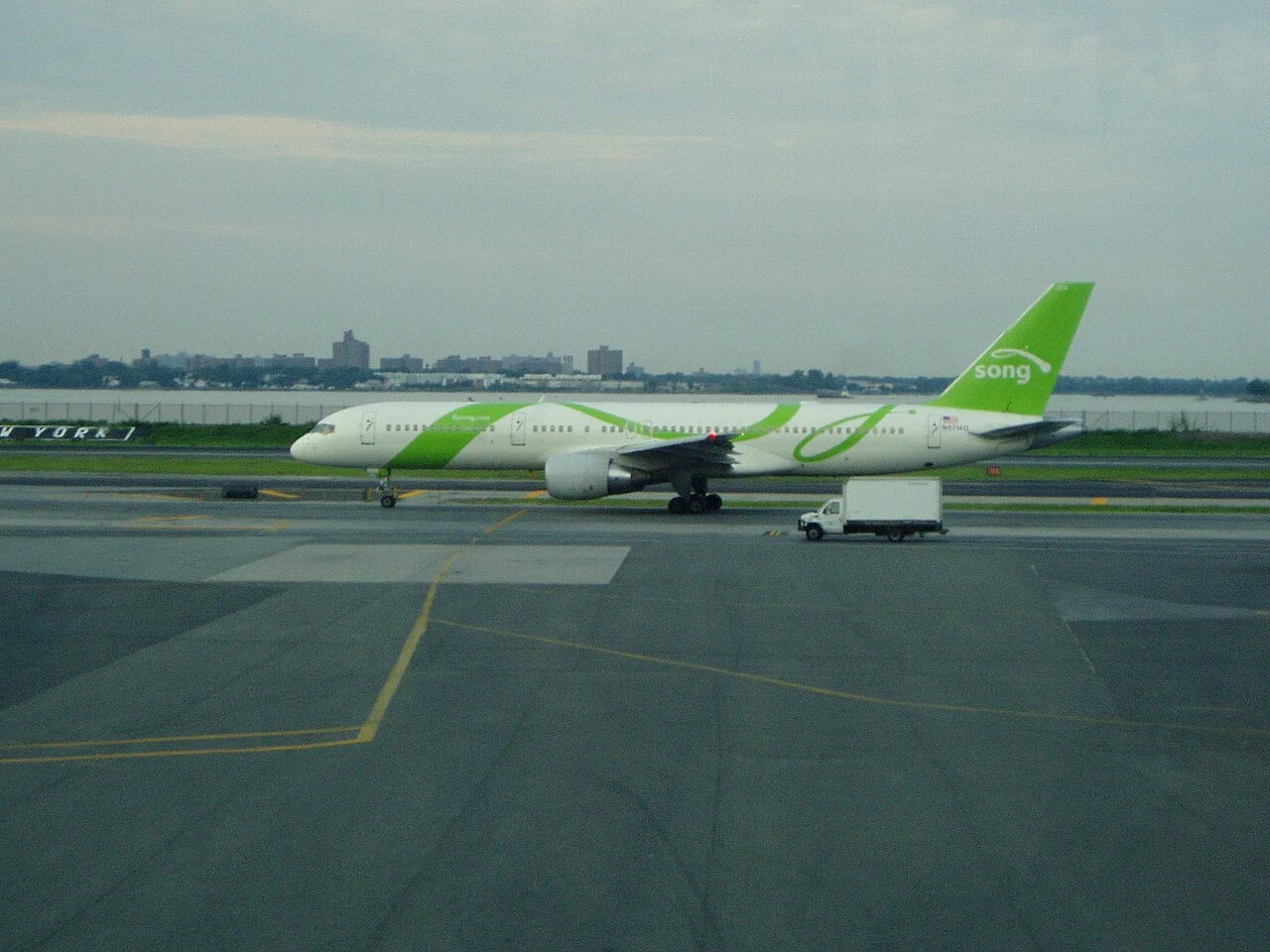
Delta Air Lines (DL) launched Song (SG) on April 15, 2003, as a low-cost leisure brand designed to compete with JetBlue (B6) and other budget carriers on routes between the northeastern United States and Florida. Song operated all-economy Boeing 757-200 aircraft from its primary hub at New York John F. Kennedy International Airport (JFK) to leisure destinations such as Orlando International Airport (MCO) and Fort Lauderdale-Hollywood International Airport (FLL). The airline was headquartered in Atlanta, Georgia, and offered passengers leather seats, free personal entertainment screens, and designer uniforms — all at low fares.
Song carried over ten million passengers and operated more than 200 flights a day at its peak in 2005. However, Delta filed for Chapter 11 bankruptcy on September 14, 2005, citing rising fuel costs, and announced the closure of Song just weeks later. Song’s final flight, number SG2056, departed Las Vegas Harry Reid International Airport (LAS) bound for MCO on April 30, 2006. The airline’s brief existence left behind a set of lasting lessons that Delta carried into its post-bankruptcy recovery.
The Competitive Pressure from JetBlue in the Early 2000s
In the early 2000s, Delta faced growing competition from low-cost carriers. JetBlue had just started operations and was winning over a sizable number of passengers flying between New York and vacation hubs in Florida. Delta had previously experimented with a budget brand called Delta Express, which ran from 1996 to 2003. Delta replaced Delta Express with Song, a more refined and stylish concept, aimed at capturing a specific type of leisure traveler.
Delta’s leadership decided that simply lowering fares was not enough. Delta broke off a team of its best marketers and told them to start from scratch, according to the PBS Frontline documentary The Persuaders (2004). The team’s goal was to build an entirely new brand — not just a cheaper version of Delta. Song was born out of that ambition.

Branding, Landor Associates, And A Women-First Strategy of Song
Song hired San Francisco-based brand consulting firm Landor Associates to create its name, visual identity, cabin interiors, and airport presence. The name “Song” was chosen to symbolise harmony, fun, and a lighthearted escape in air travel. John Selvaggio, the executive leading the brand’s development, described the philosophy: “Just as a song is the harmonious composition of distinct yet related elements, our Song will be in harmony with each individual’s self-expression.”
Song became the first airline ever designed to target women as its primary market. The airline identified style-conscious professional women aged 35 to 54 as its core demographic. These women were seen as the primary decision-makers for leisure travel, influencing over 80% of family vacation bookings. The branding process was later documented in the 2004 PBS Frontline episode The Persuaders, which showed the airline’s team working to build an emotional connection with this group.
Song’s marketing campaign was wide-ranging. The airline opened a boutique store called “Song in the City” in the SoHo district of New York City, and a second location in Boston’s Prudential Center. It also ran a promotional tie-in with the television show The Apprentice, which brought the brand to a national audience before the first flight took off.
Song Airlines’ Boeing 757-200 Fleet
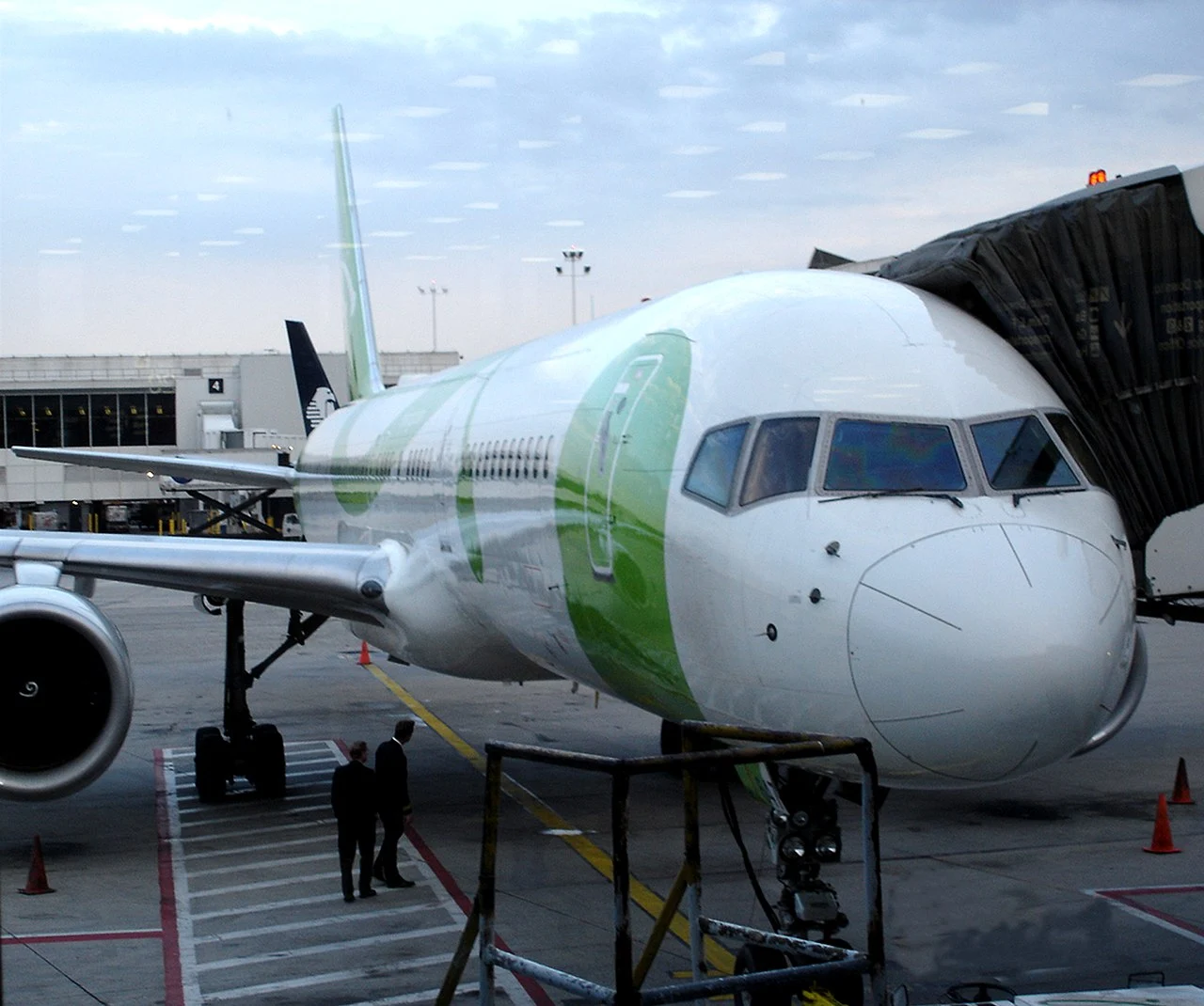
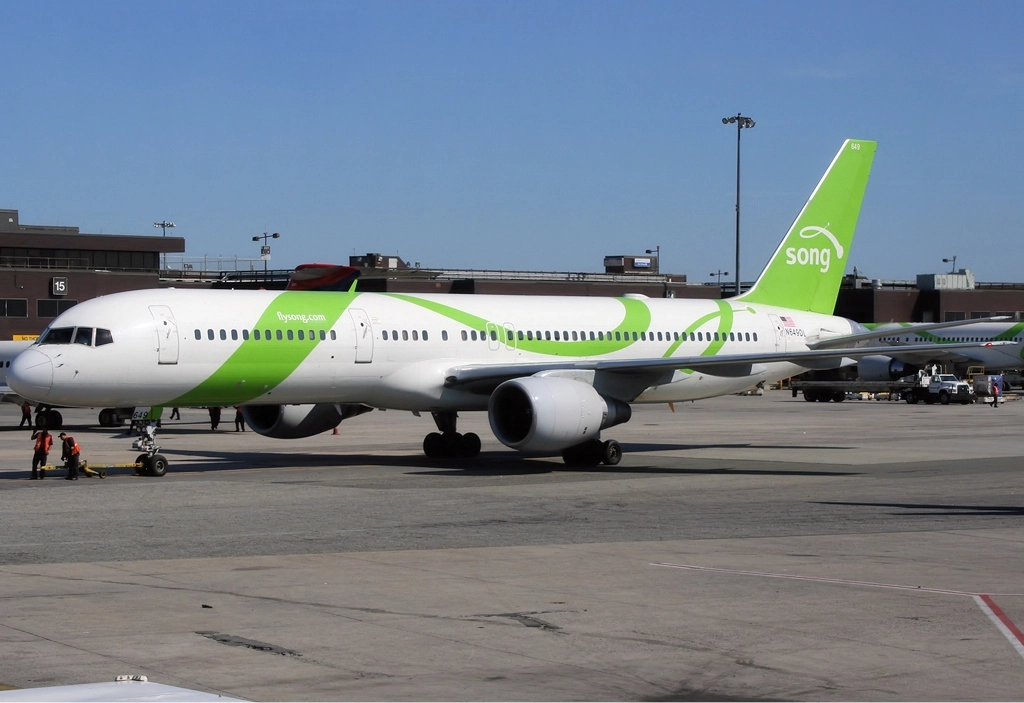
Song operated an all-Boeing 757-200 fleet sourced entirely from Delta’s existing mainline inventory. The fleet grew from 36 aircraft at launch to 48 at its peak in 2005. Each aircraft was configured for single-class, all-economy service with 199 leather seats arranged in a 3-3 layout, offering more legroom than a standard economy configuration.
The in-flight product was notably different from other low-cost carriers of the time. Song aircraft included the following features:
- Leather seats throughout the entire cabin, available on every flight
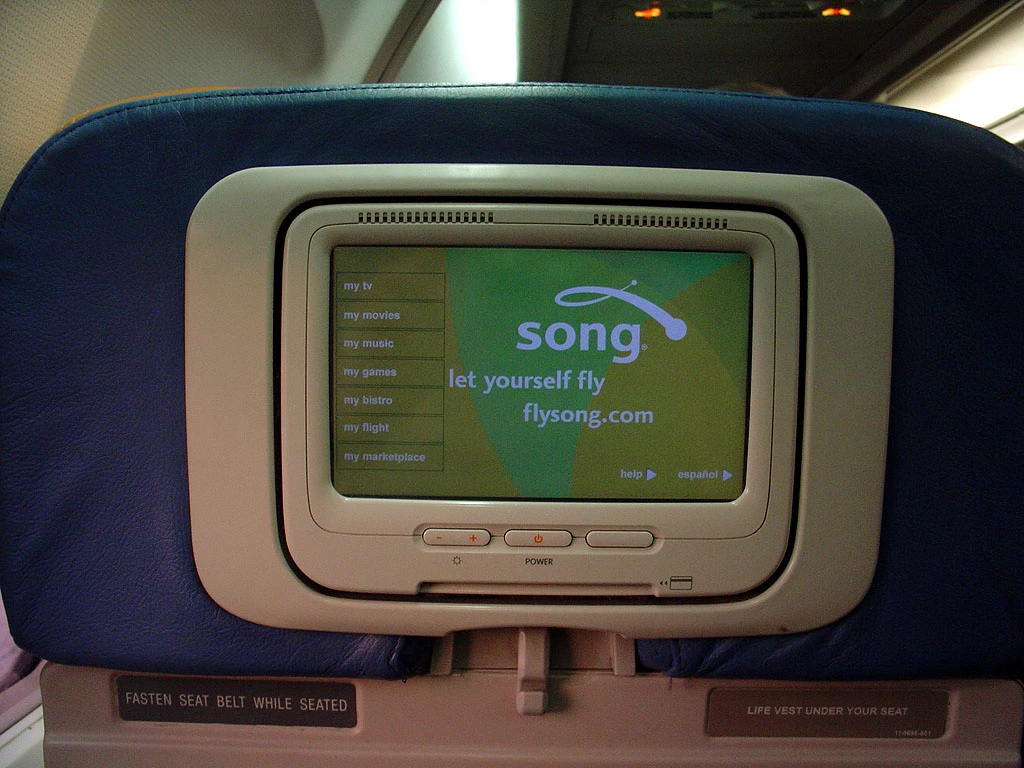
- Free personal entertainment screens at every seat, powered by DISH Network satellite television
- MP3 audio with programmable music selections
- Trivia games playable against other passengers on the same aircraft
- A live flight tracker displayed on each seatback screen
- Satellite television, making Song the first airline in Delta’s fleet to carry onboard satellite TV
- Free beverages on every flight, with meals and alcohol charged separately
- Brand-name snack boxes and healthy organic meal options
- Preflight meal ordering so passengers could select food before boarding
- An in-flight exercise programme designed by New York fitness trainer David Barton
- Signature cocktails created by nightlife entrepreneur Rande Gerber
- Flight safety instructions delivered artistically, including sung briefings and interpretive performances by cabin crew
One Boeing 757-200 (registration N610DL) was painted in pink to support the Breast Cancer Research Foundation. After Song was dissolved, this aircraft became Delta’s “Pink Plane” until 2010, when it was repainted in standard Delta livery.
Kate Spade and the Song Uniform
Song’s uniforms were one of its most talked-about features. In 2004, Song Airlines introduced new uniforms featuring dark gray charcoal pieces with black knits and lime green accents. Female uniforms were designed by fashion designer Kate Spade and accessorised with Kate Spade shoes and bags. Male uniforms were designed by Andy Spade under the Jack Spade label.
The lime green color scheme extended across the entire Song brand experience. Song’s distinctive lime green livery appeared on aircraft tails and fuselages, ticket jackets, boarding passes, and airport kiosks. The color became so associated with the brand that it was often called “Kate Spade green” in reference to the designer’s influence.
Song Airlines’ Routes and Operations at Its Peak
Song began operations with 36 Boeing 757-200s flying 144 flights per day from JFK to leisure destinations in Florida. The inaugural flight on April 15, 2003, departed from JFK bound for Palm Beach International Airport (PBI). The airline later expanded to include routes between the Northeast and the West Coast, as well as Florida-to-West Coast services.
At its height in 2005, Song operated 48 Boeing 757-200s flying to 16 destinations across the United States. Secondary focus cities included Boston Logan International Airport (BOS) and FLL. Throughout its history, Song served a total of 22 destinations in the U.S. and the Caribbean, including Nassau, San Juan, and Aruba.
Song achieved a seat load factor of 78% in 2005, according to company officials. According to a reported by NBC News, Delta’s Jim Whitehurst, then chief operating officer, described Song as “a successful lab experiment that allowed Delta to try new services”.
Song Airlines Failed Amid Bankruptcy, Union Pressure, And Structural Challenges
Multiple factors contributed to Song’s closure. The most immediate was Delta’s own financial crisis. Delta Air Lines filed for Chapter 11 bankruptcy protection on September 14, 2005, citing rising fuel costs. Song filed for bankruptcy the same day. The parent company could no longer afford to operate two separate brands.
Delta also faced pressure from its labor unions. Delta’s unions were unhappy with Song, particularly over the loss of seniority privileges among its flight attendants. This internal friction added operational complexity and cost.
The choice of the Boeing 757-200 also played a role. Song competed well against JetBlue and Southwest along price margins, with a cost per seat mile of eight cents, but the 757 required all seats to be filled to be profitable. The larger aircraft also took more time to turn around on the ground, reducing the daily revenue-generating hours per plane.
Delta also faced pressure from some Song passengers who wanted a first-class seating option, something the all-economy model did not offer. Management also wanted the flexibility to redeploy Song’s aircraft on other routes without being constrained by the brand’s positioning.
Song’s Closure and its Final Flight
On October 28, 2005, Delta announced plans to discontinue the Song brand and incorporate its aircraft into Delta’s mainline domestic long-haul operation beginning in May 2006. Joanne Smith, who was then president of Song, was appointed vice president of consumer marketing for Delta, effective immediately.
Delta officials confirmed there would be no layoffs directly from Song’s elimination. Any job reductions were part of the broader 7,000 to 9,000 job cuts Delta had already announced as part of its bankruptcy restructuring.
Song was officially removed from all Delta flight schedules on February 22, 2006. The 48 Boeing 757-200s were reconfigured to include 26 first-class seats and repainted in Delta’s standard livery. The final Song flight, SG2056, departed LAS at 11:48 p.m. on April 30, 2006, bound for MCO. Delta began repainting the last aircraft bearing the Song livery on January 1, 2008.
What Delta Learned from Song
Song’s closure did not erase its influence on Delta’s operations. Many of its innovations became standard features across Delta’s mainline fleet. Delta adopted Song’s leather interiors, improved in-flight entertainment systems, simpler fare structure, designer uniforms, and zone boarding process.
Song was also the testing ground for ideas that reshaped how Delta operated on the ground and in the air. These included:
- Zone boarding, which improved the boarding process across Delta’s wider network
- All-leather seats, which Delta later rolled out across many of its domestic aircraft
- Seatback entertainment screens, which Song pioneered within the Delta fleet
- Simplified fare structure, which removed advance-purchase requirements and Saturday-night-stay conditions
- Improved online booking, which Song developed as a key distribution channel
- New aircraft turnaround procedures, which influenced efficiency across Delta’s operations
Delta continued to maintain on-demand seatback entertainment on its Boeing 757-200s years after Song’s closure. Song also pushed Delta toward building a stronger premium product on its transcontinental routes, eventually leading to the introduction of flatbed seats on key 757 routes and upgraded services on the Los Angeles to New York corridor.
Aviation analysts viewed the end of Song as a move to reduce costs and allow Delta to emerge from bankruptcy as a leaner, more focused carrier. The lessons from Song also influenced how other carriers approached brand extensions, with many later choosing to incorporate innovative features directly into their main brand rather than creating separate operations.
Song Airlines in Popular Culture
Song’s marketing strategy attracted attention far beyond the aviation industry. PBS Frontline featured Song in its November 2004 episode “The Persuaders”, which examined how modern advertising and branding shape consumer behavior. The documentary gave audiences a behind-the-scenes look at how the Song team developed its brand identity and targeted a specific demographic of women travelers.
The documentary noted a striking finding from Song’s own market research. In terms of overall recall, 35% of the sample audience felt they had seen Song’s advertising somewhere, but many could not identify which airline the advertising was for. This pointed to a gap between brand awareness and brand recognition — a fundamental marketing challenge for the airline.
Song’s flight safety instructions were delivered in artistic formats, including sung briefings and performances styled as flamenco or Irish jig routines. This approach reinforced the airline’s brand identity and generated media attention, but it also reflected a tension at the heart of Song: a carrier that was more concerned with its image than with sustainable cost management.



