Artificial intelligence (AI) is transforming the global aviation industry at a pace that few could have predicted even five years ago. The AI-in-aviation market, valued at USD 1.75 billion in 2025, is projected to reach USD 4.86 billion by 2030, growing at a compound annual growth rate (CAGR) of 22.6%. Airlines, airports, regulators, and technology companies around the world are deploying AI across every layer of aviation — from the cockpit to the check-in counter — with the goal of making flight safer, cheaper, and cleaner.
The momentum behind this shift is driven by three converging pressures: the need to cut operating costs, the demand for better passenger experiences, and the urgency of meeting net-zero carbon targets by 2050. North America currently holds the largest share of the AI-in-aviation market, accounting for 42.8% of global activity in 2025, while Asia-Pacific is emerging as the fastest-growing region. The transformation is no longer a future ambition — it is happening now, flight by flight and algorithm by algorithm.
How AI-Powered Predictive Maintenance Is Cutting Costs and Downtime
Aircraft maintenance has always been reactive by nature — airlines fixed problems after they appeared. AI is changing that. Predictive maintenance powered by AI, IoT sensors, and data analytics can cut unplanned aircraft downtime by up to 70% and reduce maintenance costs by 25–30%. Airlines and MROs (Maintenance, Repair, and Overhaul providers) are increasingly adopting this technology as the global aircraft maintenance market approaches USD 92 billion in value.
Over 6,000 aircraft globally are being considered for predictive retrofitting in 2025, as extending the operational life of existing fleets becomes a financial priority. AI platforms begin learning equipment behaviour patterns from the moment they connect to aircraft sensor data. Predictions become more accurate over time, allowing maintenance teams to act weeks before a failure occurs.
Key AI tools already deployed by major players include:
- Airbus Skywise: Uses AI-driven analytics to predict when aircraft parts need replacement across Airbus fleets.
- Boeing AnalytX: Delivers predictive insights to improve operational reliability for Boeing operators.
- Delta TechOps APEX (Advanced Predictive Engine): Collects real-time data throughout an engine’s lifecycle to optimise performance and schedule shop visits efficiently. The system earned eight-digit cost savings for Delta Air Lines (DL) and won the 2024 Grand Laureate Award from Aviation Week Network.
- Lufthansa (LH) AVIATAR Platform: United Airlines (UA) partnered with Lufthansa Group to apply AVIATAR predictive maintenance on its Boeing 777 and Airbus A320 fleets.
A McKinsey study found that AI-powered automation can reduce airline operational costs by up to 20%, while AI-driven predictive maintenance could decrease aircraft downtime by 30%. These figures represent a compelling financial case for any airline examining its maintenance strategy.
How AI Is Transforming Air Traffic Management and Flight Safety
Air traffic control (ATC) is one of the most complex, high-stakes environments in the world. AI is now being integrated into ATC to enhance operational efficiency, airspace management, and flight safety through machine learning, reinforcement learning, and large language models.
The Federal Aviation Administration (FAA) is developing a new AI-based air traffic management tool designed to identify potential conflicts and congestion significantly earlier, with the aim of reducing flight delays. The tool forms part of a broader modernization effort that also involves replacing legacy systems and addressing controller workforce shortages. The FAA says the new system could extend planning timelines for traffic management — a meaningful improvement given that controller staffing has fallen below targets since 2012.
The parallel US NextGen and European SESAR (Single European Sky ATM Research) modernisation programmes together represent a USD 37 billion investment in AI-driven air traffic solutions through 2030. The two programmes take different philosophical approaches. American systems automate conflict detection more aggressively, presenting controllers with pre-determined solutions to accept or override. European systems offer multiple options with detailed trade-off analysis, placing final judgement firmly with the controller.
GE Aerospace’s FlightPulse programme grew to 60,000 pilot users across 42 airlines by October 2025, demonstrating strong demand for data-driven flight technique insights delivered in a non-punitive environment. The platform delivers AI-assisted coaching on fuel efficiency and technique consistency directly to pilots. It represents a model where human judgement and machine intelligence work together rather than compete.
How AI Is Personalising the Passenger Experience
For decades, flying was largely transactional — airlines moved passengers from A to B on fixed schedules. AI-driven personalisation now spans dynamic pricing, targeted promotions, in-flight entertainment, loyalty engagement, and real-time chatbots. The goal is to align every step of a journey with the individual traveller’s unique preferences and context.
Several airlines have made significant moves in this space:
- Qatar Airways (QR): Expanded its AI-powered virtual assistant, Sama, with emotionally aware AI. Sama can now interpret user emotions and recommend travel destinations based on subtle emotional cues. Business Class passengers use the Qatar Airways app to browse menus, with Sama suggesting chef’s specials and dietary-specific options.
- Delta Air Lines (DL): In October 2025, Delta began testing an AI assistant called Delta Concierge inside the Fly Delta app, designed for SkyMiles members. Delta Chief Digital Officer Eric Phillips stated: “Delta Concierge is more than just a digital assistant, it’s a reflection of how we’re using AI technology to blend the physical and digital experience.” When AI cannot resolve an issue, the system routes the passenger directly to a live agent.
- United Airlines (UA): In December 2025, United introduced estimated walking times between connecting gates, live delay notifications, and alerts when flights receive temporary holds. A Virtual Gate feature shows real-time boarding progress, reducing gate crowding.
- Lufthansa Group (LH): Offers a ChatGPT-powered packing-list generator that creates personalised recommendations for passengers before travel.
AI-powered chatbots handle high volumes of queries instantly, recognising not just intent, but tone and urgency. Today’s systems understand when a traveller is anxious, when someone is joking, or when a request requires immediate human escalation — a significant leap beyond the scripted bots of earlier years.

How AI Is Supporting Aviation’s Push Toward Net-Zero Emissions
Aviation accounts for approximately 2% of global energy-related carbon dioxide emissions. IATA estimates that even a 1% global fuel savings could eliminate approximately 3 million tonnes of CO₂ annually. AI-powered fuel optimisation tools are now delivering real savings in that range.
AI-driven fuel optimisation can deliver 2–5% fuel savings per flight, contributing directly to emissions reduction at scale. Airlines such as Alaska Airlines use AI to plan better flight routes and lower emissions through live weather data integration. Air India Group deployed SITA OptiFlight and SITA eWAS in September 2025 to optimise flight paths and reduce unnecessary fuel burn.
AI is also helping address aviation’s non-CO₂ climate impact. An experiment involving AI-assisted contrail avoidance demonstrated a 54% reduction in contrail formation — a significant finding, as contrails are estimated to contribute to 35% of aviation’s total climate impact. Scalable AI-based contrail avoidance represents one of the most promising near-term tools for reducing aviation’s broader environmental footprint.
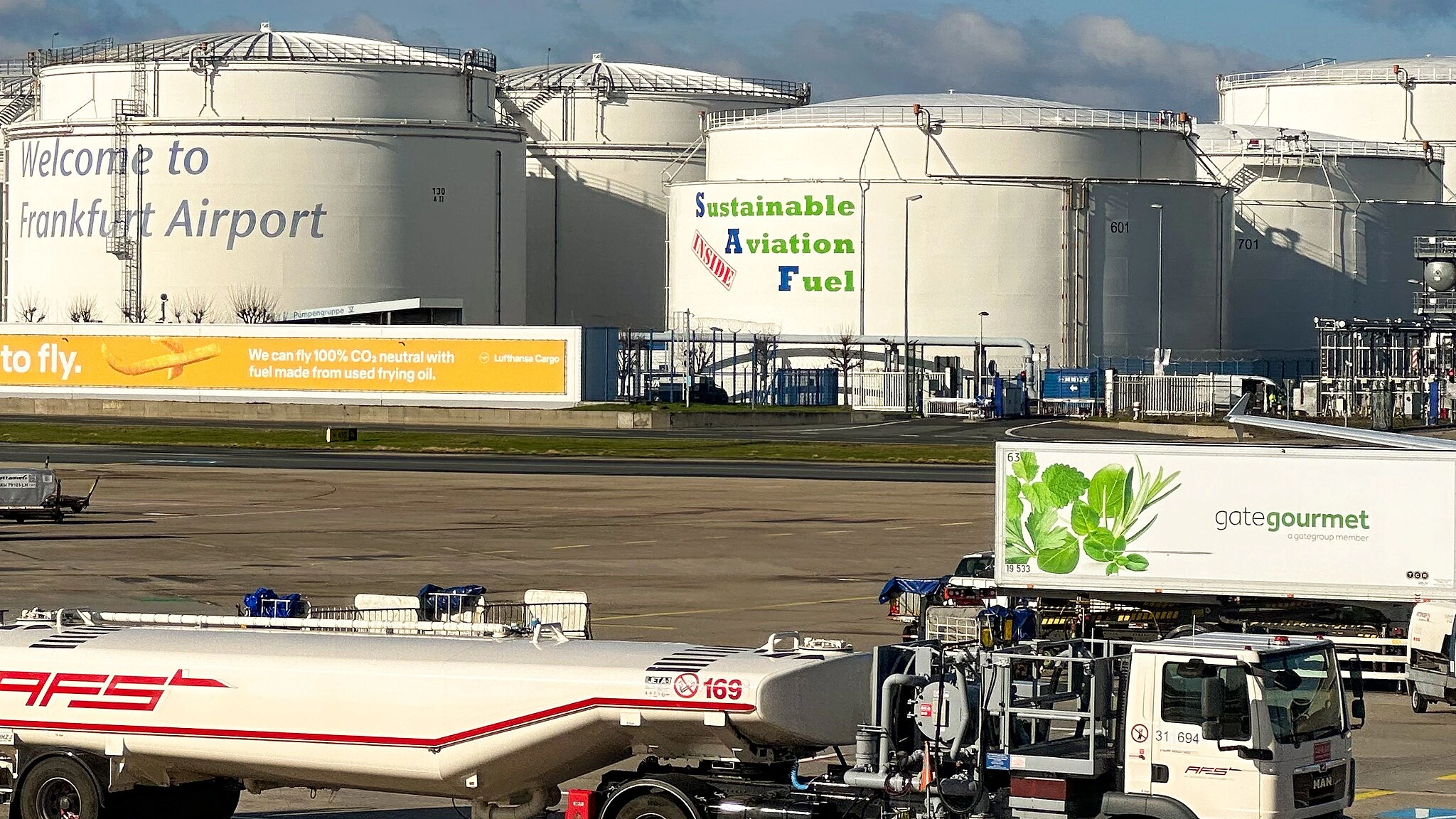
The AI-in-aviation market’s sustainability and emissions management segment is expected to register the highest CAGR of 25.0% between 2025 and 2030, reflecting how central AI has become to the industry’s decarbonisation strategy. AI is also being used to optimise Sustainable Aviation Fuel (SAF) feedstock combinations, with research models showing potential reductions in greenhouse gas emissions of 10–15% per production cycle.

EASA Leads with the First Global AI Framework
With AI now embedded in safety-critical operations, regulators have moved to establish clear governance. The European Union Aviation Safety Agency (EASA) has led the way. On 10 November 2025, EASA launched Notice of Proposed Amendment (NPA) 2025-07, its first regulatory proposal specifically addressing AI trustworthiness in aviation. The proposal provides the industry with technical guidance on how to meet the requirements for high-risk AI systems under the EU Artificial Intelligence Act (Regulation EU 2024/1689).
EASA described the purpose of the proposal directly on its website: “The NPA is now open for public consultation for 3 months and your comments at this stage are very important.” The consultation ran through February 2026. A second NPA is planned for 2026, which will extend the framework into domain-specific aviation regulations.
The framework prioritises Level 1 AI (assistance to human) and Level 2 AI (human-AI teaming), covering data-driven AI techniques including supervised and unsupervised learning. Future extensions will address reinforcement learning, generative AI, and hybrid systems. Analysts have described the initiative as potentially setting the de facto global standard for certifying AI in aviation.
The FAA is simultaneously developing its own AI tools for air traffic management as part of a broader modernisation effort, though no equivalent regulatory framework matching EASA’s scope has yet been published by the agency. The divergence between American and European regulatory approaches to AI governance in aviation is emerging as a key industry discussion point for the remainder of the decade.
Industry Leaders of AI Adoption and Challengers
The adoption of AI in aviation is not uniform. Large legacy carriers with vast fleets and data infrastructure are accelerating deployment faster than regional and low-cost operators. The following comparison reflects where major players stand:
| Airline / Organisation | AI Application | Notable Outcome |
|---|---|---|
| Delta Air Lines (DL) | APEX predictive maintenance; Delta Concierge passenger assistant | Eight-digit cost savings; 2024 Aviation Week Grand Laureate Award |
| Qatar Airways (QR) | Sama emotionally intelligent virtual assistant | First emotionally aware airline AI assistant globally |
| United Airlines (UA) | Gate-to-gate AI travel guide; real-time delay notifications | Launched December 2025 |
| Lufthansa Group (LH) | AVIATAR predictive maintenance; ChatGPT packing assistant | Partnership with United Airlines on B777/A320 fleets |
| Airbus | Skywise predictive analytics; DragonFly pilot assistance | Industry-wide fleet intelligence platform |
| Air India (AI) | SITA OptiFlight and eWAS fuel optimisation | Deployed September 2025 |
| AWS + Iberia (IB) | Cloud and AI integration for operations and customer experience | June 2025 partnership |
| TCS + Virgin Atlantic (VS) | 7-year AI and cloud modernisation deal | Signed June 2025 |
GE Aerospace’s FlightPulse, reaching 60,000 pilots across 42 airlines, shows that AI adoption in pilot-facing tools is now mainstream rather than experimental. Meanwhile, smaller carriers face cost and data access barriers that slow their adoption timelines.
Ethics, Safety, And the Human Factor are Challenges that AI Technology Faces
AI in aviation is not without risk. Over-reliance on AI can lead to automation bias — a tendency for operators to trust automated recommendations without critical evaluation — potentially compromising safety. Researchers at ScienceDirect noted in a 2025 study that AI hallucinations — where large language models generate inaccurate or non-existent information — pose serious operational risks in high-stakes environments.
EASA’s ethics survey for AI in aviation found that benefits in efficiency, data processing, and error reduction must on no account compromise aviation safety. The agency has made clear that safety remains its primary mission. Data security, regulatory compliance, and workforce transformation are all challenges that airlines must address as they scale their AI programmes.
Regulatory compliance remains a critical aspect, as both the FAA and EASA must be convinced that new predictive and AI-driven approaches do not endanger passenger safety. Airlines must ensure their AI systems meet all regulatory requirements before integrating them into safety-critical operations. The industry’s path forward involves not just adopting the technology, but earning the trust of regulators, crews, and passengers alike.