One-Of-A-Kind Flag: Emirates Launches UAE Unity Campaign with Special Airbus A380 Livery

Emirates (EK), which has revealed some interesting livery with tennis Grand Slam theme in its A380s, unveiled a striking special livery on 8 May 2026, emblazoning the UAE national flag in a large 3D-style design across both sides of Airbus A380 aircraft bearing registration A6-EVG, making it the most visually assertive expression of national solidarity ever mounted on a commercial wide-body aircraft in the carrier’s four-decade history.

The initiative, officially titled “This Flag Will Always Fly,” responds to a nationwide call by Sheikh Mohammed bin Rashid Al Maktoum, UAE Vice President, Prime Minister and Ruler of Dubai, urging citizens and residents to raise the UAE flag above homes and buildings as a symbol of unity in the wake of Iranian missile and drone attacks on the country.

The livery extends the airline’s existing UAE flag tailfin artwork across the entire fuselage of the superjumbo — the world’s largest commercial passenger aircraft — in a rendering that Emirates describes as a “powerful tribute to the spirit, ambition and unity of the UAE.” The aircraft had already operated commercial flights on the Dubai–New York and Dubai–Brisbane routes before the formal public unveiling on Friday, and will continue to serve any route on the Emirates network compatible with the A380 type. Plans are already underway to apply the same design to a Boeing 777, the second-largest commercial aircraft type in the Emirates fleet.
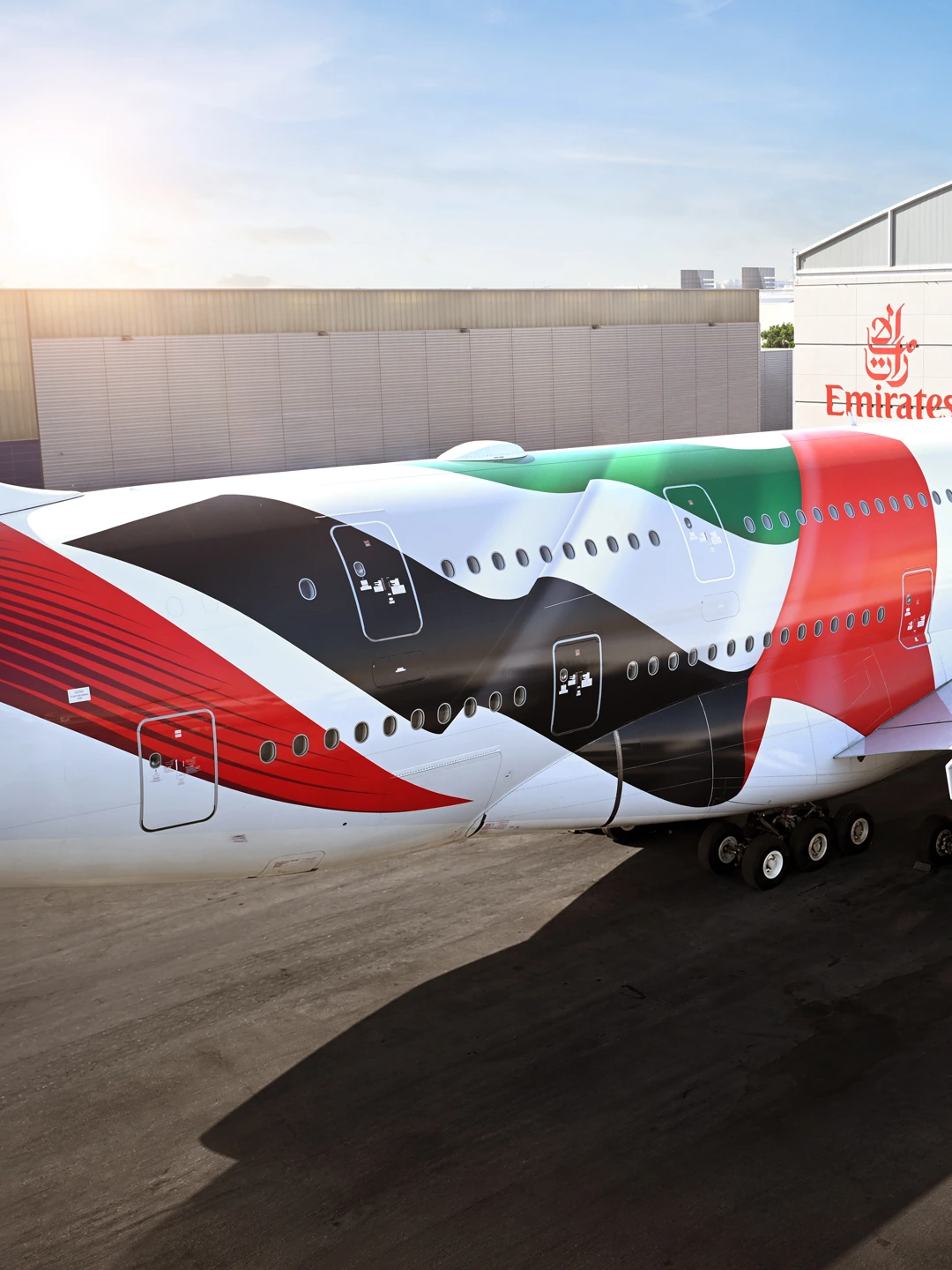
Photo: Dubai Media Office

The Political Impetus of Sheikh Mohammed’s Call to Fly UAE’s Colors

The livery did not emerge from a branding exercise. It is a direct institutional response to a public directive from the country’s leadership during a period of genuine national security stress. In a post on social media, Sheikh Mohammed bin Rashid articulated the significance of the gesture in unambiguous terms:

“The UAE flag is a symbol of strength and pride. We call on the sons of the Emirates and its residents to fly it above their homes, centres and buildings.”

He continued:

“We are proud of our country, proud of our President Sheikh Mohamed, our military strength, our economy, our workforce, all of our citizens and residents on our land, proud of our flag.”

He called on the public to raise the flag “as a sign of our love and symbol of our loyalty to our President and our unity and solidarity.”

The initiative followed a period during which Qatar’s airspace was closed by Iranian missile barrages and UAE territory — including a Fujairah oil facility struck on 4 May 2026 — came under direct attack, with the UAE Ministry of Defence confirming active responses to missile and drone threats.

The national flag’s design carries its own resonance at this moment. Designed by Abdullah Mohammed Al Maainah, the UAE flag features three horizontal bands of green, white and black, with a vertical red strip at the mast — the pan-Arab colours associated with Arab unity whose origins trace back to the Arab Revolt of 1916.

Al Maainah described the hues as representing successive eras in Islamic and regional history, from the early caliphates through the Fatimid and Ottoman periods. In the current context, the decision to project those colours at full-fuselage scale on an aircraft operating international routes carries a symbolism that extends far beyond the livery itself.
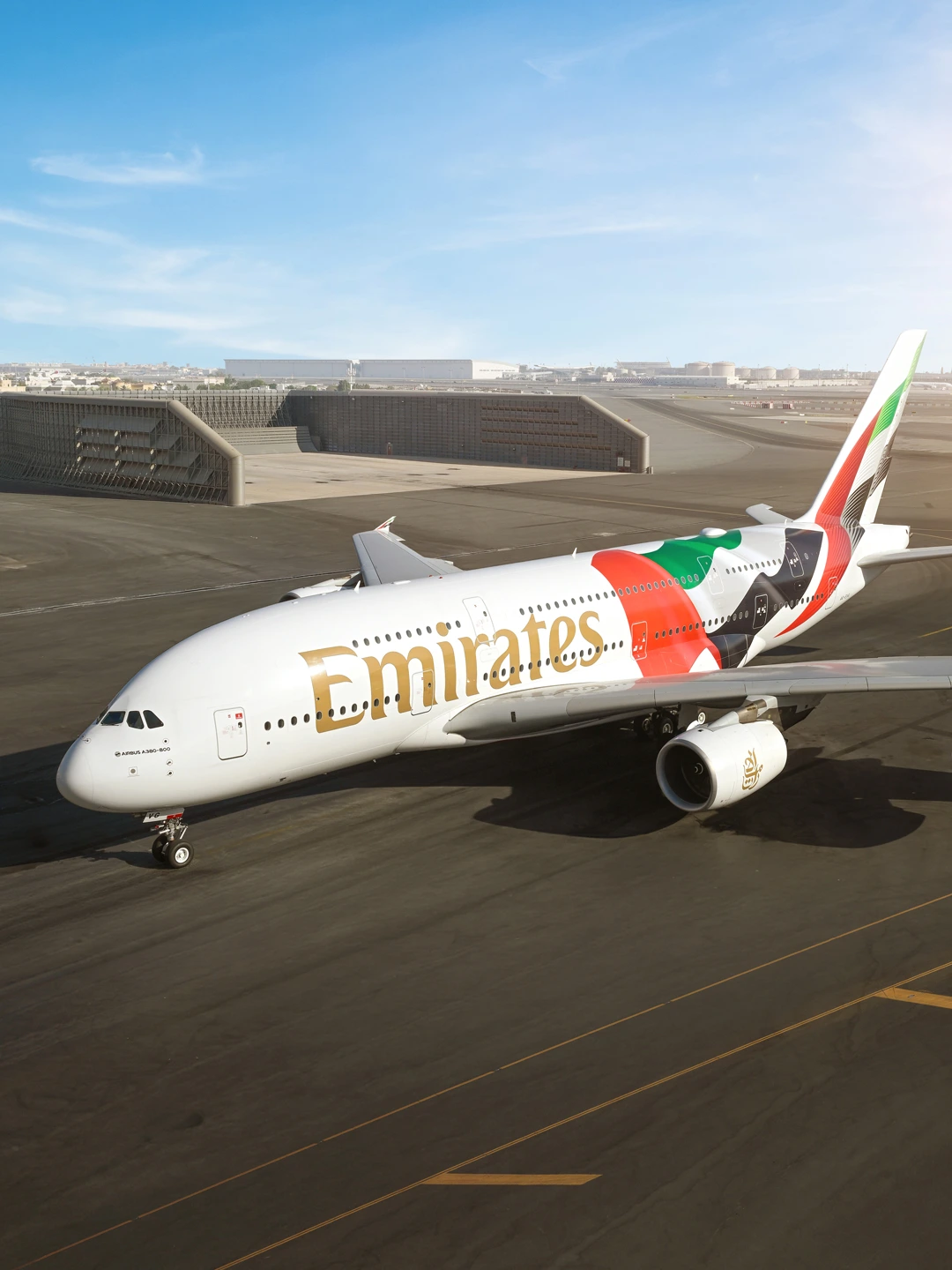
Photo: Dubai Media Office

What Makes the A6-EVG Design Technically Distinctive

The design on A6-EVG is not a decal overlay or a tail-only modification — it is a full-fuselage extension of the flag motif that Emirates has carried on its tailfin for decades, now rendered in a three-dimensional style that wraps across both sides of the aircraft simultaneously. An Emirates representative described the livery as serving as “an extension of the iconic tail identity,” signalling that the intent was to amplify an existing brand element rather than introduce an entirely new visual grammar.

The choice of the A380 as the canvas is itself significant. Emirates operates the world’s largest fleet of A380s and the superjumbo is the airline’s most internationally recognizable asset — the aircraft type most frequently photographed by spotters and passengers alike, and the one most associated in the public imagination with the Emirates brand. Deploying the special livery on this specific type maximises its visibility on high-density, long-haul routes where the aircraft’s presence in airport terminals generates the widest organic audience.

The aircraft registration A6-EVG is a familiar one within Emirates’ special livery history. The same aircraft was previously painted in the UAE’s Golden Jubilee livery for the country’s 50th anniversary in 2021, when it operated its first special flight to Frankfurt.
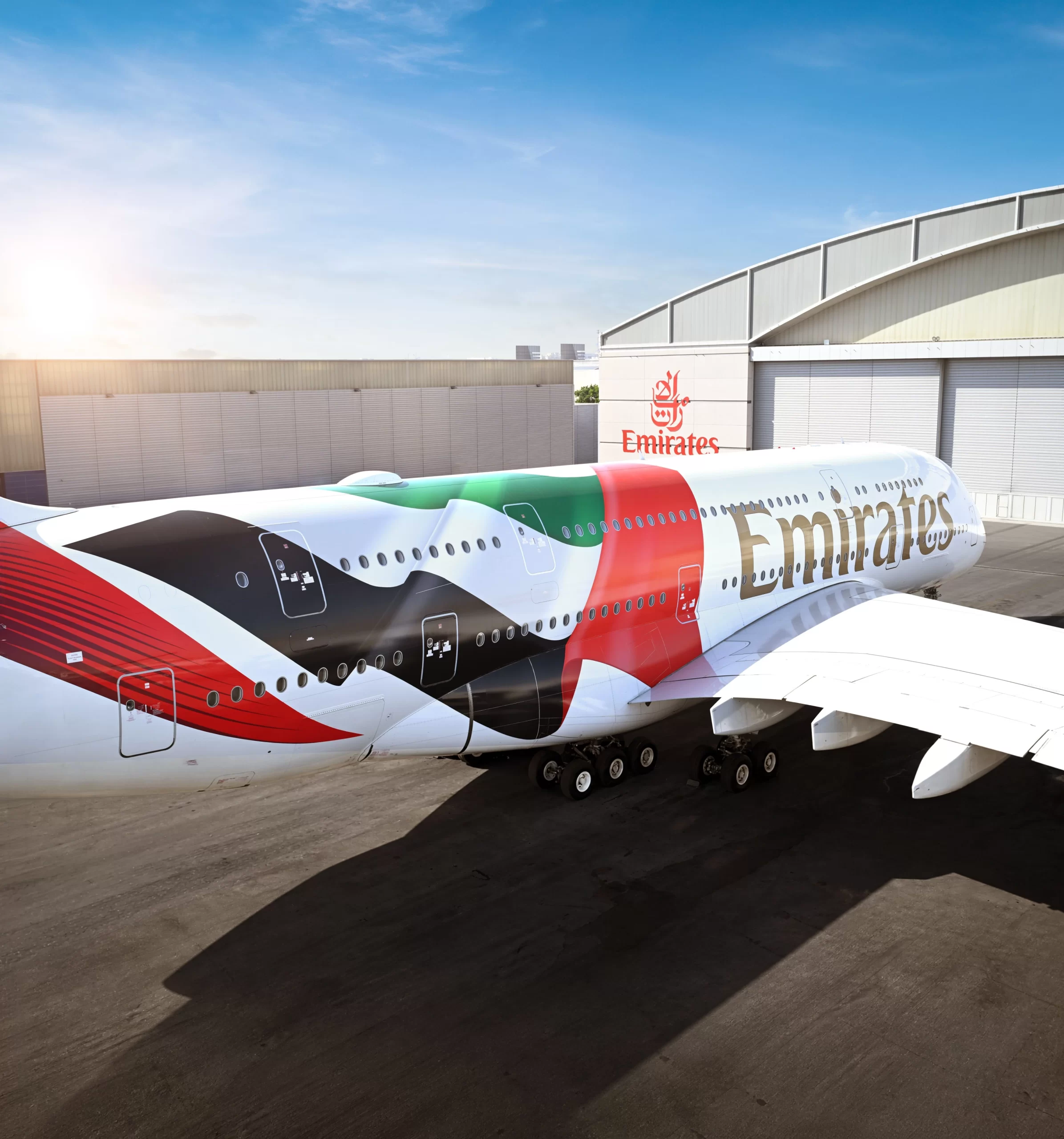
The reuse of that specific registration on this campaign carries an inadvertent continuity: A6-EVG has now been the carrier for two separate moments of national commemoration within a single decade.

Photo: Dubai Media Office

Sheikh Ahmed bin Saeed’s Statement and the Wider Institutional Message

Sheikh Ahmed bin Saeed Al Maktoum, Chairman and Chief Executive of Emirates airline and Group, issued a formal statement to coincide with the unveiling that positions the livery within the airline’s founding identity rather than framing it as a response to current events alone.

In a statement published by Gulf News, he said:

“We’re proud to respond to HH Sheikh Mohammad’s call to raise the flag as a tribute to the UAE’s unity and strength. Since our inception, every Emirates aircraft has proudly carried the UAE flag wherever it flies.”

He elaborated in a message posted to the social platform X, stating:

“This new livery is our way of honouring a home that has given us so much, and a nation that stands as proof of what is possible when we collectively choose to reach higher, every day. There is no greater stage for our flag than in the skies.”

The statement is notable for its deliberate conflation of commercial identity and national sentiment — an assertion that the airline’s role as a flag carrier is not merely regulatory but existential.

The timing of the unveiling also carries institutional weight beyond the livery itself. It arrived the morning after Emirates published its 2025-26 annual results, recording a profit after tax of Dh19.7 billion ($5.4 billion) — the best profit performance in the airline’s history — with revenue rising two per cent to Dh130.9 billion.
Photo: Emirates

A History Written in Liveries: How Emirates Uses Aircraft as National Canvases

The “This Flag Will Always Fly” livery joins a long tradition of special paint schemes through which Emirates has used its aircraft fleet as a medium for national and institutional communication.

In 2017, a bespoke livery for the airline’s 100th A380 featured a customised image of the late Sheikh Zayed bin Sultan Al Nahyan, the founding father of the UAE, marking the inaugural year of the “Year of Zayed” initiative, with 10 aircraft carrying the special design concurrently. That same year, the airline revealed the first of 40 aircraft carrying livery designs dedicated to Expo 2020 Dubai.

In September 2021, Emirates unveiled what it described at the time as its largest-ever livery project: a complete repaint of A380 aircraft A6-EEU for Expo 2020 Dubai, using 11 colours applied through wild spray methods, electrostatic guns and conventional cup guns over more than 2,500 square metres of masking material.

In January 2026, the airline unveiled an entirely different special livery for A380 aircraft celebrating all four Grand Slam tennis tournaments — Australian Open, Roland-Garros, Wimbledon and US Open — deployed on routes including Houston and São Paulo. Emirates’ total output of special liveries across the A380 and Boeing 777 fleet in the five years prior to 2021 exceeded 100 individual designs.

The airline’s most recent signature livery refresh — its third overall since launching in 1985 — was unveiled in March 2023 on A380 A6-EOE, introducing a more dynamic and three-dimensional rendering of the UAE flag on the tailfin, red wingtips with Arabic calligraphy in reverse white, and gold lettering 32.5 per cent larger than the previous iteration. The 2026 “This Flag Will Always Fly” design takes that existing three-dimensional flag motif and scales it from tail-only to full-fuselage — an escalation of visual emphasis that mirrors the escalation of national feeling the campaign is designed to express.

Photo: RON RAFFETY | Wikimedia Commons

A Small Detour of the History of Emirates’ Livery

Since the airline’s launch in 1985, the Dubai-based carrier has used only three primary liveries, each retaining the UAE flag motif, gold branding, and minimalist fuselage aesthetic while refining proportions, typography, and visual flow to strengthen long-term brand recognition. In each of its liveries, the predominant color has been white, and there are plenty of reasons why many carriers daub their aircraft with white paint.

Let’s have a look at the evolution of the carrier’s livery:

  • The original 1985 livery stood out for integrating the UAE flag into the tail and fuselage at a time when cheatline-heavy liveries dominated commercial aviation.
  • The 2005 redesign enlarged the gold “Emirates” titles by nearly 300%, making the branding more prominent on large aircraft such as the Airbus A380.
  • The 2023 update introduced a “waving” UAE flag effect on the tail, added red-painted winglets, and expanded the fuselage titles even further.
  • Across all three designs, Emirates consistently retained the same core color palette: white, gold, red, green, and black.
  • The airline’s branding strategy mirrors carriers like Qatar Airways, which also prioritize subtle refinements over dramatic rebranding exercises.

The Emirates livery is widely regarded as an example of restrained yet premium airline branding. Rather than relying on complex graphics or multiple colors, the design uses negative space and gold typography to create a luxury-oriented identity that scales effectively across aircraft ranging from Boeing 777s to Airbus A380s. The 2023 redesign modernized the visual presentation further by adding motion-inspired graphics while preserving the carrier’s established image.

Livery Era Key Visual Changes Aircraft Most Associated Design Philosophy
1985–2005 Introduced UAE flag tail graphic and gold titles Airbus A300-600R Bold national identity with minimalist structure
2005–2023 Larger titles, smoother flag curves, refined typography Airbus A380 Enhanced visibility and stronger premium branding
2023–Present Waving flag effect, red winglets, larger branding Airbus A380 & Boeing 777 Modernized motion-focused evolution without abandoning heritage
Photo: Gonzo.Lubitsch | Wikimedia Commons

What Comes Next: Boeing 777 Application and Operational Deployment

Emirates has confirmed that the UAE flag fuselage livery will be extended beyond the initial A380 to a Boeing 777, the next largest commercial aircraft type in the carrier’s fleet. No registration number or specific timeline has been disclosed for the 777 application, but the announcement signals an intent to sustain the visual campaign across more than a single aircraft operating a limited set of routes.

Aircraft A6-EVG will continue to fly any route on the Emirates network served by the A380 type, meaning the livery will appear across Dubai International Airport’s (DXB) full long-haul reach — from North America and Europe to Australia, East Africa and South Asia.

Emirates operates more than 3,600 flights per week from DXB and currently serves over 150 destinations with its widebody fleet, ensuring the flag livery accumulates substantial international visibility without any supplemental promotional effort.

The “This Flag Will Always Fly” campaign itself does not have a defined end date, and Emirates has not disclosed whether additional A380 aircraft will receive the fuselage design beyond A6-EVG and the planned 777.

Leave a Comment

Your email address will not be published. Required fields are marked *

Scroll to Top