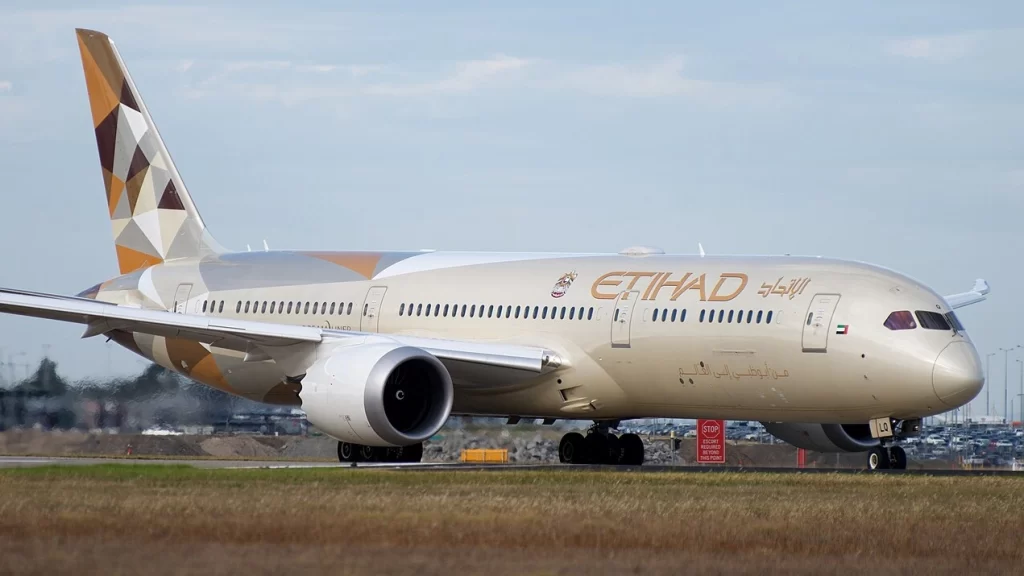
Etihad Airways (EY) has resumed flights to Israel, marking its return to Ben Gurion Airport (TLV) and restoring one of the most closely watched air corridors in the post-pandemic Middle East aviation landscape, YNet Global reported.
The restart is more than a simple route reinstatement. It reactivates a carefully structured Israel–Abu Dhabi–United States travel pipeline at a time when several major US carriers—including the big three US carriers American Airlines, Delta Air Lines, and United Airlines—remain absent from the Israeli market.

Etihad Rebuilds Corridor via Abu Dhabi
Etihad’s restored schedule re-establishes its Tel Aviv–Abu Dhabi route through Abu Dhabi International Airport, positioning the UAE capital as a primary transit hub for Israeli travellers heading west.
From Abu Dhabi, passengers are funnelled onto onward services bound for major US gateways including:
- New York (JFK)
- Chicago O’Hare (ORD)
- Washington Dulles (IAD)
The structure is designed to compress total journey times while maintaining a single, coordinated connection point in the Gulf.
According to reporting from PassportNews:
…..the company is expected to operate two daily flights between Tel Aviv and Abu Dhabi in the first phase, and later, starting May 2, expand operations to four daily flights. The flights will be operated by the new Airbus A321LR aircraft that recently entered the airline’s fleet, as part of the expansion of its international operations

Etihad is Offering Shorter Connections, Smoother Transit
A key feature of Etihad’s strategy is the reduction of layover times in Abu Dhabi to approximately 2 to 2.5 hours in both directions.
This is a significant operational detail in long-haul network planning: short, predictable connection windows reduce uncertainty for passengers and improve aircraft utilisation across intercontinental routes.
Etihad also integrates US Customs and Border Protection Preclearance at Abu Dhabi International Airport for eligible passengers, allowing travellers to complete immigration procedures before departure rather than on arrival in the United States.
In practice, this shifts much of the friction of US entry away from American airports and into the transit hub itself.
Etihad’s Competitive Pricing on Long-Haul Routes
Etihad has positioned its relaunch with aggressive introductory fares aimed at capturing suppressed demand on Israel–US routes.
Reported starting prices include:
- New York (JFK) from around $1,000 round trip
- Chicago (ORD) from approximately $1,160
- Washington (IAD) from roughly $1,085 depending on dates
Beyond the United States, Etihad is also leveraging its Abu Dhabi hub to price aggressively into Asia, including destinations such as Bangkok, Shanghai, and Tokyo (Narita and Haneda).
This reflects a broader strategy: using connectivity and scale rather than point-to-point traffic to compete in long-haul markets.
PassportNews also reported that Etihad is further strengthening its Far East network by offering one-stop connections to cities such as Bangkok, Shanghai, and Tokyo, with fares generally ranging from about $985 to $1,424 depending on the route and travel dates. The airline also highlights relatively brief transit times in Abu Dhabi, typically between two and two and a half hours.
Etihad Signals Wider Regional Reopening at Ben Gurion
Etihad is not returning in isolation. The broader regional network out of Ben Gurion Airport is also expanding, particularly among niche and leisure-focused carriers.
TUS Airways is increasing frequencies to destinations including Larnaca and Rome, adding both daily and multi-weekly services aimed at price-sensitive travellers.
Blue Bird Airways is also expanding operations, with additional flights to Athens, Barcelona, Berlin, and Heraklion, reflecting rising demand across short-haul Mediterranean and European leisure routes.
Together, these expansions point to a fragmented but active recovery in Israel’s outbound aviation market—particularly on routes vacated or reduced by legacy carriers.
All in All
At the centre of Etihad’s strategy is Abu Dhabi International Airport’s evolution into a high-efficiency global transit node linking Israel with long-haul destinations.
The airline’s hub model prioritises:
- Reduced minimum connection times
- Integrated security and immigration processing
- Streamlined baggage transfer systems
All of which are designed to minimise passenger handling friction and improve transfer reliability for long-haul itineraries.
Etihad’s return to Tel Aviv reflects more than route restoration—it signals a recalibration of Middle Eastern aviation power dynamics. While certain airspace in the Middle East might be too dangerous for operations, the ceasefire between the US and Iran might shape how Israel connects to North America and Asia.

.jpg)