AirAsia (AK), headquartered in Malaysia, has grown into one of the most prominent low-cost airlines in Asia, connecting destinations across Southeast Asia, India, China, Australia, and several other regions. Its rise has been closely tied to a strategy built on affordability, frequent services, and a distinctly energetic workforce.
Since its launch in 2001, AirAsia has played a defining role in reshaping air travel in the region, making flying accessible to a much wider segment of passengers. Today, it operates through multiple affiliated carriers across different markets, reinforcing its presence as a dominant budget airline group.
Unlike traditional full-service carriers, AirAsia concentrates largely on short- and medium-haul routes. This operational focus directly influences how its cabin crew work—and how they are paid.
The role extends beyond safety and passenger care to include onboard sales, which form an integral part of the airline’s revenue model. With tight turnaround times and multiple daily sectors, crew members operate in a fast-paced environment where earnings are closely tied to productivity.

Air Asia Cabin Crew Salary Overview for 2026
Compensation for AirAsia cabin crew reflects its low-cost framework. While the base salary is comparatively modest, additional income streams significantly shape total earnings.
Newly recruited crew members typically receive a monthly base pay ranging from RM2,300 to RM2,800 (approximately USD 500–600). However, once flight-related allowances, sector-based payments, and performance incentives are added, monthly earnings generally fall between RM3,500 and RM5,000 (USD 800–1,100) for those on standard rosters.
On a yearly basis, this translates to roughly RM42,000 to RM60,000 (USD 9,200–13,200), depending largely on how intensively an individual flies.
More experienced crew members, particularly those consistently assigned busy schedules, can exceed these figures. With higher sector counts and stronger sales performance, monthly income can rise to around RM5,500–RM6,500 (USD 1,200–1,400) during peak periods.
Senior roles, such as lead cabin crew or supervisors, offer somewhat higher pay due to added responsibilities and incentive structures. That said, the difference in earnings between junior and senior positions tends to be narrower than what is typically seen at full-service airlines.
Overall, earnings at AirAsia are heavily performance-driven. Crew members who log more flight hours, operate additional sectors, or excel in onboard sales are likely to see a noticeable increase in their income.

Air Asia Cabin Crew: Benefits and Perks
Beyond salary, AirAsia provides a range of employment benefits that complement the role:
| Benefit / Perk | Description |
|---|---|
| Staff travel benefits | Employees have access to discounted or standby tickets across the airline’s network, with certain privileges also available to family members. |
| Flexible scheduling | Duty rosters can be relatively adaptable, often resulting in fewer working days per month compared to full-service carriers. |
| Inflight sales incentives | Cabin crew can boost their income through commissions and bonuses earned from onboard sales performance. |
| Accommodation during layovers | The airline arranges hotel stays for crew on international routes, ensuring proper rest between flights. |
| Flying-related allowances | A significant portion of earnings comes from payments linked to flight hours and the number of sectors operated. |
| Medical and insurance cover | Basic healthcare benefits and insurance are provided throughout the duration of employment. |
| Daily layover allowance | Crew members receive per diem payments during overnight stops to cover meals and incidental expenses. |
| Training programmes | New hires undergo structured, airline-funded training focused on safety procedures, emergency handling, and service delivery. |
| Career progression | Opportunities exist to move into senior positions such as lead cabin crew or inflight supervisors over time. |
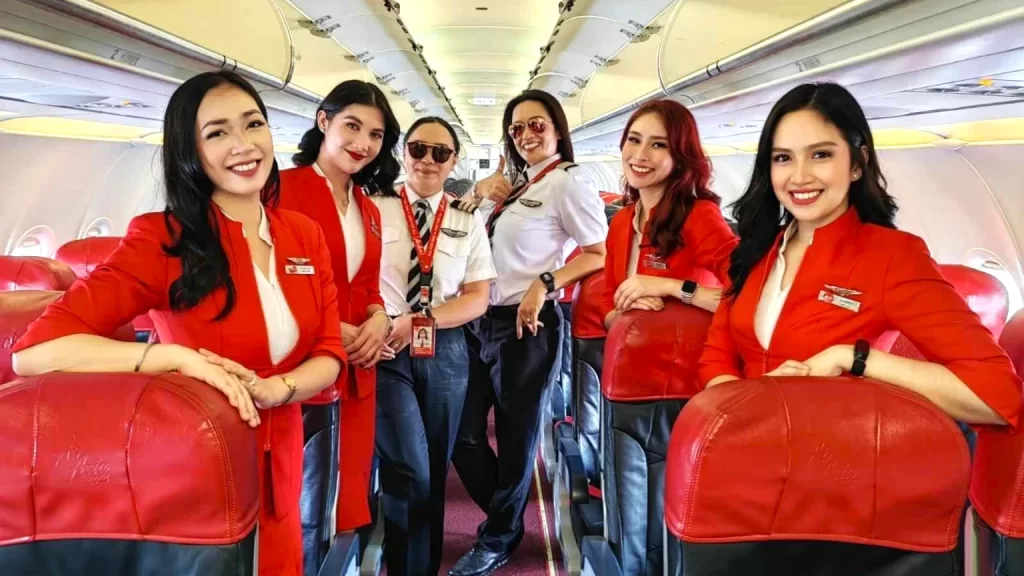
Eligibility Criteria
To qualify as cabin crew with AirAsia, applicants must meet several baseline requirements:
- Minimum age of 18 years
- Height requirements: at least 157 cm for females and 170 cm for males (barefoot)
- Minimum arm reach of 210 cm
- Willingness to relocate to Kuala Lumpur
- Valid passport with eligibility for international travel
- Completion of secondary education or equivalent
- Proficiency in English; additional languages are beneficial
- Professional appearance, including no visible tattoos
- Physical fitness and ability to pass aviation medical assessments
- Strong interpersonal and customer service skills
- Flexibility to handle irregular schedules and multiple flights per day
Hiring Process
The recruitment process at AirAsia is structured in multiple stages, beginning with candidates submitting an online application through the airline’s official portal. Once received, applications go through an initial screening phase, where eligibility and basic qualifications are assessed.
Candidates who meet the requirements are then invited to participate in assessment sessions, which typically include group activities, role-playing exercises, and communication-based tasks designed to evaluate interpersonal skills. Those who progress further move on to the interview stage, where recruiters assess personality, service orientation, and overall suitability for the role.
Shortlisted applicants must then undergo a medical examination to ensure they meet aviation health standards. Successful candidates are finally enrolled in a formal training programme, where they are trained in safety procedures, emergency response, and inflight service before beginning their duties.

Final Thoughts
Working as cabin crew at AirAsia offers a distinct experience compared to full-service airlines. The pay structure leans heavily on activity-based earnings rather than fixed salary, meaning income potential varies depending on workload and performance.
Crew members often operate several short-haul flights within a single day, which can be demanding but also financially rewarding for those willing to maintain a busy schedule. When combined with travel perks, training, and career progression opportunities, the role presents a practical entry point into the aviation industry.
For individuals seeking flexibility, international exposure, and a performance-linked income model, AirAsia continues to be a compelling option—particularly within the fast-growing Southeast Asian aviation market.

FAQs
What is the typical monthly income for AirAsia cabin crew in 2026?
Most crew members earn between RM3,500 and RM5,000 per month, including allowances and incentives, depending on their flying schedule.
Do cabin crew earn commissions?
Yes, inflight sales generate commission-based earnings, which can significantly boost overall income.
Where are AirAsia cabin crew based?
The primary base is Kuala Lumpur, with additional bases spread across the airline’s subsidiaries in Southeast Asia.