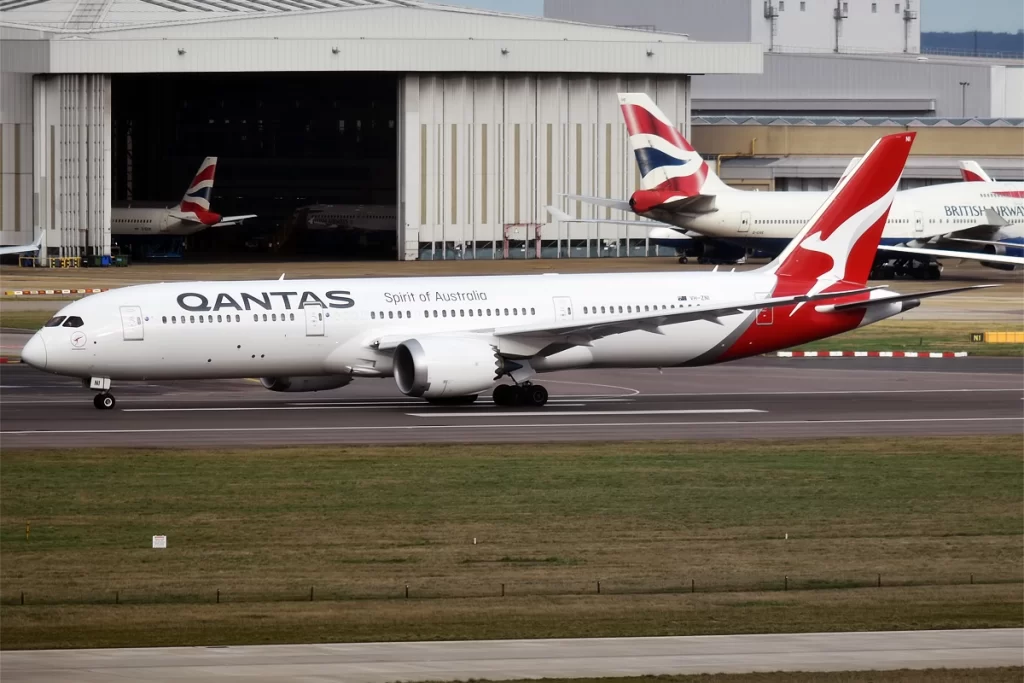
A woman has died aboard a Qantas long-haul flight from New York (JFK) to Auckland Airport (AKL), prompting an investigation by New Zealand authorities after the aircraft landed on Tuesday morning. The airline confirmed that the medical emergency occurred mid-flight on the QF4 service, despite immediate efforts by cabin crew and medically trained passengers to assist, Stuff reported.
Emergency Unfolds on Qantas’ Ultra-Long-Haul QF4 Service
The incident took place on Qantas flight QF4, which operates between New York John F. Kennedy International Airport (JFK) and Sydney (SYD) via Auckland (AKL). The New York–Auckland sector alone covers approximately 14,230 kilometres and typically takes around 17 hours and 30 minutes on a Boeing 787-9 aircraft.
The passenger became unwell during this long-haul segment, prompting an immediate response from cabin crew and onboard medical professionals who stepped in to provide emergency assistance. Despite these efforts, the woman could not be revived during the flight.

Qantas’ Response Aboard QF4 at 35,000 Feet
Qantas confirmed that crew members followed standard in-flight emergency procedures, including seeking assistance from doctors travelling as passengers, who helped administer urgent care.
The airline noted that in situations like this, cabin crew are trained in first aid and supported by onboard medical kits, while also relying on any qualified medical professionals on board when available.
No diversion of the aircraft was reported during the incident, and the flight continued to Auckland as scheduled.
A Qantas spokesperson was quoted in The New Zealand Herlad to have said:
Urgent assistance was provided by crew and doctors onboard but sadly they passed away. In line with standard procedure, emergency services met the aircraft as part of the response. Further enquiries on this incident are best directed to them.
The spokesperson said that their thoughts were family and loved ones of the deceased.
_Boeing_787-9_Dreamliner_departing_Sydney_Airport_(3).jpg)
QF4’s Arrival in Auckland and Police Investigation
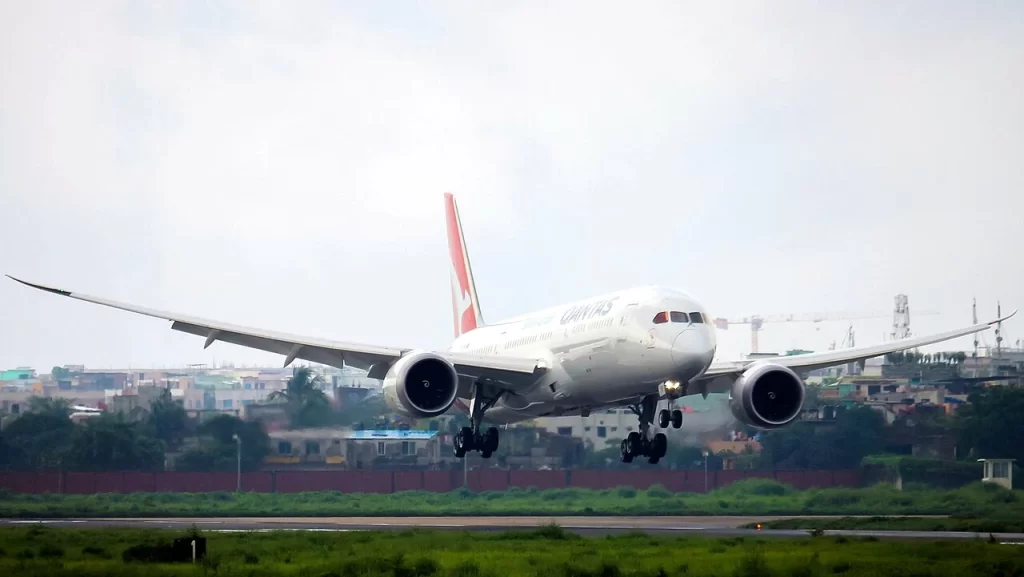
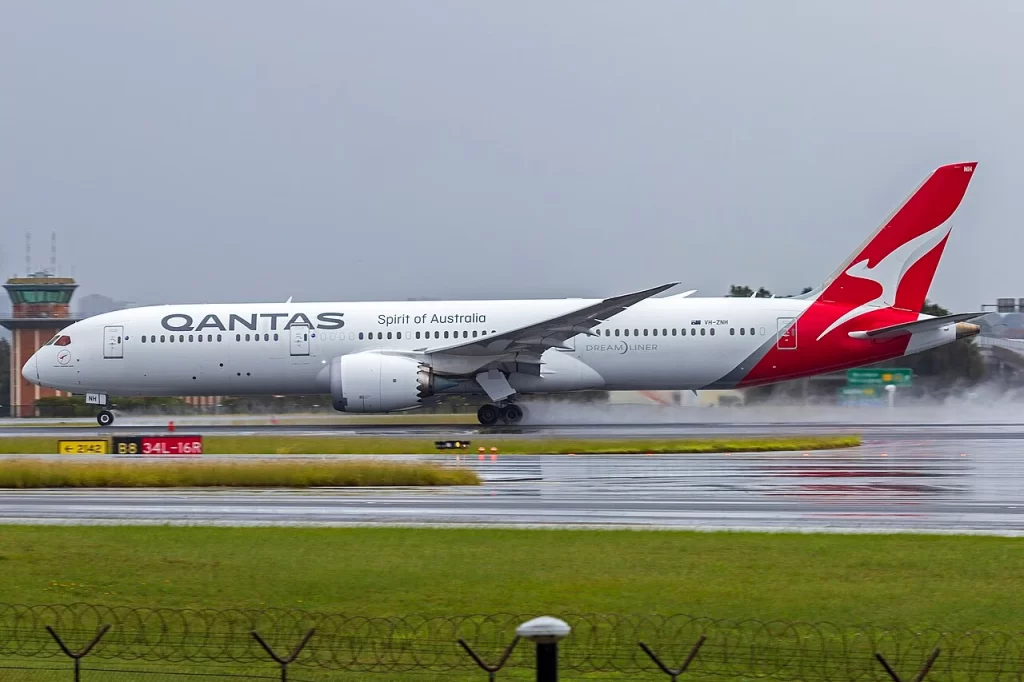
Data from Flight Aware suggests that the aircraft involved in the incident was a Boeing 787-9 and the landed at Auckland Airport. Flight tracking data indicates that the aircraft departed Auckland for its onward journey to Sydney shortly after 8 a.m., roughly an hour and a half later than its originally scheduled departure time.
Details of Qantas’ 787 Dreamliners
Qantas has fourteen Boeing 787 Dreamliners in its fleet and all of these are of the 787-9 types and these average 7.1 years.:
| Registration | Delivered | Aircraft Name | Age |
|---|---|---|---|
| VH-ZNA | Oct 2017 | Great Southern Land | 8.5 years |
| VH-ZNB | Dec 2017 | Waltzing Matilda | 8.4 years |
| VH-ZNC | Jan 2018 | Quokka | 8.3 years |
| VH-ZND | Feb 2018 | Emily Kame Kngwarreye | 8.2 years |
| VH-ZNE | Jun 2018 | Skippy | 7.8 years |
| VH-ZNF | Aug 2018 | Boomerang | 7.7 years |
| VH-ZNG | Nov 2018 | Jillaroo | 7.4 years |
| VH-ZNH | Nov 2018 | Great Barrier Reef | 7.4 years |
| VH-ZNI | Oct 2019 | Kookaburra | 6.5 years |
| VH-ZNJ | Nov 2019 | Longreach | 6.5 years |
| VH-ZNK | Dec 2019 | Gangurru | 6.4 years |
| VH-ZNL | Apr 2023 | Billabong | 5.5 years |
| VH-ZNM | Jun 2023 | Mateship | 5.6 years |
| VH-ZNN | Jul 2023 | Snowy River | 5.4 years |
What the Authorities Said?
New Zealand Police were deployed to the scene early Tuesday morning in response to what they described as a sudden death onboard the flight, and were quoted in New Zealand Herald to have said that they were in attendance of “a sudden death, which occurred on an inbound Qantas flight from New York to Auckland overnight”.
Authorities confirmed that the case has been referred for investigation on behalf of the coroner, a standard procedure following unexpected deaths in transit. At this stage, officials have not released any details regarding the passenger’s identity, age, or medical circumstances surrounding the incident.
Qantas Boeing 787 Configuration
In the table below, we can see how Qantas configures its 787s- the aircraft type that was involved in the in-flight death aboard QF4:
| Feature | Business Class | Premium Economy | Economy |
|---|---|---|---|
| Cabin layout | 1–2–1 configuration | 2–3–2 configuration | 3–3–3 configuration |
| Number of seats | 42 seats | 28 seats | 166 seats |
| Seat width | 58.4–60 cm (23–24 in) as seat; 61–63.5 cm (24–25 in) as bed | 58 cm (22.8 in) | 43.7 cm (17.2 in) |
| Seat pitch / legroom | Converts to 2m (80 in) fully flat bed | 96.5 cm (38 in) | 81.3 cm (32 in) |
| Recline | Fully lie-flat bed | Reclining seat with leg and foot rest | 15.2 cm (6 in) recline |
| Aisle access | Direct aisle access for all seats | Not for all seats (2–3–2 layout) | Not for all seats |
| Headrest | Adjustable headrest | Ergonomic headrest with pillow support | Adjustable headrest |
| Privacy | Privacy screen for each seat | Privacy wings with integrated night light | Standard seating privacy |
| Leg & foot support | Extendable leg rest | Leg rest + footrest | Limited ergonomic support |
| Charging | USB + AC power outlets | Dual USB ports + shared AC outlet | USB + shared AC outlet |
| Entertainment screen | 40 cm (16 in) HD screen | HD seat-back touchscreen | 30 cm (12 in) HD touchscreen |
| Storage | Dedicated storage for shoes, laptop, personal items | Five storage options incl. bottle holder | Seat-back pouch + device shelf + tray |
| Dining & service | Premium dining curated by chef Neil Perry; duvets & amenity kits | Premium service, noise-cancelling headphones, amenity kit on intl flights | Standard long-haul meal service |
| Extras / comfort | Lie-flat bed, luxury bedding, enhanced privacy | Dedicated crew, fewer seats, premium drinks menu | Standard comfort-focused economy seating |

Medical Emergencies on Long-Haul Flights
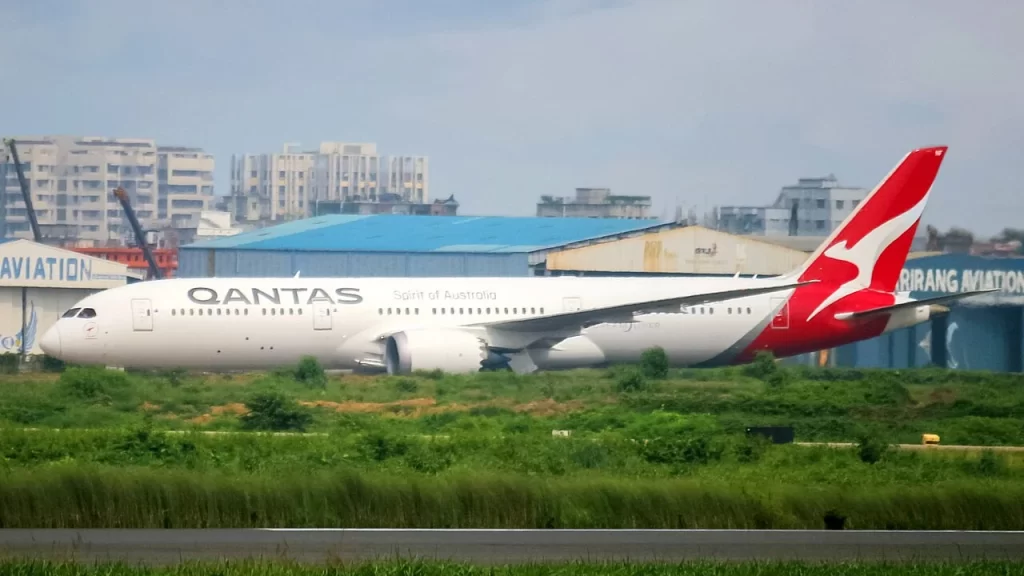
While rare, in-flight medical emergencies remain an operational reality for airlines operating ultra-long-haul routes such as QF4. Flights lasting more than 15 hours often operate far from diversion airports or immediate hospital care, making onboard response critical in stabilising passengers until landing.
Airlines typically equip aircraft with emergency medical kits and train cabin crew in basic life-saving procedures, while also relying on volunteer assistance from medically trained passengers when available. Despite this, deaths are inevitable.
Earlier this year, Cathay Pacific flight CX270, operating from Amsterdam to Hong Kong, was the scene of a fatal in-flight medical emergency when a passenger became critically unwell during the long-haul journey. The 72-year-old Dutch man reportedly lost consciousness as the aircraft approached Hong Kong International Airport, prompting cabin crew to initiate emergency first aid with the assistance of medically trained passengers onboard.
Despite these efforts, he could not be revived and was pronounced dead after the flight landed, with authorities classifying the case as a “death on arrival” pending a post-mortem investigation.
The following table gives us a comparison of some of the recent in-flight deaths (such as on Qantas QF4) aboard airlines around the globe:
| Incident | Airline | Route | Date | Outcome | Medical Situation |
|---|---|---|---|---|---|
| Cathay Pacific CX270 (Amsterdam–Hong Kong) | Cathay Pacific | Amsterdam → Hong Kong | 2026 | 1 passenger died | Passenger collapsed during flight; CPR and emergency care performed; died after landing |
| Cathay Pacific (Amsterdam–Hong Kong, earlier case) | Cathay Pacific | Amsterdam → Hong Kong | 2026 | 1 passenger died | Medical collapse mid-flight; emergency response by crew; pronounced dead at hospital |
| Korean Air medical emergency death | Korean Air | Virginia → Seoul | 2024 | 1 passenger died | Passenger collapsed mid-flight; lawsuit alleges oxygen equipment issues during emergency response |
| Turkish Airlines in-flight death (diversion case) | Turkish Airlines | Istanbul → San Francisco | 2025 | 1 passenger died | Passenger suffered severe medical emergency; aircraft diverted but death confirmed onboard/after landing |